




In the arrangement as shown, the tension \[{{\text{T}}_{\text{2}}}\] is , (Take $g=10\text{ m/}{{\text{s}}^{2}}$)
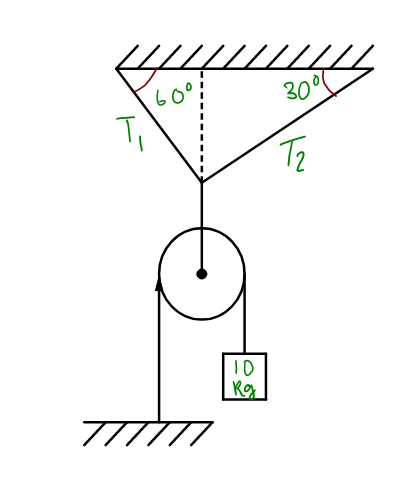
A. 50 N
B. 100 N
C. $50\sqrt{3}\text{ N}$
D. $100\sqrt{3}\text{ N}$
Answer
 Verified
615.6k+ views
Hint: There will be a tension in the string acting opposite to the weight. The tension can split into two smaller tensions ${{\text{T}}_{1}}\text{ and }{{\text{T}}_{2}}$ by connecting the main string to two other strings which are on a fixed surface.
Complete step by step answer:
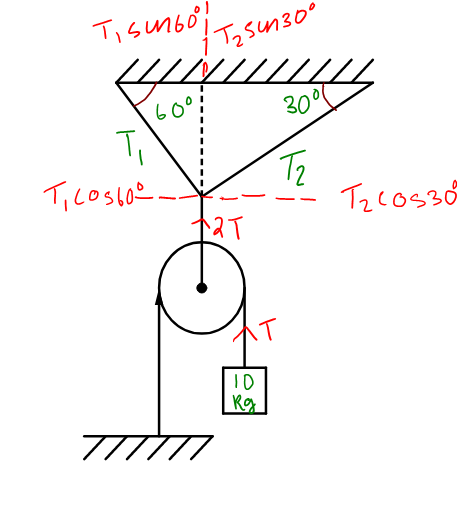
The weight of the mass m acting downwards is given by the formula,
$\text{W}=\text{mg}$
Here, m=10kg, $g=10\text{ m/}{{\text{s}}^{2}}$
$\therefore \text{ W}=100\text{N}$ ….. equation (1)
The weight acting will be equal to the tension in the string.
$\therefore \text{ T=W=100N}$
The tension or force on the string of the pulley will be 2T.
Splitting ${{\text{T}}_{1}}\text{ and }{{\text{T}}_{2}}$ into horizontal and vertical components as shown in the figure, we can write the forces acting along the x axis as,
$\begin{align}
& {{T}_{1}}\cos {{60}^{\circ }}={{T}_{2}}\cos {{30}^{\circ }} \\
& \Rightarrow {{T}_{1}}\left( \dfrac{1}{2} \right)={{T}_{2}}\left( \dfrac{\sqrt{3}}{2} \right) \\
\end{align}$
$\therefore {{\text{T}}_{\text{1}}}={{\text{T}}_{\text{2}}}\sqrt{\text{3}}$ ….equation (1)
Forces along the horizontal direction is given by,
${{T}_{1}}\sin {{60}^{\circ }}+{{T}_{2}}\sin {{30}^{\circ }}=2T$
$\begin{align}
& \Rightarrow {{T}_{1}}\sin {{60}^{\circ }}+{{T}_{2}}\sin {{30}^{\circ }}=200\text{N} \\
& \Rightarrow {{T}_{1}}\left( \dfrac{\sqrt{3}}{2} \right)+{{T}_{2}}\left( \dfrac{1}{2} \right)=200\text{N} \\
\end{align}$
From equation (1) we can substitute $T_1$ in the above equation.
$\begin{align}
& {{T}_{2}}\sqrt{3}\left( \dfrac{\sqrt{3}}{2} \right)={{T}_{2}}\left( \dfrac{1}{2} \right)=200 \\
& \Rightarrow 4{{T}_{2}}=400 \\
\end{align}$
$\therefore {{\text{T}}_{\text{2}}}=100\text{N}$
So the answer to the question option (B) 100 N
Additional Information:
Pulley systems are used to provide us with a mechanical advantage, where the amount of input effort is multiplied to exert greater forces on a load.
They are typically used for hauling and lifting loads but can also be used to apply tension within a system such as in a Tensioned Line or Tyrolean.
We can see pulley through all the ages. Pulley was extensively used by people in the past to lift heavy loads and it was seen in the works of early mathematicians like Archimedes.
Note: The tension ${{\text{T}}_{\text{1}}}$ has the value $100\sqrt{3}\text{ N}$.
The same problem can be solved using Lami’s theorem.
Complete step by step answer:
The weight of the mass m acting downwards is given by the formula,
$\text{W}=\text{mg}$
Here, m=10kg, $g=10\text{ m/}{{\text{s}}^{2}}$
$\therefore \text{ W}=100\text{N}$ ….. equation (1)
The weight acting will be equal to the tension in the string.
$\therefore \text{ T=W=100N}$
The tension or force on the string of the pulley will be 2T.
Splitting ${{\text{T}}_{1}}\text{ and }{{\text{T}}_{2}}$ into horizontal and vertical components as shown in the figure, we can write the forces acting along the x axis as,
$\begin{align}
& {{T}_{1}}\cos {{60}^{\circ }}={{T}_{2}}\cos {{30}^{\circ }} \\
& \Rightarrow {{T}_{1}}\left( \dfrac{1}{2} \right)={{T}_{2}}\left( \dfrac{\sqrt{3}}{2} \right) \\
\end{align}$
$\therefore {{\text{T}}_{\text{1}}}={{\text{T}}_{\text{2}}}\sqrt{\text{3}}$ ….equation (1)
Forces along the horizontal direction is given by,
${{T}_{1}}\sin {{60}^{\circ }}+{{T}_{2}}\sin {{30}^{\circ }}=2T$
$\begin{align}
& \Rightarrow {{T}_{1}}\sin {{60}^{\circ }}+{{T}_{2}}\sin {{30}^{\circ }}=200\text{N} \\
& \Rightarrow {{T}_{1}}\left( \dfrac{\sqrt{3}}{2} \right)+{{T}_{2}}\left( \dfrac{1}{2} \right)=200\text{N} \\
\end{align}$
From equation (1) we can substitute $T_1$ in the above equation.
$\begin{align}
& {{T}_{2}}\sqrt{3}\left( \dfrac{\sqrt{3}}{2} \right)={{T}_{2}}\left( \dfrac{1}{2} \right)=200 \\
& \Rightarrow 4{{T}_{2}}=400 \\
\end{align}$
$\therefore {{\text{T}}_{\text{2}}}=100\text{N}$
So the answer to the question option (B) 100 N
Additional Information:
Pulley systems are used to provide us with a mechanical advantage, where the amount of input effort is multiplied to exert greater forces on a load.
They are typically used for hauling and lifting loads but can also be used to apply tension within a system such as in a Tensioned Line or Tyrolean.
We can see pulley through all the ages. Pulley was extensively used by people in the past to lift heavy loads and it was seen in the works of early mathematicians like Archimedes.
Note: The tension ${{\text{T}}_{\text{1}}}$ has the value $100\sqrt{3}\text{ N}$.
The same problem can be solved using Lami’s theorem.
Recently Updated Pages
Basicity of sulphurous acid and sulphuric acid are

Master Class 11 Business Studies: Engaging Questions & Answers for Success
Master Class 11 Computer Science: Engaging Questions & Answers for Success
Master Class 11 Economics: Engaging Questions & Answers for Success
Master Class 11 Social Science: Engaging Questions & Answers for Success
Master Class 11 English: Engaging Questions & Answers for Success
Trending doubts
One Metric ton is equal to kg A 10000 B 1000 C 100 class 11 physics CBSE
The largest wind power cluster is located in the state class 11 social science CBSE
Explain zero factorial class 11 maths CBSE
State and prove Bernoullis theorem class 11 physics CBSE
Which among the following are examples of coming together class 11 social science CBSE
Draw a diagram of a plant cell and label at least eight class 11 biology CBSE