




In the anomalous expansion of water, at what temperature, the density of water is maximum and what is the value of density at that temperature?
A. 4°C and 1.0 gm/$cm^3$
B. <4°C and 0.4 gm/$cm^3$
C. >4°C and 0.4 gm/$cm^3$
D. 10°C and 0.99 gm/$cm^3$
Answer
 Verified
597.3k+ views
Hint: Expansion coefficient becomes negative when the temperature of the water is in the range of 0°C
Complete answer:
It is the general rule for most of the substances that the volume will increase as you heat it. This general rule holds true above 4°C. When you are cooling the temperature from a high temperature to 4°C, the movement of the water molecules gets restricted and they start to come close to each other.
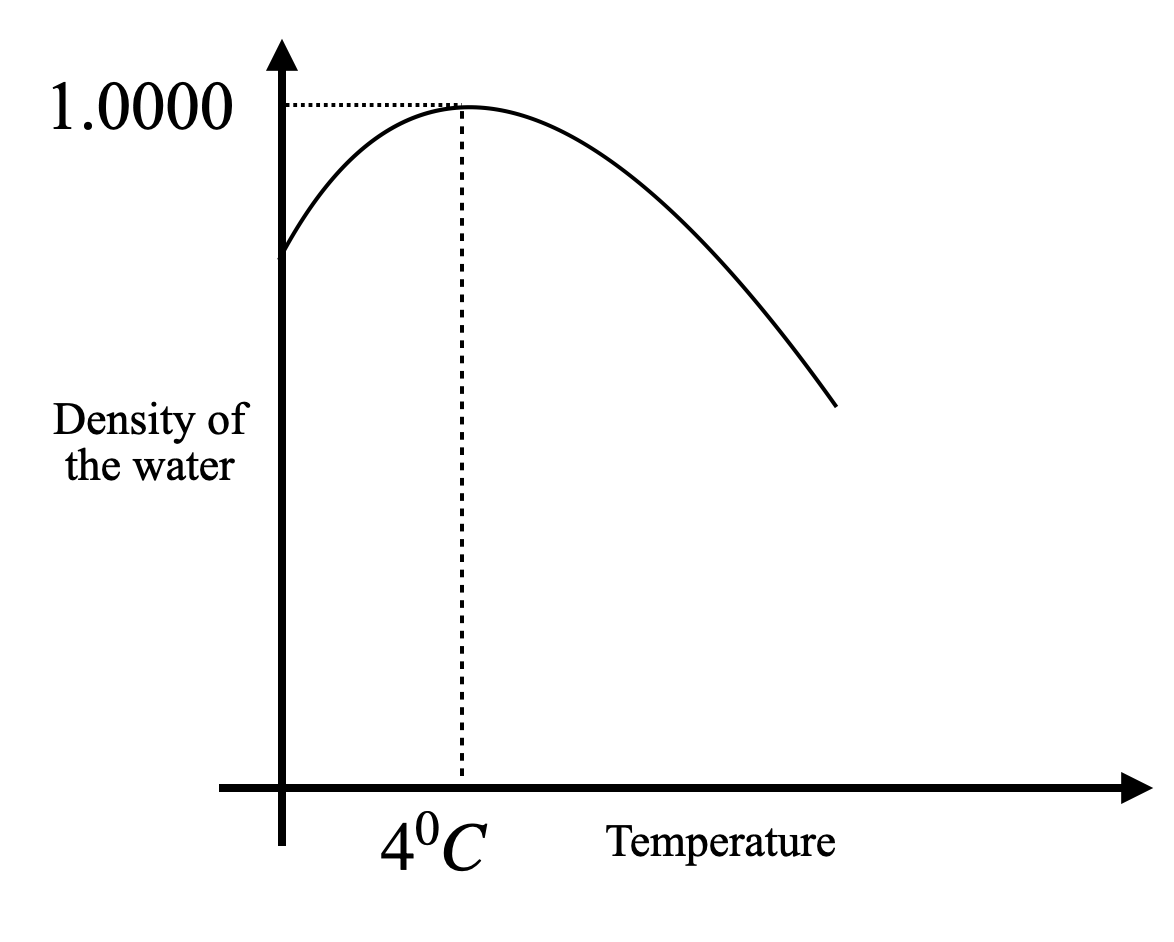
As a result, the volume of the water decreases and the density of water increases at the same time. So, as we can see in the plot, the density of the water reaches its maximum at 4°C. However, the density starts to decrease as we cool it further.
Let us look at the reason behind this phenomenon. When the temperature of the water is more than 4°C, the molecules are attracted because of the O-O polar attraction. However, as the volume of the water has reached the minimum value at 4°C, H-O interactions take over. This interaction is not powerful enough to contact the molecules any further. That is why it experiences an expansion, rather than a contraction.
As a result, the volume expansion coefficient of water is negative in the range of
0°CThe volume increases as we reduce the temperature from 4℃. As a result, we have a maximum density at 4°C and density will be 1.0 gm/$cm^3$
So, the correct choice is option (A).
Note:
This phenomenon helps the water bodies to bear life even when the surface of the lake/river is completely frozen. As the density of water is maximum at 4°C, it goes at the bottom of the water body. Water with lower temperature stays at the top and is frozen. However, the bottom stays at a comfortable 4°C.
Complete answer:
It is the general rule for most of the substances that the volume will increase as you heat it. This general rule holds true above 4°C. When you are cooling the temperature from a high temperature to 4°C, the movement of the water molecules gets restricted and they start to come close to each other.
As a result, the volume of the water decreases and the density of water increases at the same time. So, as we can see in the plot, the density of the water reaches its maximum at 4°C. However, the density starts to decrease as we cool it further.
Let us look at the reason behind this phenomenon. When the temperature of the water is more than 4°C, the molecules are attracted because of the O-O polar attraction. However, as the volume of the water has reached the minimum value at 4°C, H-O interactions take over. This interaction is not powerful enough to contact the molecules any further. That is why it experiences an expansion, rather than a contraction.
As a result, the volume expansion coefficient of water is negative in the range of
0°C
So, the correct choice is option (A).
Note:
This phenomenon helps the water bodies to bear life even when the surface of the lake/river is completely frozen. As the density of water is maximum at 4°C, it goes at the bottom of the water body. Water with lower temperature stays at the top and is frozen. However, the bottom stays at a comfortable 4°C.
Recently Updated Pages
Which will be the least stable resonating structure class 11 chemistry CBSE

How many 5 digit telephone numbers can be construc-class-11-maths-CBSE
How do you find the angle of the resultant vector class 11 physics CBSE
Draw labelled diagram of the following i Gram seed class 11 biology CBSE
1 Quintal is equal to a 110 kg b 10 kg c 100kg d 1000 class 11 physics CBSE
What is the need and importance of classification class 11 biology CBSE
Trending doubts
One Metric ton is equal to kg A 10000 B 1000 C 100 class 11 physics CBSE
Find the value of the expression given below sin 30circ class 11 maths CBSE
Draw a diagram of nephron and explain its structur class 11 biology CBSE
10 examples of friction in our daily life
Proton was discovered by A Thomson B Rutherford C Chadwick class 11 chemistry CBSE
The teeth used for biting and cutting food are called class 11 biology CBSE