




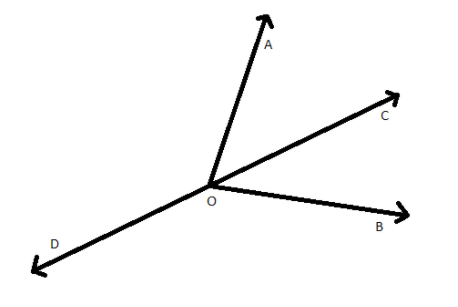
In the adjoining figure, ray OC bisects $\angle AOB$ . If OD is a ray opposite to OC, then prove that $\angle AOD = \angle BOD$.
Answer
 Verified
592.8k+ views
Hint:
We can equate the two angles formed after bisection with the ray. Then we can consider the ray extended as a straight line. Then we can consider the linear pair on both sides of the extended ray. Then by giving substitution, we can prove that the required angles are equal.
Complete step by step solution:
It is given that the ray OC bisects the angle $\angle AOB$ . So, the ray will divide the angle $\angle AOB$ into two equal angles. So, from the figure we can write it as,
$ \Rightarrow \angle AOC = \angle COB$ … (1)
It is given that the ray OC is extended backwards to D. So, CD will be a straight line.
Now consider the angles $\angle AOD$ and $\angle AOC$ . They form a linear pair. We know that linear pairs are supplementary. So, we can write,
$ \Rightarrow \angle AOD + \angle AOC = 180^\circ $
On rearranging, we get,
$ \Rightarrow \angle AOD = 180^\circ - \angle AOC$ … (2)
Now consider the angles $\angle BOD$ and $\angle BOC$ . They also form a linear pair. We know that linear pairs are supplementary. So, we can write,
$ \Rightarrow \angle BOD + \angle BOC = 180^\circ $
On rearranging, we get,
$ \Rightarrow \angle BOD = 180^\circ - \angle BOC$ … (3)
On substituting equation (1) in (3), we get,
$ \Rightarrow \angle BOD = 180^\circ - \angle AOC$ … (4)
On comparing equations (2) and (4), the RHS are equal. So, we can equate the LHS.
$ \Rightarrow \angle BOD = \angle AOD$
This is the required relation.
Hence proved.
Note:
Alternate solution to this problem is given by,
It is given that the ray OC bisects the angle $\angle AOB$ . So, the ray will divide the angle $\angle AOB$into two equal angles. So, from the figure we can write it as,
$ \Rightarrow \angle AOC = \angle COB$ … (a)
It is given that the ray OC is extended backwards to D. So, CD will be a straight line.
Now we can equate the angles on both sides of the line.
$ \Rightarrow \angle DOC = \angle COD$
Form the figure we can write the angles as,
$ \Rightarrow \angle AOC + \angle AOD = \angle COB + \angle BOD$
Now we can substitute equation (a).
$ \Rightarrow \angle AOC + \angle AOD = \angle AOC + \angle BOD$
On cancelling the common terms, we get,
$ \Rightarrow \angle AOD = \angle BOD$
This is the required relation.
Hence proved.
We can equate the two angles formed after bisection with the ray. Then we can consider the ray extended as a straight line. Then we can consider the linear pair on both sides of the extended ray. Then by giving substitution, we can prove that the required angles are equal.
Complete step by step solution:
It is given that the ray OC bisects the angle $\angle AOB$ . So, the ray will divide the angle $\angle AOB$ into two equal angles. So, from the figure we can write it as,
$ \Rightarrow \angle AOC = \angle COB$ … (1)
It is given that the ray OC is extended backwards to D. So, CD will be a straight line.
Now consider the angles $\angle AOD$ and $\angle AOC$ . They form a linear pair. We know that linear pairs are supplementary. So, we can write,
$ \Rightarrow \angle AOD + \angle AOC = 180^\circ $
On rearranging, we get,
$ \Rightarrow \angle AOD = 180^\circ - \angle AOC$ … (2)
Now consider the angles $\angle BOD$ and $\angle BOC$ . They also form a linear pair. We know that linear pairs are supplementary. So, we can write,
$ \Rightarrow \angle BOD + \angle BOC = 180^\circ $
On rearranging, we get,
$ \Rightarrow \angle BOD = 180^\circ - \angle BOC$ … (3)
On substituting equation (1) in (3), we get,
$ \Rightarrow \angle BOD = 180^\circ - \angle AOC$ … (4)
On comparing equations (2) and (4), the RHS are equal. So, we can equate the LHS.
$ \Rightarrow \angle BOD = \angle AOD$
This is the required relation.
Hence proved.
Note:
Alternate solution to this problem is given by,
It is given that the ray OC bisects the angle $\angle AOB$ . So, the ray will divide the angle $\angle AOB$into two equal angles. So, from the figure we can write it as,
$ \Rightarrow \angle AOC = \angle COB$ … (a)
It is given that the ray OC is extended backwards to D. So, CD will be a straight line.
Now we can equate the angles on both sides of the line.
$ \Rightarrow \angle DOC = \angle COD$
Form the figure we can write the angles as,
$ \Rightarrow \angle AOC + \angle AOD = \angle COB + \angle BOD$
Now we can substitute equation (a).
$ \Rightarrow \angle AOC + \angle AOD = \angle AOC + \angle BOD$
On cancelling the common terms, we get,
$ \Rightarrow \angle AOD = \angle BOD$
This is the required relation.
Hence proved.
Recently Updated Pages
Basicity of sulphurous acid and sulphuric acid are

Master Class 9 Social Science: Engaging Questions & Answers for Success
Master Class 9 Science: Engaging Questions & Answers for Success
Master Class 9 Maths: Engaging Questions & Answers for Success
Master Class 9 General Knowledge: Engaging Questions & Answers for Success
Class 9 Question and Answer - Your Ultimate Solutions Guide
Trending doubts
Fill the blanks with the suitable prepositions 1 The class 9 english CBSE
Difference Between Plant Cell and Animal Cell
Find the sum of series 1 + 2 + 3 + 4 + 5 + + 100 class 9 maths CBSE
Distinguish between Conventional and nonconventional class 9 social science CBSE
What is pollution? How many types of pollution? Define it
Describe the 4 stages of the Unification of German class 9 social science CBSE