




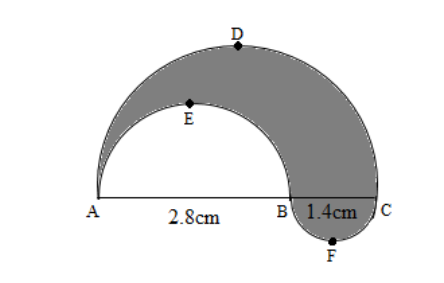
In the adjoining figure, find the perimeter of the shaded region where $ ADC $ , $ AEB $ and $ BFC $ are semicircles in diameter $ AC $ , $ AB $ and $ BC $ respectively.
Answer
 Verified
549.9k+ views
Hint: There are three semicircles in the given figure. To find the perimeter of the shaded region first we will find the radius of all the three semicircles then we will calculate the arc length of all the arcs of semicircles. If we carefully observe the given figure the shaded region is nothing but the sum of the arc length of the arcs $ ADC $ , $ AEB $ and $ BFC $ .
Complete step by step solution:
Consider the semicircle \[ADC\] , from the figure its diameter is $AC = AB + BC = 2.8 + 1.4 = 4.2cm$ .
We know that radius is half of diameter, therefore radius of semicircle $ADC = {r_1} = \dfrac{{4.2}}{2} = 2.1cm$
The diameter of semicircle $AEB$ is $2.8cm$ then its radius is, ${r_2} = \dfrac{{2.8}}{2} = 1.4cm$
The diameter of semicircle $BFC$is $1.4cm$then its radius is, ${r_3} = \dfrac{{1.4}}{2} = 0.7cm$
Now from the figure the perimeter of the shaded region = sum of arc length of arcs\[ADC\], \[AEB\]and $BFC$ .
The perimeter of a circle of radius $r$ is given by $2\pi r$, then the length of the arc of semicircle will be half of the perimeter of circle, therefore the length of the arc a semicircle of radius $r$will be $\pi r$.
The length of the arc $ADC$$ = \pi {r_1} = \pi \times 2.1cm$.
The length of the arc $AEB$$ = \pi {r_2} = \pi \times 1.4cm$.
The length of the arc $BFC$$ = \pi {r_3} = \pi \times 0.7cm$
$ \Rightarrow $Sum of the shaded region $ = \pi {r_1} + \pi {r_2} + \pi {r_3} = \pi (2.1 + 1.4 + 0.7)$
\[ \Rightarrow \pi \times 4.2\]
$ \Rightarrow \dfrac{{22}}{7} \times 4.2$
$ \Rightarrow 22 \times 0.6$
\[\therefore \,\,13.2cm\]
Therefore, the sum of the shaded region is $13.2cm$.
So, the correct answer is “ $ 13.2\;cm $ ”.
Note: A semicircle is a half-circle that is formed by cutting a whole circle into two halves along a diameter line, which produces two equal semicircles. The area of a semicircle is half the area of a full circle. Therefore the area of the semicircle of radius $ r $ is $ \dfrac{{\pi {r^2}}}{2} $ . The perimeter of a semicircle is the sum of the arc length and the diameter which is given by $ \pi r + 2r = r(\pi + 2) $ .
Complete step by step solution:
Consider the semicircle \[ADC\] , from the figure its diameter is $AC = AB + BC = 2.8 + 1.4 = 4.2cm$ .
We know that radius is half of diameter, therefore radius of semicircle $ADC = {r_1} = \dfrac{{4.2}}{2} = 2.1cm$
The diameter of semicircle $AEB$ is $2.8cm$ then its radius is, ${r_2} = \dfrac{{2.8}}{2} = 1.4cm$
The diameter of semicircle $BFC$is $1.4cm$then its radius is, ${r_3} = \dfrac{{1.4}}{2} = 0.7cm$
Now from the figure the perimeter of the shaded region = sum of arc length of arcs\[ADC\], \[AEB\]and $BFC$ .
The perimeter of a circle of radius $r$ is given by $2\pi r$, then the length of the arc of semicircle will be half of the perimeter of circle, therefore the length of the arc a semicircle of radius $r$will be $\pi r$.
The length of the arc $ADC$$ = \pi {r_1} = \pi \times 2.1cm$.
The length of the arc $AEB$$ = \pi {r_2} = \pi \times 1.4cm$.
The length of the arc $BFC$$ = \pi {r_3} = \pi \times 0.7cm$
$ \Rightarrow $Sum of the shaded region $ = \pi {r_1} + \pi {r_2} + \pi {r_3} = \pi (2.1 + 1.4 + 0.7)$
\[ \Rightarrow \pi \times 4.2\]
$ \Rightarrow \dfrac{{22}}{7} \times 4.2$
$ \Rightarrow 22 \times 0.6$
\[\therefore \,\,13.2cm\]
Therefore, the sum of the shaded region is $13.2cm$.
So, the correct answer is “ $ 13.2\;cm $ ”.
Note: A semicircle is a half-circle that is formed by cutting a whole circle into two halves along a diameter line, which produces two equal semicircles. The area of a semicircle is half the area of a full circle. Therefore the area of the semicircle of radius $ r $ is $ \dfrac{{\pi {r^2}}}{2} $ . The perimeter of a semicircle is the sum of the arc length and the diameter which is given by $ \pi r + 2r = r(\pi + 2) $ .
Recently Updated Pages
Master Class 11 Social Science: Engaging Questions & Answers for Success

Master Class 11 English: Engaging Questions & Answers for Success
Master Class 11 Maths: Engaging Questions & Answers for Success
Master Class 11 Chemistry: Engaging Questions & Answers for Success
Master Class 11 Biology: Engaging Questions & Answers for Success
Class 11 Question and Answer - Your Ultimate Solutions Guide
Trending doubts
Find the sum of series 1 + 2 + 3 + 4 + 5 + + 100 class 9 maths CBSE
Difference Between Plant Cell and Animal Cell
Fill the blanks with the suitable prepositions 1 The class 9 english CBSE
What is pollution? How many types of pollution? Define it
What is the Full Form of ICSE / ISC ?
Name 10 Living and Non living things class 9 biology CBSE