




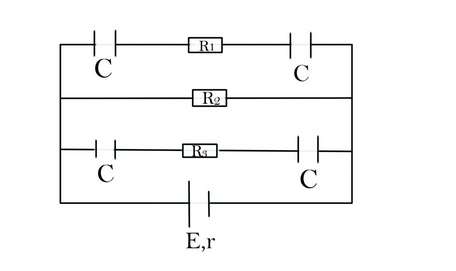
In the adjoining figure, $E = 5V$,$r = 1\Omega $, ${R_2} = 4\Omega $, ${R_1} = {R_3} = 1\Omega $ and $C = 3\mu F$. The numerical value of charge on each capacitor is
A. $3\mu C$
B. $6\mu C$
C. $12\mu C$
D. $24\mu C$
Answer
 Verified
663.6k+ views
Hint: Capacitor will behave as a broken wire when it is fully charged.
Complete step-by-step answer:
Initially, the capacitor starts charging due to the potential difference across the capacitor. When the capacitor is fully charged, it behaves as a broken wire and the flow of current will stop in the wire in which the capacitor is connected.
So, in this case, the resistances ${R_1}$and ${R_3}$will not contribute to the resistance of the circuit because the current will not flow in that wire due to capacitors. The current will only flow in the ${R_2}$ resistor. So, the total resistance in the circuit will be
$R = {R_2} + r$
$
R = 4 + 1 \\
R = 5\Omega \\
$
Current in the circuit,
$I = \dfrac{E}{R}$
$I = \dfrac{5}{5} = 1A$
Potential difference across ${R_2}$
$V = I{R_2}$
$
V = 1 \times 4 \\
V = 4V \\
$
We can see that all the resistors in the circuit are parallel to each other which means that the potential difference will be the same across all the three.
Total capacitance in one branch
$ = \dfrac{C}{2} = \dfrac{3}{2}\mu F$
We know that,
$Q = CV$
$Q = \dfrac{3}{2} \times 4 = 6\mu C$
b) is correct.
Additional information: In an AC circuit, capacitor reverses its charges as the current alternates and produces a lagging voltage (in other words, capacitor provides leading current in AC circuits and networks) Role of Capacitor in DC Circuits: In a DC Circuit, the capacitor once charged with the applied voltage acts as an open switch.
Note: The current does not flow through a fully charged capacitor because the potential difference across the capacitor becomes equal to the potential difference of the battery. Current does not flow between two points if the potential of the points are equal.
Complete step-by-step answer:
Initially, the capacitor starts charging due to the potential difference across the capacitor. When the capacitor is fully charged, it behaves as a broken wire and the flow of current will stop in the wire in which the capacitor is connected.
So, in this case, the resistances ${R_1}$and ${R_3}$will not contribute to the resistance of the circuit because the current will not flow in that wire due to capacitors. The current will only flow in the ${R_2}$ resistor. So, the total resistance in the circuit will be
$R = {R_2} + r$
$
R = 4 + 1 \\
R = 5\Omega \\
$
Current in the circuit,
$I = \dfrac{E}{R}$
$I = \dfrac{5}{5} = 1A$
Potential difference across ${R_2}$
$V = I{R_2}$
$
V = 1 \times 4 \\
V = 4V \\
$
We can see that all the resistors in the circuit are parallel to each other which means that the potential difference will be the same across all the three.
Total capacitance in one branch
$ = \dfrac{C}{2} = \dfrac{3}{2}\mu F$
We know that,
$Q = CV$
$Q = \dfrac{3}{2} \times 4 = 6\mu C$
b) is correct.
Additional information: In an AC circuit, capacitor reverses its charges as the current alternates and produces a lagging voltage (in other words, capacitor provides leading current in AC circuits and networks) Role of Capacitor in DC Circuits: In a DC Circuit, the capacitor once charged with the applied voltage acts as an open switch.
Note: The current does not flow through a fully charged capacitor because the potential difference across the capacitor becomes equal to the potential difference of the battery. Current does not flow between two points if the potential of the points are equal.
Recently Updated Pages
Which of the following graphs shows the variation of class 12 physics CBSE

Draw a labelled diagram of the human male reproductive class 12 biology CBSE
Describe the experiment to compare the emf of two cells class 12 physics CBSE
What is standard hydrogen electrode
What is conventional current and electric current class 12 physics CBSE
2Bromopentane is treated with an alcoholic KOH solution class 12 chemistry CBSE
Trending doubts
Draw a labelled sketch of the human eye class 12 physics CBSE
Which are the Top 10 Largest Countries of the World?
Differentiate between homogeneous and heterogeneous class 12 chemistry CBSE
Draw ray diagrams each showing i myopic eye and ii class 12 physics CBSE
Which is the correct genotypic ratio of mendel dihybrid class 12 biology CBSE
What is the Full Form of PVC, PET, HDPE, LDPE, PP and PS ?