



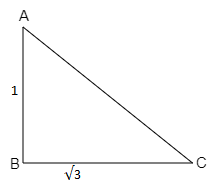
In the adjacent figure value of AC is,
A. Even Prime
B. Irrational
C. Odd
D. Composite
Answer
 Verified
591.6k+ views
Hint: The given triangle has lengths of two mutually perpendicular sides and we need to find the value of the third side, we can apply the Pythagoras theorem which is ${h^2} = {p^2} + {b^2}$ where h is the hypotenuse, p is perpendicular and b is base. After that simplify the equation to get the desired result.
Complete step by step answer:
The two mutually perpendicular sides are 1 and $\sqrt 3 $.
Let the hypotenuse of the triangle be $x$.
The important thing related to any right-angled triangle is that the Pythagoras theorem is applicable. It is a theorem that relates the three sides of a right-angled triangle. According to the theorem, the square of the hypotenuse is equal to the square of the base plus the square of the perpendicular.
In right-angled triangle ABC, applying Pythagoras theorem,
$A{C^2} = A{B^2} + B{C^2}$
Substitute the values in the formula,
$ \Rightarrow {x^2} = {1^2} + {\left( {\sqrt 3 } \right)^2}$
Square the terms on the right side,
$ \Rightarrow {x^2} = 1 + 3$
Add the terms,
$ \Rightarrow {x^2} = 4$
Take the square root on both sides,
$\therefore x = 2$
Thus, the value of AC is 2 which is a prime number and is even.
Hence, option (A) is the correct answer.
Note: In a right triangle, the hypotenuse is the longest side, an opposite side is the one across from a given angle, and an adjacent side is next to a given angle. Pythagoras theorem provides us with the relation between the sides in a right triangle. A right triangle consists of two legs and a hypotenuse. The two legs meet at an angle of $90^\circ $.
The hypotenuse is the longest side of the right triangle and is the side opposite to the right angle. Pythagora's theorem states that the square on the hypotenuse of a right-angled triangle is equal in area to the sum of the squares on the other two sides.
Complete step by step answer:
The two mutually perpendicular sides are 1 and $\sqrt 3 $.
Let the hypotenuse of the triangle be $x$.
The important thing related to any right-angled triangle is that the Pythagoras theorem is applicable. It is a theorem that relates the three sides of a right-angled triangle. According to the theorem, the square of the hypotenuse is equal to the square of the base plus the square of the perpendicular.
In right-angled triangle ABC, applying Pythagoras theorem,
$A{C^2} = A{B^2} + B{C^2}$
Substitute the values in the formula,
$ \Rightarrow {x^2} = {1^2} + {\left( {\sqrt 3 } \right)^2}$
Square the terms on the right side,
$ \Rightarrow {x^2} = 1 + 3$
Add the terms,
$ \Rightarrow {x^2} = 4$
Take the square root on both sides,
$\therefore x = 2$
Thus, the value of AC is 2 which is a prime number and is even.
Hence, option (A) is the correct answer.
Note: In a right triangle, the hypotenuse is the longest side, an opposite side is the one across from a given angle, and an adjacent side is next to a given angle. Pythagoras theorem provides us with the relation between the sides in a right triangle. A right triangle consists of two legs and a hypotenuse. The two legs meet at an angle of $90^\circ $.
The hypotenuse is the longest side of the right triangle and is the side opposite to the right angle. Pythagora's theorem states that the square on the hypotenuse of a right-angled triangle is equal in area to the sum of the squares on the other two sides.
Recently Updated Pages
Master Class 12 Business Studies: Engaging Questions & Answers for Success

Master Class 12 Biology: Engaging Questions & Answers for Success
Master Class 12 Chemistry: Engaging Questions & Answers for Success
Class 12 Question and Answer - Your Ultimate Solutions Guide
Master Class 11 Social Science: Engaging Questions & Answers for Success
Master Class 11 English: Engaging Questions & Answers for Success
Trending doubts
Find the sum of series 1 + 2 + 3 + 4 + 5 + + 100 class 9 maths CBSE
Fill the blanks with the suitable prepositions 1 The class 9 english CBSE
Difference Between Plant Cell and Animal Cell
How many hours before the closure of election must class 9 social science CBSE
What is pollution? How many types of pollution? Define it
Name 10 Living and Non living things class 9 biology CBSE