




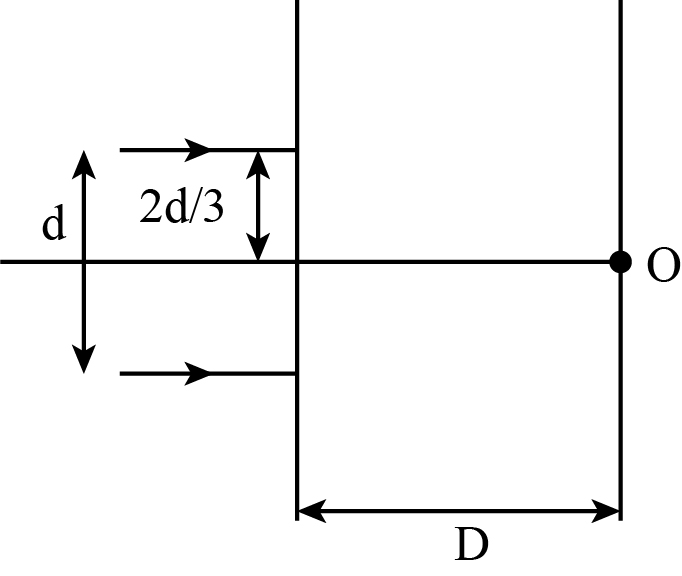
In the above question if the light incident is monochromatic and point O is a maxima, then the wavelength of the light incident cannot be
A. \[\dfrac{{{d^2}}}{{3D}}\]
B. \[\dfrac{{{d^2}}}{{6D}}\]
C. \[\dfrac{{{d^2}}}{{12D}}\]
D. \[\dfrac{{{d^2}}}{{18D}}\]
Answer
 Verified
628.8k+ views
Hint: The above problem can be resolved using the concepts and the fundamental of the wavelength of light incident on a specific point, given the necessary condition that the incident light is the monochromatic light. The formula for the wavelength is used for the condition of the maximum obtained on the screen.
Complete step by step answer:
The path difference of the light incident on the point O is given as,
\[\dfrac{{xd}}{D} = n\lambda \]
Here, x is the path difference of the incident light, d is the distance between the slit or the slit width and the D is the distance between the slit and the screen, \[\lambda \] is the wavelength of light and n is the order of diffraction
The above relation can be standardised as in the form of,
\[n\lambda = \dfrac{{{d^2}}}{{6D}}\]
For the maxima at point O, the value of n can be, \[n = 1,2,3\].
Substituting the values one by one in the above equation as,
\[\begin{array}{l}
\lambda = \dfrac{{{d^2}}}{{6nD}}\\
{\lambda _1} = \dfrac{{{d^2}}}{{6\left( 1 \right)D}}\\
{\lambda _1} = \dfrac{{{d^2}}}{{6D}}..................................\left( 1 \right)
\end{array}\]
Further solving for other values as,
\[\begin{array}{l}
{\lambda _2} = \dfrac{{{d^2}}}{{6\left( 2 \right)D}}\\
{\lambda _2} = \dfrac{{{d^2}}}{{12D}}..................................\left( 2 \right)\\
{\lambda _3} = \dfrac{{{d^2}}}{{6\left( 3 \right)D}}\\
{\lambda _3} = \dfrac{{{d^2}}}{{18D}}.......................................\left( 3 \right)
\end{array}\]
The equation 1,2 and 3 shows that the values of the wavelength of the light does not match with the option (A), that is \[\lambda = \dfrac{{{d^2}}}{{3D}}\] .
Therefore, the wavelength of the light incident cannot be \[\lambda = \dfrac{{{d^2}}}{{3D}}\]
So, the correct answer is “Option A”.
Note:
The given problem is resolved by understanding the meaning of the basic terms related to the diffraction and the terms involved in the diffraction, like the distance between the slit and the screen, phase difference, path difference, and many more. Moreover, some fundamental relations for the conditions need to be remembered to resolve such type problems.
Complete step by step answer:
The path difference of the light incident on the point O is given as,
\[\dfrac{{xd}}{D} = n\lambda \]
Here, x is the path difference of the incident light, d is the distance between the slit or the slit width and the D is the distance between the slit and the screen, \[\lambda \] is the wavelength of light and n is the order of diffraction
The above relation can be standardised as in the form of,
\[n\lambda = \dfrac{{{d^2}}}{{6D}}\]
For the maxima at point O, the value of n can be, \[n = 1,2,3\].
Substituting the values one by one in the above equation as,
\[\begin{array}{l}
\lambda = \dfrac{{{d^2}}}{{6nD}}\\
{\lambda _1} = \dfrac{{{d^2}}}{{6\left( 1 \right)D}}\\
{\lambda _1} = \dfrac{{{d^2}}}{{6D}}..................................\left( 1 \right)
\end{array}\]
Further solving for other values as,
\[\begin{array}{l}
{\lambda _2} = \dfrac{{{d^2}}}{{6\left( 2 \right)D}}\\
{\lambda _2} = \dfrac{{{d^2}}}{{12D}}..................................\left( 2 \right)\\
{\lambda _3} = \dfrac{{{d^2}}}{{6\left( 3 \right)D}}\\
{\lambda _3} = \dfrac{{{d^2}}}{{18D}}.......................................\left( 3 \right)
\end{array}\]
The equation 1,2 and 3 shows that the values of the wavelength of the light does not match with the option (A), that is \[\lambda = \dfrac{{{d^2}}}{{3D}}\] .
Therefore, the wavelength of the light incident cannot be \[\lambda = \dfrac{{{d^2}}}{{3D}}\]
So, the correct answer is “Option A”.
Note:
The given problem is resolved by understanding the meaning of the basic terms related to the diffraction and the terms involved in the diffraction, like the distance between the slit and the screen, phase difference, path difference, and many more. Moreover, some fundamental relations for the conditions need to be remembered to resolve such type problems.
Recently Updated Pages
Master Class 5 English: Engaging Questions & Answers for Success

Master Class 5 Maths: Engaging Questions & Answers for Success
Master Class 5 Social Science: Engaging Questions & Answers for Success
Master Class 5 Science: Engaging Questions & Answers for Success
Class 5 Question and Answer - Your Ultimate Solutions Guide
Master Class 9 General Knowledge: Engaging Questions & Answers for Success
Trending doubts
Which are the Top 10 Largest Countries of the World?
The total number of vertebrae in man is a30 b31 c32 class 12 biology CBSE
Draw a labelled sketch of the human eye class 12 physics CBSE
The number of cranial nerves in a frog is A 10 pairs class 12 biology CBSE
Differentiate between homogeneous and heterogeneous class 12 chemistry CBSE
Differentiate between Pyramid of energy and pyramid class 12 biology CBSE