




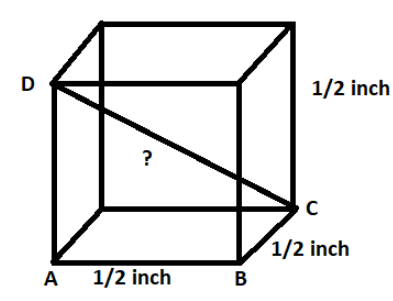
In the above figure, calculate the length of the body diagonal, if the length of each edge of the cube is $\dfrac{1}{2}$ inch.
A. $\dfrac{1}{6}$
B. $\dfrac{1}{4}$
C. $\dfrac{{\sqrt 3 }}{2}$
D. $\dfrac{{\sqrt 2 }}{2}$
Answer
 Verified
520.5k+ views
Hint: With the help of Pythagoras theorem, we can do this question. But we have to apply it in multiple triangles. As we know that it is a cube so we also have to use the properties of a cube which may help us to do this particular problem.
Complete step by step answer:
In the given figure, we know that
$AB = BC = AD = \dfrac{1}{2}inch$
Also, $\angle DAC = {90^ \circ }\,\,and\,\,\angle ABC = {90^ \circ }$
Now, In $\vartriangle ABC$,
Using Pythagoras theorem,
$A{C^2} = A{B^2} + B{C^2}$
$ \Rightarrow A{C^2} = {\left( {\dfrac{1}{2}} \right)^2} + {\left( {\dfrac{1}{2}} \right)^2}$
$ \Rightarrow A{C^2} = \dfrac{1}{4} + \dfrac{1}{4}$
On adding, we get
$ \Rightarrow A{C^2} = \dfrac{2}{4}$
On dividing, we get
$ \Rightarrow A{C^2} = \dfrac{1}{2}$
Taking, square root both sides
$ \Rightarrow AC = \dfrac{1}{{\sqrt 2 }}inch$
Therefore, the value of AC is $\dfrac{1}{{\sqrt 2 }}inch.$
Now,in $\vartriangle ADC$,
Using Pythagoras theorem
$C{D^2} = A{C^2} + A{D^2}$
$C{D^2} = {\left( {\dfrac{1}{{\sqrt 2 }}} \right)^2} + {\left( {\dfrac{1}{2}} \right)^2}$
$ \Rightarrow C{D^2} = \dfrac{1}{2} + \dfrac{1}{4}$
$ \Rightarrow C{D^2} = \dfrac{3}{4}$
$CD = \dfrac{{\sqrt 3 }}{2}inch$$\left( C \right).$
Therefore, the length of the body diagonal is $\dfrac{{\sqrt 3 }}{2}\,inch.$
Hence, the correct option is C.
Note: The diagonal of a cube formula helps in calculating the lengths of different diagonals of a cube, namely, the face diagonals and the body diagonal. A cube is a three-dimensional solid figure, also known as the square solid that has edges of all the same measure, meaning that it has the length, width, and height equal, and each of its faces is a square. The main diagonal of a cube is the one that cuts through the centre of the cube; the diagonal of a face of a cube is not the main diagonal. The main diagonal of any cube can be found by multiplying the length of one side by the square root of $3$.
Complete step by step answer:
In the given figure, we know that
$AB = BC = AD = \dfrac{1}{2}inch$
Also, $\angle DAC = {90^ \circ }\,\,and\,\,\angle ABC = {90^ \circ }$
Now, In $\vartriangle ABC$,
Using Pythagoras theorem,
$A{C^2} = A{B^2} + B{C^2}$
$ \Rightarrow A{C^2} = {\left( {\dfrac{1}{2}} \right)^2} + {\left( {\dfrac{1}{2}} \right)^2}$
$ \Rightarrow A{C^2} = \dfrac{1}{4} + \dfrac{1}{4}$
On adding, we get
$ \Rightarrow A{C^2} = \dfrac{2}{4}$
On dividing, we get
$ \Rightarrow A{C^2} = \dfrac{1}{2}$
Taking, square root both sides
$ \Rightarrow AC = \dfrac{1}{{\sqrt 2 }}inch$
Therefore, the value of AC is $\dfrac{1}{{\sqrt 2 }}inch.$
Now,in $\vartriangle ADC$,
Using Pythagoras theorem
$C{D^2} = A{C^2} + A{D^2}$
$C{D^2} = {\left( {\dfrac{1}{{\sqrt 2 }}} \right)^2} + {\left( {\dfrac{1}{2}} \right)^2}$
$ \Rightarrow C{D^2} = \dfrac{1}{2} + \dfrac{1}{4}$
$ \Rightarrow C{D^2} = \dfrac{3}{4}$
$CD = \dfrac{{\sqrt 3 }}{2}inch$$\left( C \right).$
Therefore, the length of the body diagonal is $\dfrac{{\sqrt 3 }}{2}\,inch.$
Hence, the correct option is C.
Note: The diagonal of a cube formula helps in calculating the lengths of different diagonals of a cube, namely, the face diagonals and the body diagonal. A cube is a three-dimensional solid figure, also known as the square solid that has edges of all the same measure, meaning that it has the length, width, and height equal, and each of its faces is a square. The main diagonal of a cube is the one that cuts through the centre of the cube; the diagonal of a face of a cube is not the main diagonal. The main diagonal of any cube can be found by multiplying the length of one side by the square root of $3$.
Recently Updated Pages
Master Class 11 English: Engaging Questions & Answers for Success

Master Class 11 Maths: Engaging Questions & Answers for Success
Class 11 Question and Answer - Your Ultimate Solutions Guide
Master Class 11 Biology: Engaging Questions & Answers for Success
Master Class 11 Physics: Engaging Questions & Answers for Success
Master Class 11 Accountancy: Engaging Questions & Answers for Success
Trending doubts
Explain the Treaty of Vienna of 1815 class 10 social science CBSE
Who Won 36 Oscar Awards? Record Holder Revealed
What is the median of the first 10 natural numbers class 10 maths CBSE
Why is it 530 pm in india when it is 1200 afternoon class 10 social science CBSE
Select the word that is correctly spelled a Twelveth class 10 english CBSE
Why is there a time difference of about 5 hours between class 10 social science CBSE