




In Tape Grass (= Vallisneria).
A. Both male and female flowers break from the plant and float on the surface of the water
B. The male flowers are brought to the surface by long stalks where only the female flowers break from the plant
C. The female flowers are brought to the surface by long pedicels where only the male flowers break from the plant and rise to the surface.
D. Any of the two flowers can break
Answer
 Verified
651k+ views
Hint: One can define the Vallisneria spiralis as a common aquarium plant that prefers good light and a nutrient-rich substratum. In the wild, it can be found worldwide in tropical and subtropical regions. However, it is also known as straight Vallisneria, tape grass, or eelgrass. Tape grass is a plant that is submerged.
Complete answer: Tape grass is a hydrophyte that is submerged. It is a dioecious plant with undersea-borne flowers. It has small, linear leaves up to 3 feet (1 m) long and up to 0.75 inches thick, varying in colour from pale green to reddish. Species of tape grass have long, thin leaves developing in a clustered rosette. From creeping underground rhizomes and stolons, they can reproduce asexually. The plants are dioecious and have a special aquatic pollination mechanism (bearing either male or female flowers).
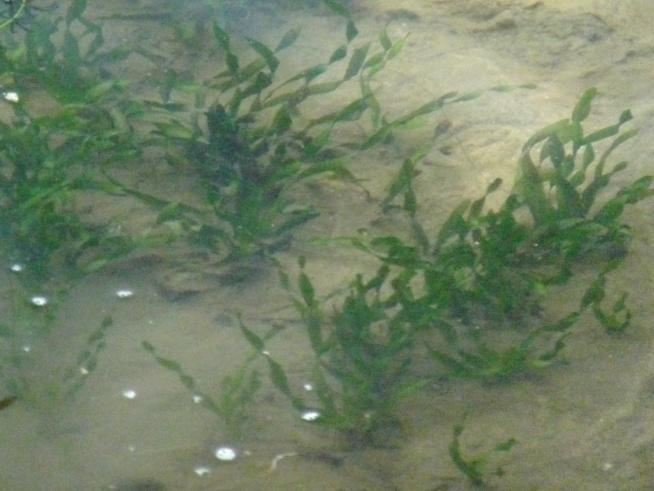
On maturity, the male flowers disconnect and float on the water surface while the female flowers grow underwater and, with the aid of their long thin stem, they come to the surface.
So, the correct answer is “Option C”.
Note: The staminate flower is then blown by the wind along the water surface and can gradually approach a carpellate flower's meniscus. The stalk of the staminate flower splits as the pollen matures, and the flower ascends to the surface of the water. The change in water pressure causes the flower to open when the flower hits the surface of the water, and it is floating on a "boat" shaped by its reflexed petals. The staminate flower is then blown by the wind along the water surface and can gradually approach a carpellate flower's meniscus.
Complete answer: Tape grass is a hydrophyte that is submerged. It is a dioecious plant with undersea-borne flowers. It has small, linear leaves up to 3 feet (1 m) long and up to 0.75 inches thick, varying in colour from pale green to reddish. Species of tape grass have long, thin leaves developing in a clustered rosette. From creeping underground rhizomes and stolons, they can reproduce asexually. The plants are dioecious and have a special aquatic pollination mechanism (bearing either male or female flowers).
On maturity, the male flowers disconnect and float on the water surface while the female flowers grow underwater and, with the aid of their long thin stem, they come to the surface.
So, the correct answer is “Option C”.
Note: The staminate flower is then blown by the wind along the water surface and can gradually approach a carpellate flower's meniscus. The stalk of the staminate flower splits as the pollen matures, and the flower ascends to the surface of the water. The change in water pressure causes the flower to open when the flower hits the surface of the water, and it is floating on a "boat" shaped by its reflexed petals. The staminate flower is then blown by the wind along the water surface and can gradually approach a carpellate flower's meniscus.
Recently Updated Pages
Master Class 11 Business Studies: Engaging Questions & Answers for Success

Master Class 11 Social Science: Engaging Questions & Answers for Success
Master Class 11 Accountancy: Engaging Questions & Answers for Success
Master Class 11 Computer Science: Engaging Questions & Answers for Success
Master Class 11 Chemistry: Engaging Questions & Answers for Success
Master Class 11 English: Engaging Questions & Answers for Success
Trending doubts
Find the value of the expression given below sin 30circ class 11 maths CBSE
One Metric ton is equal to kg A 10000 B 1000 C 100 class 11 physics CBSE
10 examples of friction in our daily life
Draw a diagram of a plant cell and label at least eight class 11 biology CBSE
Difference between physical and chemical change class 11 chemistry CBSE
Proton was discovered by A Thomson B Rutherford C Chadwick class 11 chemistry CBSE