




In soil, the water available for root absorption is
(a) Gravitational water
(b) Capillary water
(c) Hygroscopic water
(d) Combined water
Answer
 Verified
618.9k+ views
Hint: The water which is held in the micropores of soils. This water is retained on the soil particles by force of attraction between soil particles and water molecules and is present in the form of the film around the soil.
Complete step by step answer:
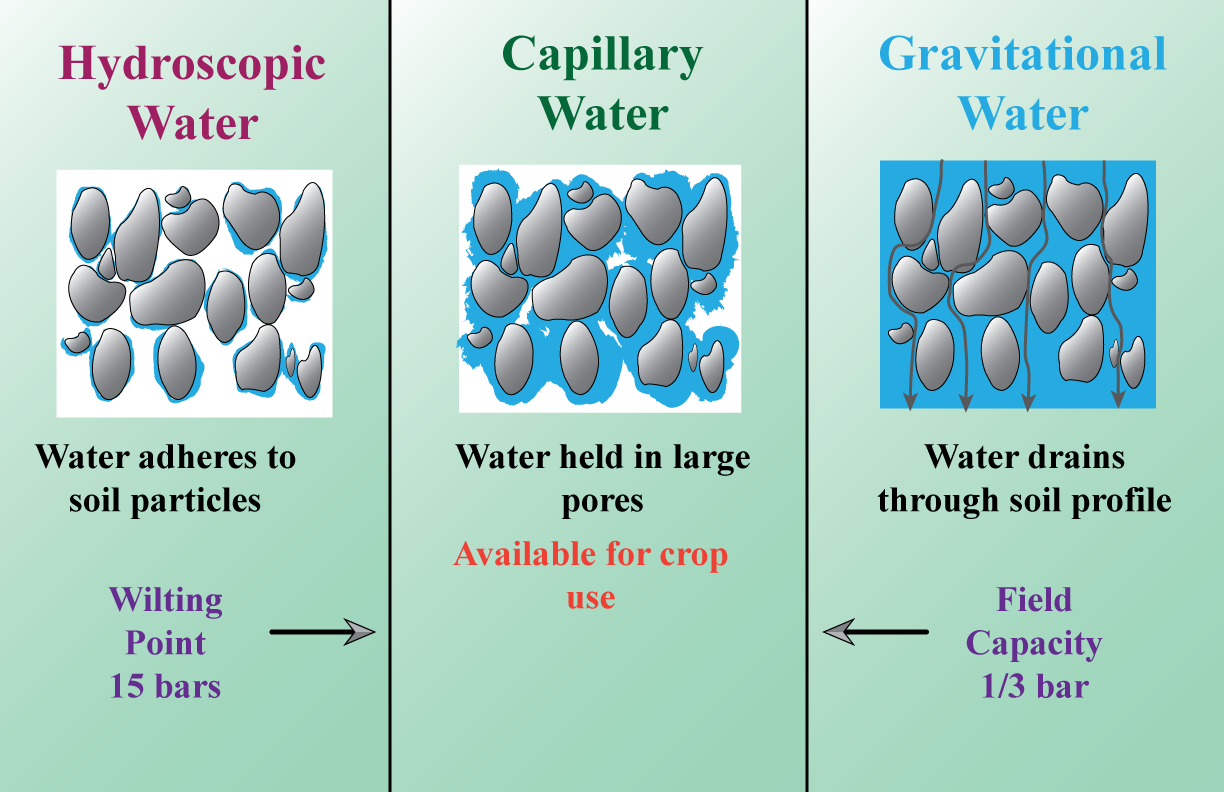
Capillary water
- Capillary water is held so rigidly so that the force of gravity is not able to separate it from soil particles.
- Capillary water may be defined as the water that is retained in the soil between the water potential of - $\frac{1}{3}$ bar to - 31 bars.
- The force of retention of water molecules by the soil particles is high and part of the water is available and part of the water is not available, i.e. all capillary water is not available to plants.
- Capillary water is water held between the soil particles.
 So, the correct answer is, ‘(b) Capillary water.’
Additional Information:
- Classification of soil water: gravitational water, field water, capillary water and hygroscopic water.
- The difference between the free energy of soil water and that of pure water in a standard reference is called soil water potential.
- The movement of water under saturated soil condition and it is mainly determined by two forces: hydraulic force and hydraulic conductivity are termed as saturated water flow.
- The movement of water in the soil through capillary pores and it mainly depends upon two factors: hydraulic conductivity and driving force.
Gravitational water
- This water may be defined as the water that is held at a potential greater than - $\frac{1}{3}$
bar and that portion of the soil water will drain freely from the soil by the force of gravity.
- Gravitational water contains low energy of retention; this type of water is of little use to plants because they occupy the larger pores resulting in poor aeration. So, it is essential to remove excess water for plant growth.
- Gravitational water found in the macropores.
- Gravitational water not considered to be available to plants.
- Gravitational water drains out of the soil in 2- 3 days
Hygroscopic water
- Hygroscopic water is defined as the water that is held by the soil particles at the suction of more than - 31 bars.
- Hygroscopic water is held so tenaciously (tightly) that plants are not able to absorb it and thereby unavailable to plants. Some microorganisms can utilize such a form of water.
- Forms very thin films around soil particles.
- Not available to the plant.
Note:
Permanent wilting percentage
- Also known as a permanent wilting point or wilting coefficient.
- Soil moisture content at which plants can no longer obtain enough moisture to meet transpiration requirements; and remain wilted unless the water is added to the soil.
- Moisture tension of soil at the permanent wilting point ranges from 7 to 32 atmospheres.
- The water vapours move from moist soil to a dry soil where the vapour is somewhat lower is termed as vapour movement.
- The plant access to water either by the capillary movement of soil water to plant roots and growth of plant roots into moist soil.
- The transport of soil solution containing nutrients to plant roots caused by water potential gradient developed due to loss of water through transpiration or evaporation is termed as mass flow.
Complete step by step answer:
Capillary water
- Capillary water is held so rigidly so that the force of gravity is not able to separate it from soil particles.
- Capillary water may be defined as the water that is retained in the soil between the water potential of - $\frac{1}{3}$ bar to - 31 bars.
- The force of retention of water molecules by the soil particles is high and part of the water is available and part of the water is not available, i.e. all capillary water is not available to plants.
- Capillary water is water held between the soil particles.
Additional Information:
- Classification of soil water: gravitational water, field water, capillary water and hygroscopic water.
- The difference between the free energy of soil water and that of pure water in a standard reference is called soil water potential.
- The movement of water under saturated soil condition and it is mainly determined by two forces: hydraulic force and hydraulic conductivity are termed as saturated water flow.
- The movement of water in the soil through capillary pores and it mainly depends upon two factors: hydraulic conductivity and driving force.
Gravitational water
- This water may be defined as the water that is held at a potential greater than - $\frac{1}{3}$
bar and that portion of the soil water will drain freely from the soil by the force of gravity.
- Gravitational water contains low energy of retention; this type of water is of little use to plants because they occupy the larger pores resulting in poor aeration. So, it is essential to remove excess water for plant growth.
- Gravitational water found in the macropores.
- Gravitational water not considered to be available to plants.
- Gravitational water drains out of the soil in 2- 3 days
Hygroscopic water
- Hygroscopic water is defined as the water that is held by the soil particles at the suction of more than - 31 bars.
- Hygroscopic water is held so tenaciously (tightly) that plants are not able to absorb it and thereby unavailable to plants. Some microorganisms can utilize such a form of water.
- Forms very thin films around soil particles.
- Not available to the plant.
Note:
Permanent wilting percentage
- Also known as a permanent wilting point or wilting coefficient.
- Soil moisture content at which plants can no longer obtain enough moisture to meet transpiration requirements; and remain wilted unless the water is added to the soil.
- Moisture tension of soil at the permanent wilting point ranges from 7 to 32 atmospheres.
- The water vapours move from moist soil to a dry soil where the vapour is somewhat lower is termed as vapour movement.
- The plant access to water either by the capillary movement of soil water to plant roots and growth of plant roots into moist soil.
- The transport of soil solution containing nutrients to plant roots caused by water potential gradient developed due to loss of water through transpiration or evaporation is termed as mass flow.
Recently Updated Pages
Master Class 12 Economics: Engaging Questions & Answers for Success

Master Class 12 English: Engaging Questions & Answers for Success
Master Class 12 Social Science: Engaging Questions & Answers for Success
Master Class 12 Maths: Engaging Questions & Answers for Success
Master Class 12 Physics: Engaging Questions & Answers for Success
Master Class 9 General Knowledge: Engaging Questions & Answers for Success
Trending doubts
One Metric ton is equal to kg A 10000 B 1000 C 100 class 11 physics CBSE
Difference Between Prokaryotic Cells and Eukaryotic Cells
Two of the body parts which do not appear in MRI are class 11 biology CBSE
Find the value of the expression given below sin 30circ class 11 maths CBSE
1 ton equals to A 100 kg B 1000 kg C 10 kg D 10000 class 11 physics CBSE
Draw a diagram of nephron and explain its structur class 11 biology CBSE