




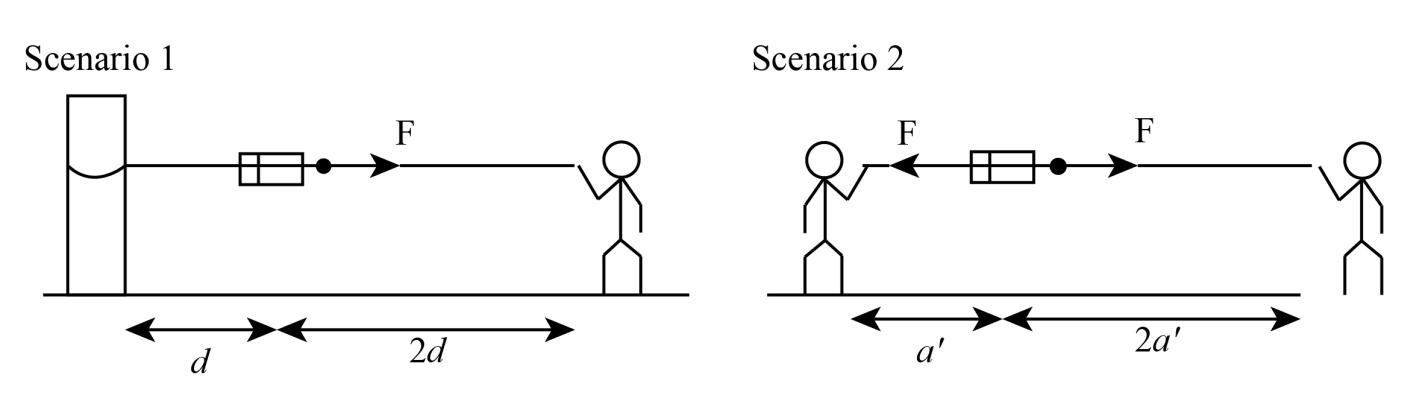
In scenario 1, a person pulls with a force F on a string of length 2d that is connected to a spring scale. The other end of the spring scale is connected to a post by a string of length d . In scenario 2, the person pulls on the string of length \[2d\] with a force of F, and a second person stands where the post was in scenario 1, and also pulls with a force of F. If the spring scale reads \[50\;{\rm{N}}\] in scenario 1, what does the spring scale read in scenario 2?
Answer
 Verified
598.8k+ views
Hint: In this question, a person stands and stretches the length of the wire. We see that in scenario 1, the scale reads \[50\;{\rm{N}}\] with a person stretching the string and in scenario 2, the other person pulls the string with the same force. So, there is the same force acting on both scenarios.
Complete step by step answer:
First, we take scenario 1, in this scenario, the one end of the spring scale is attached to the post and the other end is pulled by a person, which means that there is no net force acting on it. Now in scenario 2, the post is replaced by the person with one end connected to another person. In scenario 1, if the person is pulling the spring scale to the right with force F, then there must be a tension force generated in the string F attaching the spring scale to the post in order for the spring scale to remain motionless.
Therefore, this shows that the same forces are acting on the spring scale in both scenarios. So if the spring scale reads \[50\;{\rm{N}}\] in scenario 1, then it must also read \[50\;{\rm{N}}\] in scenario 2. There are no effects of changing the length of the pieces of string. The length has no effect on the tension force in a string.
Note:
In this question, students make sure that there is no effect on the length of the string. The same force is applied on the spring scale in both scenarios. The spring scale shows the same force, whether it is attached to the post or any other person.
Complete step by step answer:
First, we take scenario 1, in this scenario, the one end of the spring scale is attached to the post and the other end is pulled by a person, which means that there is no net force acting on it. Now in scenario 2, the post is replaced by the person with one end connected to another person. In scenario 1, if the person is pulling the spring scale to the right with force F, then there must be a tension force generated in the string F attaching the spring scale to the post in order for the spring scale to remain motionless.
Therefore, this shows that the same forces are acting on the spring scale in both scenarios. So if the spring scale reads \[50\;{\rm{N}}\] in scenario 1, then it must also read \[50\;{\rm{N}}\] in scenario 2. There are no effects of changing the length of the pieces of string. The length has no effect on the tension force in a string.
Note:
In this question, students make sure that there is no effect on the length of the string. The same force is applied on the spring scale in both scenarios. The spring scale shows the same force, whether it is attached to the post or any other person.
Recently Updated Pages
Three beakers labelled as A B and C each containing 25 mL of water were taken A small amount of NaOH anhydrous CuSO4 and NaCl were added to the beakers A B and C respectively It was observed that there was an increase in the temperature of the solutions contained in beakers A and B whereas in case of beaker C the temperature of the solution falls Which one of the following statements isarecorrect i In beakers A and B exothermic process has occurred ii In beakers A and B endothermic process has occurred iii In beaker C exothermic process has occurred iv In beaker C endothermic process has occurred

Master Class 11 Social Science: Engaging Questions & Answers for Success
Master Class 11 Physics: Engaging Questions & Answers for Success
Master Class 11 Maths: Engaging Questions & Answers for Success
Master Class 11 Economics: Engaging Questions & Answers for Success
Master Class 11 Computer Science: Engaging Questions & Answers for Success
Three beakers labelled as A B and C each containing 25 mL of water were taken A small amount of NaOH anhydrous CuSO4 and NaCl were added to the beakers A B and C respectively It was observed that there was an increase in the temperature of the solutions contained in beakers A and B whereas in case of beaker C the temperature of the solution falls Which one of the following statements isarecorrect i In beakers A and B exothermic process has occurred ii In beakers A and B endothermic process has occurred iii In beaker C exothermic process has occurred iv In beaker C endothermic process has occurred
Master Class 11 Social Science: Engaging Questions & Answers for Success
Master Class 11 Physics: Engaging Questions & Answers for Success
Trending doubts
One Metric ton is equal to kg A 10000 B 1000 C 100 class 11 physics CBSE
There are 720 permutations of the digits 1 2 3 4 5 class 11 maths CBSE
State and prove Bernoullis theorem class 11 physics CBSE
Draw a diagram of a plant cell and label at least eight class 11 biology CBSE
Difference Between Prokaryotic Cells and Eukaryotic Cells
1 Quintal is equal to a 110 kg b 10 kg c 100kg d 1000 class 11 physics CBSE