




In $\rm{2sp}$ hybridization, two s-orbital can be mixed with
A: Only $\rm{2p_x}$
B: Only $\rm{2p_y}$
C: Only $\rm{2p_z}$
D: Any one of $\rm{2p_x, 2p_y and \,2p_z}$
Answer
 Verified
629.1k+ views
Hint:An orbit is referred to as the simple planar representation of an electron. On the other hand, an orbital is referred to as the dimensional motion or movement of an electron around the nucleus in the three-dimensional motion. An orbital is actually a space or a region where an electron is most likely to be found.
Complete answer:
The names of the orbital i.e. s, p, d, or f stand for the names given to the groups of lines which are originally noted in the spectra of alkali metals. The line groups are known as sharp, principal, diffuse, or fundamental, respectively.
Orbital hybridisation or simply hybridization is the concept in chemistry which states that mixing of the atomic orbitals into the new hybrid orbitals (which possess different shapes, energies, etc., in comparison to component atomic orbitals) is suitable for the electron pairing in order to form chemical bonds in the valence bond theory.
The $\rm{2sp}$ hybridization is mixing of two s with one p atomic orbitals. S orbital is actually spherically symmetric so it can be mixed with the p orbital from any axis as shown below:
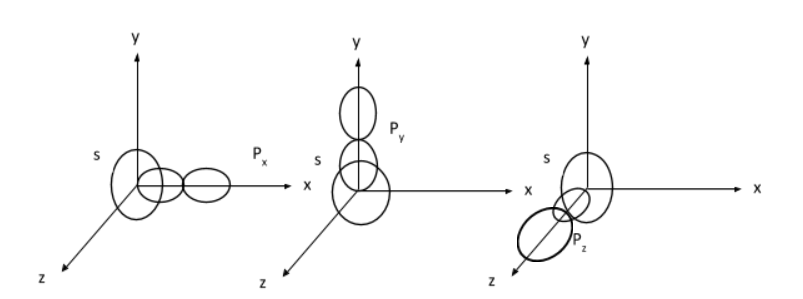
Hence, the correct answer is Option D. Any one of $\rm{2p_x, 2p_y and \,2p_z}$
Note:
The sequence of hybrids according to energy level is $\rm{sp < sp_2 < sp_3}$. If p character is higher, it means that the energy is more, thus indicating that the electrophilicity is higher and moreover, its affinity for reaction is also higher. It should also be noted that hybrids $(\rm{sp, sp_2, sp_3})$ lead to the formation of $\sigma$ bonds and pure-breeds on the other hand, lead to the formation of $\pi$ bonds.
Complete answer:
The names of the orbital i.e. s, p, d, or f stand for the names given to the groups of lines which are originally noted in the spectra of alkali metals. The line groups are known as sharp, principal, diffuse, or fundamental, respectively.
Orbital hybridisation or simply hybridization is the concept in chemistry which states that mixing of the atomic orbitals into the new hybrid orbitals (which possess different shapes, energies, etc., in comparison to component atomic orbitals) is suitable for the electron pairing in order to form chemical bonds in the valence bond theory.
The $\rm{2sp}$ hybridization is mixing of two s with one p atomic orbitals. S orbital is actually spherically symmetric so it can be mixed with the p orbital from any axis as shown below:
Hence, the correct answer is Option D. Any one of $\rm{2p_x, 2p_y and \,2p_z}$
Note:
The sequence of hybrids according to energy level is $\rm{sp < sp_2 < sp_3}$. If p character is higher, it means that the energy is more, thus indicating that the electrophilicity is higher and moreover, its affinity for reaction is also higher. It should also be noted that hybrids $(\rm{sp, sp_2, sp_3})$ lead to the formation of $\sigma$ bonds and pure-breeds on the other hand, lead to the formation of $\pi$ bonds.
Recently Updated Pages
Which will be the least stable resonating structure class 11 chemistry CBSE

How many 5 digit telephone numbers can be construc-class-11-maths-CBSE
How do you find the angle of the resultant vector class 11 physics CBSE
Draw labelled diagram of the following i Gram seed class 11 biology CBSE
What is the need and importance of classification class 11 biology CBSE
The way in which the sparrows expressed their sorrow class 11 english CBSE
Trending doubts
One Metric ton is equal to kg A 10000 B 1000 C 100 class 11 physics CBSE
Find the value of the expression given below sin 30circ class 11 maths CBSE
1 Quintal is equal to a 110 kg b 10 kg c 100kg d 1000 class 11 physics CBSE
Draw a diagram of nephron and explain its structur class 11 biology CBSE
10 examples of friction in our daily life
Proton was discovered by A Thomson B Rutherford C Chadwick class 11 chemistry CBSE