




In quadrilateral $ ABCD $ , diagonals $ AC $ and $ BD $ intersect at point $ E $ such that $ AE:EC = BE:ED $ .
Show that: $ ABCD $ is a trapezium.
Answer
 Verified
588.3k+ views
Hint: In this question, we need to prove $ ABCD $ is a trapezium. Here, we will construct a quadrilateral $ ABCD $ with diagonals $ AC $ and $ BD $ intersect at point $ E $ . Then, using the properties of basic proportionality theorem, vertically opposite angles, SAS similarity theorem, corresponding angles congruence we will determine $ ABCD $ is a trapezium.
Complete step-by-step answer:
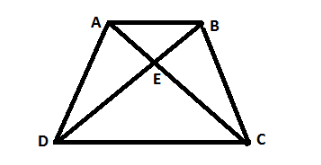
Now, we have constructed a quadrilateral $ ABCD $ with diagonals $ AC $ and $ BD $ intersect at point $ E $ .
Then, $ \dfrac{{AE}}{{EC}} = \dfrac{{BE}}{{ED}} $
$ \dfrac{{AE}}{{BE}} = \dfrac{{EC}}{{ED}} $
Let this be equation (1),
In $ \Delta ABE $ and $ \Delta CDE $ ,
Therefore, from equation (1),
$ \dfrac{{AE}}{{BE}} = \dfrac{{EC}}{{ED}} $
We know that vertically opposite angles are equal. Therefore, we have,
$ \angle ABE = \angle DEC $
Then, we also know that, the SAS similarity theorem states that if two sides in one triangle are proportional to two sides in another triangle and the included angle in both are congruent, then the two triangles are similar.
Therefore, by the theorem, we have,
$ \Delta ABE \sim \Delta CDE $
Here, the corresponding angles are equal,
$ \angle EDC = \angle EBA $
Therefore,
$ \angle BDC = \angle ABD $
From the figure we can say this is a pair of alternate angles.
Thus, $ AB\parallel DC $
Hence, the quadrilateral $ ABCD $ is trapezium.
So, the correct answer is “ $ ABCD $ is trapezium”.
Note: It is important to note here that vertically opposite angles are the angles opposite to each other when two lines cross. These angles are equal. Also, the angle rule of corresponding angles states that the corresponding angles are equal if a transversal cuts two parallel lines. However, we can also prove this by constructing a line $ EF $ where $ F $ in the side $ AD $ . Then, we can use basic proportionality theorem and converse of basic proportionality theorem to prove $ ABCD $ is a trapezium.
Complete step-by-step answer:
Now, we have constructed a quadrilateral $ ABCD $ with diagonals $ AC $ and $ BD $ intersect at point $ E $ .
Then, $ \dfrac{{AE}}{{EC}} = \dfrac{{BE}}{{ED}} $
$ \dfrac{{AE}}{{BE}} = \dfrac{{EC}}{{ED}} $
Let this be equation (1),
In $ \Delta ABE $ and $ \Delta CDE $ ,
Therefore, from equation (1),
$ \dfrac{{AE}}{{BE}} = \dfrac{{EC}}{{ED}} $
We know that vertically opposite angles are equal. Therefore, we have,
$ \angle ABE = \angle DEC $
Then, we also know that, the SAS similarity theorem states that if two sides in one triangle are proportional to two sides in another triangle and the included angle in both are congruent, then the two triangles are similar.
Therefore, by the theorem, we have,
$ \Delta ABE \sim \Delta CDE $
Here, the corresponding angles are equal,
$ \angle EDC = \angle EBA $
Therefore,
$ \angle BDC = \angle ABD $
From the figure we can say this is a pair of alternate angles.
Thus, $ AB\parallel DC $
Hence, the quadrilateral $ ABCD $ is trapezium.
So, the correct answer is “ $ ABCD $ is trapezium”.
Note: It is important to note here that vertically opposite angles are the angles opposite to each other when two lines cross. These angles are equal. Also, the angle rule of corresponding angles states that the corresponding angles are equal if a transversal cuts two parallel lines. However, we can also prove this by constructing a line $ EF $ where $ F $ in the side $ AD $ . Then, we can use basic proportionality theorem and converse of basic proportionality theorem to prove $ ABCD $ is a trapezium.
Recently Updated Pages
Master Class 11 English: Engaging Questions & Answers for Success

Master Class 11 Maths: Engaging Questions & Answers for Success
Class 11 Question and Answer - Your Ultimate Solutions Guide
Master Class 11 Biology: Engaging Questions & Answers for Success
Master Class 11 Physics: Engaging Questions & Answers for Success
Master Class 11 Accountancy: Engaging Questions & Answers for Success
Trending doubts
What is BLO What is the full form of BLO class 8 social science CBSE
What are the 12 elements of nature class 8 chemistry CBSE
Citizens of India can vote at the age of A 18 years class 8 social science CBSE
Name the states through which the Tropic of Cancer class 8 social science CBSE
Advantages and disadvantages of science
Right to vote is a AFundamental Right BFundamental class 8 social science CBSE