




In $P{{O}^{3-}}$ ion, the effective charge on each oxygen atom and P-O bond order respectively are-
(A) (-0.75), 1.25
(B) (-0.75), 1.0
(C) (-0.75), 0.6
(D) (-3), 1.25
Answer
 Verified
645.6k+ views
Hint: Draw all the resonating structures of $P{{O}^{3-}}$ion. Also, \[\text{Bond order = }\dfrac{\text{number of bonds}}{\text{number of resonating structures}}\]
\[\text{Effective charge = }\dfrac{\text{total charge on ion}}{\text{total no}\text{. of O atoms}}\]
Complete answer:
Firstly, draw all the resonating structures of $P{{O}^{3-}}$ ion:
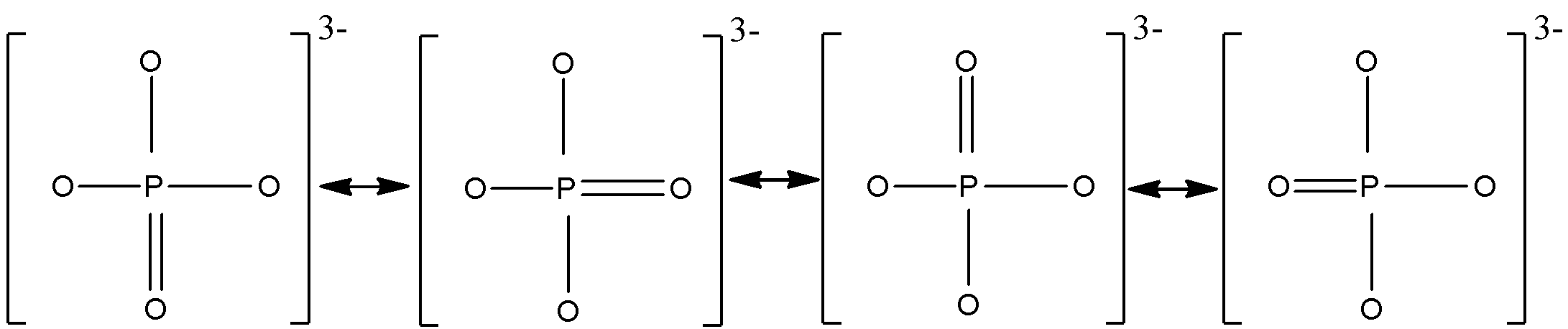
\[\text{Bond order = }\dfrac{\text{number of bonds}}{\text{number of resonating structures}}\]
Total number of bonds $=5$
Number of resonating structures $=4$
Therefore, $\text{Bond order = }\dfrac{5}{4}=1.25$
Since we know that \[\text{Effective charge = }\dfrac{\text{total charge on ion}}{\text{total no}\text{. of O atoms}}\]
In these resonance hybrid structures, a total of -3 charge is distributed over 4 oxygen atoms. Hence, the effective charge of each O atom is $\dfrac{-3}{4}=-0.75$
Hence, in $P{{O}^{3-}}$ ion, the effective charge on each oxygen atom and P-O bond order respectively are (-0.75), 1.25 respectively.
Therefore, the correct answer is option (A) (-0.75), 1.25
Additional information:
Bond order is the number of chemical bonds between a pair of atoms and depicts the stability of a bond. When bond order is zero, the molecule cannot form. The higher bond orders indicate greater stability for the chemical species. In molecules that have resonance bonding, the bond order may not be an integer. In molecular orbital theory (MOT), bond order is described as half the difference between the no. of bonding electrons and the no. of antibonding electrons.
Note:
Formal charge on each atom can be calculated by the following formula-
\[FC=\text{ No}\text{. of valence electrons on atom - unshared electrons - number of bonds}\]
The formal charge on an atom in a molecule is important as it shows the electron count associated with the atom as compared to the isolated neutral atom.
Alternatively, Bond order in this question can be calculated as :\[\text{Bond order = }\dfrac{\text{number of bonds}}{\text{number of bonding groups}}=\dfrac{5}{4}=1.25\]
\[\text{Effective charge = }\dfrac{\text{total charge on ion}}{\text{total no}\text{. of O atoms}}\]
Complete answer:
Firstly, draw all the resonating structures of $P{{O}^{3-}}$ ion:
\[\text{Bond order = }\dfrac{\text{number of bonds}}{\text{number of resonating structures}}\]
Total number of bonds $=5$
Number of resonating structures $=4$
Therefore, $\text{Bond order = }\dfrac{5}{4}=1.25$
Since we know that \[\text{Effective charge = }\dfrac{\text{total charge on ion}}{\text{total no}\text{. of O atoms}}\]
In these resonance hybrid structures, a total of -3 charge is distributed over 4 oxygen atoms. Hence, the effective charge of each O atom is $\dfrac{-3}{4}=-0.75$
Hence, in $P{{O}^{3-}}$ ion, the effective charge on each oxygen atom and P-O bond order respectively are (-0.75), 1.25 respectively.
Therefore, the correct answer is option (A) (-0.75), 1.25
Additional information:
Bond order is the number of chemical bonds between a pair of atoms and depicts the stability of a bond. When bond order is zero, the molecule cannot form. The higher bond orders indicate greater stability for the chemical species. In molecules that have resonance bonding, the bond order may not be an integer. In molecular orbital theory (MOT), bond order is described as half the difference between the no. of bonding electrons and the no. of antibonding electrons.
Note:
Formal charge on each atom can be calculated by the following formula-
\[FC=\text{ No}\text{. of valence electrons on atom - unshared electrons - number of bonds}\]
The formal charge on an atom in a molecule is important as it shows the electron count associated with the atom as compared to the isolated neutral atom.
Alternatively, Bond order in this question can be calculated as :\[\text{Bond order = }\dfrac{\text{number of bonds}}{\text{number of bonding groups}}=\dfrac{5}{4}=1.25\]
Recently Updated Pages
If x a + bt + ct2 where x is in meters and t is in class 11 physics CBSE

A car covers the first half distance between two places class 11 physics CBSE
The resultant of two vectors overrightarrow P and overrightarrow class 11 physics CBSE
Find the value of cos 135 class 11 maths CBSE
A mass M is held in place by an applied force F and class 11 physics CBSE
A solution of glucose in water is labelled as 10 dfracwv class 11 chemistry CBSE
Trending doubts
One Metric ton is equal to kg A 10000 B 1000 C 100 class 11 physics CBSE
Find the value of the expression given below sin 30circ class 11 maths CBSE
What do you mean by retardation What is its SI uni class 11 physics CBSE
Draw a diagram of nephron and explain its structur class 11 biology CBSE
10 examples of friction in our daily life
Difference between physical and chemical change class 11 chemistry CBSE