




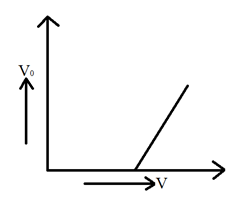
In photoelectric effect the slope of straight line graph between stopping potential $4({{V}_{0}})$ and frequency of incident light $(V)$ gives:
A. Charge on electron
B. Work function of emitter
C. Planck’s Constant
D. Ratio of Planck’s constant to charge on electrons
Answer
 Verified
617.4k+ views
Hint: The solution to this question can be obtained with the help of Photoelectric Equation. Using the photoelectric equation, we can find the slope of the graph shown above, just modify the equation in such a way, such that the modified equation represents the equation of a line. Once the equation of a line is obtained, we can know the slope from that equation.
Formula used:
$hv=h{{v}_{0}}+K.E.$
Complete Step-by-Step solution:
From the data given in the question, the kinetic energy is:
$K.E.=e{{V}_{0}}$
Where, $e$ is the charge of electrons.
Now,
We know that, by photoelectric equation we have:
$hv=h{{v}_{0}}+K.E.$
Substituting the value of kinetic energy in the equation, we get:
$\begin{align}
& hv=W+e{{V}_{0}} \\
& \Rightarrow e{{V}_{0}}=hv-W \\
& \Rightarrow {{V}_{0}}=\left( \dfrac{h}{e} \right)v+\left( \dfrac{-W}{e} \right) \\
\end{align}$
We also know that the equation of straight line can be written as:
$y=mx+c$
Hence, after comparing both the equation, we get:
$m=\dfrac{h}{e}$
which means, slope is the ratio of Planck’s constant to charge of electrons.
Therefore, the correct answer is Option (D).
Additional Information:
The photoelectric effect is the emission of electrons when electromagnetic radiation, such as light, hits a material. Electrons emitted in this manner are called photoelectrons. The phenomenon is studied in condensed matter physics, and solid state and quantum chemistry to draw inferences about the properties of atoms, molecules and solids. The effect has found use in electronic devices specialized for light detection and precisely timed electron emission.
Note:
To get the solution for this question, first understand the graph and then from that understanding find out which equation will help to get the slope of the straight line. Main part of this question is to guess the equation that should be used. Once the correct equation is guessed, it just becomes a simple question of writing the equation in such a way, that it represents the equation of a straight line.
Formula used:
$hv=h{{v}_{0}}+K.E.$
Complete Step-by-Step solution:
From the data given in the question, the kinetic energy is:
$K.E.=e{{V}_{0}}$
Where, $e$ is the charge of electrons.
Now,
We know that, by photoelectric equation we have:
$hv=h{{v}_{0}}+K.E.$
Substituting the value of kinetic energy in the equation, we get:
$\begin{align}
& hv=W+e{{V}_{0}} \\
& \Rightarrow e{{V}_{0}}=hv-W \\
& \Rightarrow {{V}_{0}}=\left( \dfrac{h}{e} \right)v+\left( \dfrac{-W}{e} \right) \\
\end{align}$
We also know that the equation of straight line can be written as:
$y=mx+c$
Hence, after comparing both the equation, we get:
$m=\dfrac{h}{e}$
which means, slope is the ratio of Planck’s constant to charge of electrons.
Therefore, the correct answer is Option (D).
Additional Information:
The photoelectric effect is the emission of electrons when electromagnetic radiation, such as light, hits a material. Electrons emitted in this manner are called photoelectrons. The phenomenon is studied in condensed matter physics, and solid state and quantum chemistry to draw inferences about the properties of atoms, molecules and solids. The effect has found use in electronic devices specialized for light detection and precisely timed electron emission.
Note:
To get the solution for this question, first understand the graph and then from that understanding find out which equation will help to get the slope of the straight line. Main part of this question is to guess the equation that should be used. Once the correct equation is guessed, it just becomes a simple question of writing the equation in such a way, that it represents the equation of a straight line.
Recently Updated Pages
Basicity of sulphurous acid and sulphuric acid are

Master Class 12 Economics: Engaging Questions & Answers for Success
Master Class 12 Biology: Engaging Questions & Answers for Success
Master Class 11 English: Engaging Questions & Answers for Success
Master Class 11 Physics: Engaging Questions & Answers for Success
Master Class 11 Computer Science: Engaging Questions & Answers for Success
Trending doubts
Draw a labelled sketch of the human eye class 12 physics CBSE
The chemical formula of tear gas is A CO Cl 2 B C 10 class 12 chemistry CBSE
Draw ray diagrams each showing i myopic eye and ii class 12 physics CBSE
Which are the Top 10 Largest Countries of the World?
Differentiate between homogeneous and heterogeneous class 12 chemistry CBSE
Which is the correct genotypic ratio of mendel dihybrid class 12 biology CBSE