



In parallelogram \[MNOP\], \[MN\] is a part of Line \[L\].
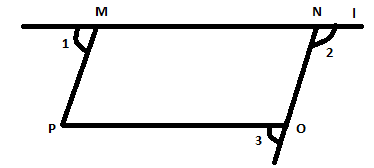
A) Find the measure of \[\angle 1 + \angle 2\].
B) Find the measure of \[\angle 2 + \angle 3\] .
Answer
 Verified
609k+ views
Hint: In this question, we have to find the measure of addition of angles. We are going to solve this problem by using some geometrical properties.
If two parallel lines are intersected by one line the corresponding angles are equal.
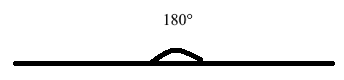
If we consider the angle over a straight line it is \[180^\circ \].
Thus we can use these two ideas to solve the given problem.
Complete step-by-step answer:
It is given that, in the given parallelogram \[MNOP\], \[MN\] is a part of Line $L$.
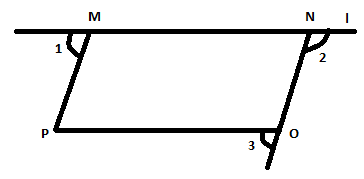
We need to find out the measure of \[\angle 1 + \angle 2\] &\[\angle 2 + \angle 3\].
We know, in a parallelogram opposite sides are parallel.
So we get, \[MP\parallel NO\] and \[MN\parallel PO\].
A) Thus, \[MP\parallel NO\] and \[L\] is the intersecting line.
We know, when the two lines being crossed by one line are Parallel Lines the Corresponding Angles are equal.
Thus \[\angle 1 = \angle MNO\]
Again, since the angle over a straight line is \[180^\circ \], \[\angle MNO + \angle 2 = 180^\circ \]
Therefore, \[\angle 1 + \angle 2 = 180^\circ \][using, \[\angle 1 = \angle MNO\]]
B) We have, \[MN\parallel PO\] and \[NO\] is the intersecting line.
We know, when the two lines being crossed by one line are Parallel Lines the Corresponding Angles are equal.
Thus \[\angle 3 = \angle MNO\]
Again, since the angle over a straight line is \[180^\circ \], \[\angle MNO + \angle 2 = 180^\circ \]
Therefore, \[\angle 3 + \angle 2 = 180^\circ \] [using, \[\angle 3 = \angle MNO\]]
Hence, the measure of \[\angle 1 + \angle 2\] is \[180^\circ \]
The measure of \[\angle 2 + \angle 3\] is \[180^\circ \].
Note: Here we are finding the measure of two angles by doing addition. So we must use the diagram for our understanding. We have made it clear and simple with the given attributes.
Corresponding angles are the angles which are formed in matching corners or corresponding corners with the transversal when two parallel lines are intersected by any other line.
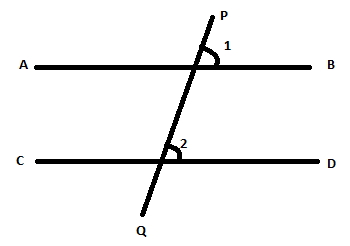
Here \[\angle 1\& \angle 2\] are corresponding angles.
When the two lines being crossed by one line are Parallel Lines the Corresponding Angles are equal.
Thus, here \[\angle 1 = \angle 2\]
If two parallel lines are intersected by one line the corresponding angles are equal.
If we consider the angle over a straight line it is \[180^\circ \].
Thus we can use these two ideas to solve the given problem.
Complete step-by-step answer:
It is given that, in the given parallelogram \[MNOP\], \[MN\] is a part of Line $L$.
We need to find out the measure of \[\angle 1 + \angle 2\] &\[\angle 2 + \angle 3\].
We know, in a parallelogram opposite sides are parallel.
So we get, \[MP\parallel NO\] and \[MN\parallel PO\].
A) Thus, \[MP\parallel NO\] and \[L\] is the intersecting line.
We know, when the two lines being crossed by one line are Parallel Lines the Corresponding Angles are equal.
Thus \[\angle 1 = \angle MNO\]
Again, since the angle over a straight line is \[180^\circ \], \[\angle MNO + \angle 2 = 180^\circ \]
Therefore, \[\angle 1 + \angle 2 = 180^\circ \][using, \[\angle 1 = \angle MNO\]]
B) We have, \[MN\parallel PO\] and \[NO\] is the intersecting line.
We know, when the two lines being crossed by one line are Parallel Lines the Corresponding Angles are equal.
Thus \[\angle 3 = \angle MNO\]
Again, since the angle over a straight line is \[180^\circ \], \[\angle MNO + \angle 2 = 180^\circ \]
Therefore, \[\angle 3 + \angle 2 = 180^\circ \] [using, \[\angle 3 = \angle MNO\]]
Hence, the measure of \[\angle 1 + \angle 2\] is \[180^\circ \]
The measure of \[\angle 2 + \angle 3\] is \[180^\circ \].
Note: Here we are finding the measure of two angles by doing addition. So we must use the diagram for our understanding. We have made it clear and simple with the given attributes.
Corresponding angles are the angles which are formed in matching corners or corresponding corners with the transversal when two parallel lines are intersected by any other line.
Here \[\angle 1\& \angle 2\] are corresponding angles.
When the two lines being crossed by one line are Parallel Lines the Corresponding Angles are equal.
Thus, here \[\angle 1 = \angle 2\]
Recently Updated Pages
Master Class 12 Business Studies: Engaging Questions & Answers for Success

Master Class 12 Biology: Engaging Questions & Answers for Success
Master Class 12 Chemistry: Engaging Questions & Answers for Success
Class 12 Question and Answer - Your Ultimate Solutions Guide
Master Class 11 Social Science: Engaging Questions & Answers for Success
Master Class 11 English: Engaging Questions & Answers for Success
Trending doubts
What is the Full Form of ICSE / ISC ?
Fill the blanks with the suitable prepositions 1 The class 9 english CBSE
Difference Between Plant Cell and Animal Cell
How many hours before the closure of election must class 9 social science CBSE
What is pollution? How many types of pollution? Define it
Name 10 Living and Non living things class 9 biology CBSE