




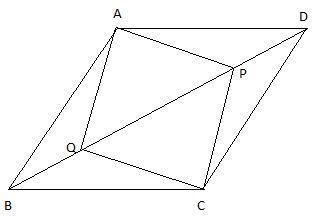
In parallelogram ABCD, two points P and Q are taken on diagonal BD such that DP = BQ. Show that AQ = CP.
Answer
 Verified
620.7k+ views
Hint: Draw the diagonal AC and assume that it intersects the diagonal BD at O. To prove that AQ = CP, prove that quadrilateral AQCP is also a parallelogram by proving PO = QO. Use the property of parallelogram that ‘diagonals of a parallelogram bisect each other’.
Complete step-by-step solution -
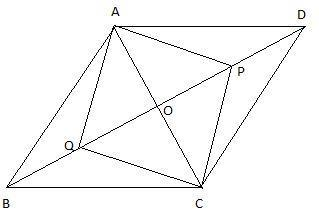
Let us construct or join the diagonal AC of the parallelogram which intersects the diagonal BD at O. we know that diagonals of a parallelogram bisect each other. Therefore, BO = DO and AO = CO.
We have been given that, DP = BQ. Therefore,
$\begin{align}
& BO-BQ=DO-DP \\
& \Rightarrow OQ=OP \\
\end{align}$
Hence, we can say that the diagonal QP of the quadrilateral AQCP is bisected at point O. Also, it is already known that AO = CO. Therefore, the conclusion is that diagonals AC and PQ of the quadrilateral AQCP bisect each other. Hence, AQCP is a parallelogram.
Now, we know that opposite sides of a parallelogram are equal. Therefore, AQ = CP.
Note: One may note that there are certain quadrilaterals whose diagonals bisect each other but here we have assumed the quadrilateral as a parallelogram because this is the basic property of a parallelogram. Other special quadrilaterals have certain other properties which we are not able to prove here because of limited information. So, if we have to prove that a quadrilateral is a parallelogram, we just prove that its diagonals bisect each other.
Complete step-by-step solution -
Let us construct or join the diagonal AC of the parallelogram which intersects the diagonal BD at O. we know that diagonals of a parallelogram bisect each other. Therefore, BO = DO and AO = CO.
We have been given that, DP = BQ. Therefore,
$\begin{align}
& BO-BQ=DO-DP \\
& \Rightarrow OQ=OP \\
\end{align}$
Hence, we can say that the diagonal QP of the quadrilateral AQCP is bisected at point O. Also, it is already known that AO = CO. Therefore, the conclusion is that diagonals AC and PQ of the quadrilateral AQCP bisect each other. Hence, AQCP is a parallelogram.
Now, we know that opposite sides of a parallelogram are equal. Therefore, AQ = CP.
Note: One may note that there are certain quadrilaterals whose diagonals bisect each other but here we have assumed the quadrilateral as a parallelogram because this is the basic property of a parallelogram. Other special quadrilaterals have certain other properties which we are not able to prove here because of limited information. So, if we have to prove that a quadrilateral is a parallelogram, we just prove that its diagonals bisect each other.
Recently Updated Pages
Basicity of sulphurous acid and sulphuric acid are

Master Class 10 English: Engaging Questions & Answers for Success
Master Class 10 Social Science: Engaging Questions & Answers for Success
Master Class 10 Computer Science: Engaging Questions & Answers for Success
Class 10 Question and Answer - Your Ultimate Solutions Guide
Master Class 10 General Knowledge: Engaging Questions & Answers for Success
Trending doubts
Who is known as the "Little Master" in Indian cricket history?
Explain the Treaty of Vienna of 1815 class 10 social science CBSE
A boat goes 24 km upstream and 28 km downstream in class 10 maths CBSE
Which are the three major ports of Tamil Nadu A Chennai class 10 social science CBSE
The highest dam in India is A Bhakra dam B Tehri dam class 10 social science CBSE
Describe the process of Unification of Italy class 10 social science CBSE