



In parallelogram ABCD the length of the diagonal AC is 8.75 cm and distance of vertex B from AC is 7.5 cm. Find the area of parallelogram ABCD.
Answer
 Verified
597.6k+ views
Hint: In this question a diagonal line is drawn through the parallelogram so the parallelogram will be divided into two triangles whose base will be the diagonal line and the height will be the line which is drawn from the congruent vertex and by using this base and the height we will find the area of the parallelogram.
Complete step-by-step answer:
Length of the diagonal AC is\[d = 8.75cm\]
Distance of the vertex B from AC is \[l = 7.5cm\]
We know when we will draw a diagonal AC in the parallelogram ABCD then the parallelogram will be divided into triangles ABC and ACD as shown in the diagram below and the area of two triangles will be equal \[\Delta ABC = \Delta ACD\]
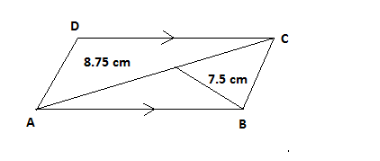
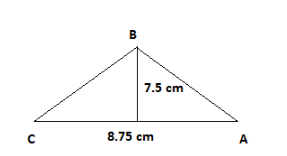
Now from the figure we can see the two triangles ABC and ACD share the same base which is the diagonal AC of the parallelogram and if we consider \[\Delta ABC\] we can say the base of the triangle will be the length of the diagonal AC
\[base = d = 8.75cm\]
And the line from the vertex B to the line AC will be the then height of the triangle
\[height = l = 7.5cm\]
We know that the area of the triangle is calculated by the formula
\[A = \dfrac{1}{2} \times b \times h\]
So the area of the triangle ABC will be equal to
\[
\Rightarrow Area\left( {ABC} \right) = \dfrac{1}{2} \times base \times height \\
= \dfrac{1}{2} \times 8.75 \times 7.5 \\
= 32.81c{m^2} \;
\]
Hence the area of \[\Delta ABC = 32.81c{m^2}\]
Now since we know a diagonal cuts a parallelogram into two equal triangles, hence we can say
\[\Delta ABC = \Delta ACD = 32.81c{m^2}\]
Hence the area of the parallelogram will be equal to
\[\Rightarrow \Delta ABC + \Delta ACD = 32.81c{m^2} + 32.81c{m^2} = 65.62c{m^2}\]
Therefore area of parallelogram ABCD \[ = 65.62c{m^2}\]
Note: A parallelogram is a quadrilateral having two pairs of parallel sides but is it different from a square as the sides are not at 90 degrees. A diagonal divides a parallelogram into two congruent triangles whose area will be equal.
Complete step-by-step answer:
Length of the diagonal AC is\[d = 8.75cm\]
Distance of the vertex B from AC is \[l = 7.5cm\]
We know when we will draw a diagonal AC in the parallelogram ABCD then the parallelogram will be divided into triangles ABC and ACD as shown in the diagram below and the area of two triangles will be equal \[\Delta ABC = \Delta ACD\]
Now from the figure we can see the two triangles ABC and ACD share the same base which is the diagonal AC of the parallelogram and if we consider \[\Delta ABC\] we can say the base of the triangle will be the length of the diagonal AC
\[base = d = 8.75cm\]
And the line from the vertex B to the line AC will be the then height of the triangle
\[height = l = 7.5cm\]
We know that the area of the triangle is calculated by the formula
\[A = \dfrac{1}{2} \times b \times h\]
So the area of the triangle ABC will be equal to
\[
\Rightarrow Area\left( {ABC} \right) = \dfrac{1}{2} \times base \times height \\
= \dfrac{1}{2} \times 8.75 \times 7.5 \\
= 32.81c{m^2} \;
\]
Hence the area of \[\Delta ABC = 32.81c{m^2}\]
Now since we know a diagonal cuts a parallelogram into two equal triangles, hence we can say
\[\Delta ABC = \Delta ACD = 32.81c{m^2}\]
Hence the area of the parallelogram will be equal to
\[\Rightarrow \Delta ABC + \Delta ACD = 32.81c{m^2} + 32.81c{m^2} = 65.62c{m^2}\]
Therefore area of parallelogram ABCD \[ = 65.62c{m^2}\]
Note: A parallelogram is a quadrilateral having two pairs of parallel sides but is it different from a square as the sides are not at 90 degrees. A diagonal divides a parallelogram into two congruent triangles whose area will be equal.
Recently Updated Pages
Three beakers labelled as A B and C each containing 25 mL of water were taken A small amount of NaOH anhydrous CuSO4 and NaCl were added to the beakers A B and C respectively It was observed that there was an increase in the temperature of the solutions contained in beakers A and B whereas in case of beaker C the temperature of the solution falls Which one of the following statements isarecorrect i In beakers A and B exothermic process has occurred ii In beakers A and B endothermic process has occurred iii In beaker C exothermic process has occurred iv In beaker C endothermic process has occurred

Master Class 9 Social Science: Engaging Questions & Answers for Success
Master Class 9 Science: Engaging Questions & Answers for Success
Master Class 9 Maths: Engaging Questions & Answers for Success
Master Class 9 General Knowledge: Engaging Questions & Answers for Success
Class 9 Question and Answer - Your Ultimate Solutions Guide
Three beakers labelled as A B and C each containing 25 mL of water were taken A small amount of NaOH anhydrous CuSO4 and NaCl were added to the beakers A B and C respectively It was observed that there was an increase in the temperature of the solutions contained in beakers A and B whereas in case of beaker C the temperature of the solution falls Which one of the following statements isarecorrect i In beakers A and B exothermic process has occurred ii In beakers A and B endothermic process has occurred iii In beaker C exothermic process has occurred iv In beaker C endothermic process has occurred
Master Class 9 Social Science: Engaging Questions & Answers for Success
Master Class 9 Science: Engaging Questions & Answers for Success