




In optical fibers, propagation of light is due to
A. Diffraction
B. Total internal reflection
C. Reflection
D. Refraction
Answer
 Verified
654.6k+ views
Hint: We know that the optical fibers are an extremely thin and long strand of very fine quality glass or quartz coated within a thin layer of material of refractive index less than the refractive index of the strand. It works on the principle of TIR (total internal reflection).
Complete step by step answer:
In optical fibers, propagation of light takes place due to total internal reflection. When light falls one end of the optical fiber; it gets refracted into the fiber. The refracted ray of light falls on the interface separating the fiber and coating an angle which is greater than the critical angle. Thus the TIR can take place. The light travels the entire length of the fiber and arrives at other ends of the fiber without any loss in its intensity even if the fiber is rounded and curved.
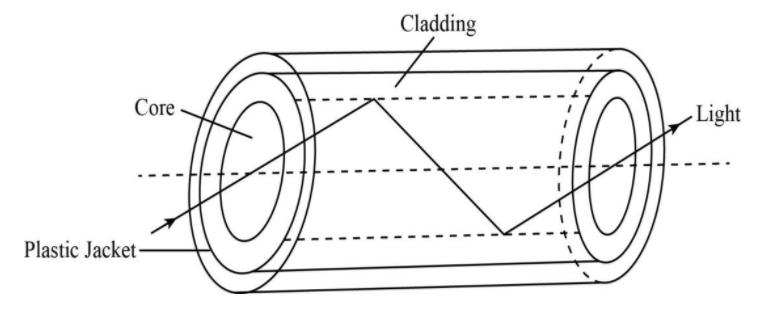
Here the thin fiber of optical fiber is called core. The coating or surrounding layer of optical fiber is known as cladding. The refractive index of the typical core of the fiber is 1.458 and that of cladding 1.440. The sleeve containing a bundle of optical fibers is called a light pipe.
Additional information: Here the phenomenon of TIR is defined as when a ray of light travelling from denser to a rarer medium is sent back to the same denser medium if it strikes the interface of the rare and denser medium at an angle greater than the critical angle. It has two necessary conditions:
i) The light must travel from denser to rarer.
ii) The angle of incidence must be greater than the critical angle.
Note: There are two limitations that an optical fiber has. The first one is the actual loss of light as it travels through the fiber and the other one is a maximum limit of the bandwidth of the signals that can be carried.
Complete step by step answer:
In optical fibers, propagation of light takes place due to total internal reflection. When light falls one end of the optical fiber; it gets refracted into the fiber. The refracted ray of light falls on the interface separating the fiber and coating an angle which is greater than the critical angle. Thus the TIR can take place. The light travels the entire length of the fiber and arrives at other ends of the fiber without any loss in its intensity even if the fiber is rounded and curved.
Here the thin fiber of optical fiber is called core. The coating or surrounding layer of optical fiber is known as cladding. The refractive index of the typical core of the fiber is 1.458 and that of cladding 1.440. The sleeve containing a bundle of optical fibers is called a light pipe.
Additional information: Here the phenomenon of TIR is defined as when a ray of light travelling from denser to a rarer medium is sent back to the same denser medium if it strikes the interface of the rare and denser medium at an angle greater than the critical angle. It has two necessary conditions:
i) The light must travel from denser to rarer.
ii) The angle of incidence must be greater than the critical angle.
Note: There are two limitations that an optical fiber has. The first one is the actual loss of light as it travels through the fiber and the other one is a maximum limit of the bandwidth of the signals that can be carried.
Recently Updated Pages
Master Class 12 Economics: Engaging Questions & Answers for Success

Master Class 12 Social Science: Engaging Questions & Answers for Success
Master Class 12 English: Engaging Questions & Answers for Success
Master Class 12 Maths: Engaging Questions & Answers for Success
Master Class 12 Physics: Engaging Questions & Answers for Success
Master Class 12 Biology: Engaging Questions & Answers for Success
Trending doubts
Draw a labelled sketch of the human eye class 12 physics CBSE
Which are the Top 10 Largest Countries of the World?
Draw ray diagrams each showing i myopic eye and ii class 12 physics CBSE
Which is the correct genotypic ratio of mendel dihybrid class 12 biology CBSE
Differentiate between homogeneous and heterogeneous class 12 chemistry CBSE
Which animal never drinks water in its entire life class 12 biology CBSE