




In one plant, adventitious roots are modified for storage and in the other plant it has a lateral branch with short internodes with each node bearing a rosette of leaves and a tuft of roots. Respectively, they are:
(a) Sweet Potato and Pistia
(b) Eichhornia and Jasmine
(c) Carrot and Mint
(d) Turnip and Chrysanthemum
(e) Sweet Potato and Mint
Answer
 Verified
629.1k+ views
Hint: These roots do not arise from the radicle of the embryo but from other parts like the stem and the leaves of the plant and act as the storage organ. They include the sweet root vegetables having starch and the plant belonging to the family Araceae.
Complete answer:
The roots are modified and have a lateral branch consisting of short internodes and each node bears a rosette of leaves and a tuft of roots that are found in the aquatic plants like Pistia and Eichhornia.
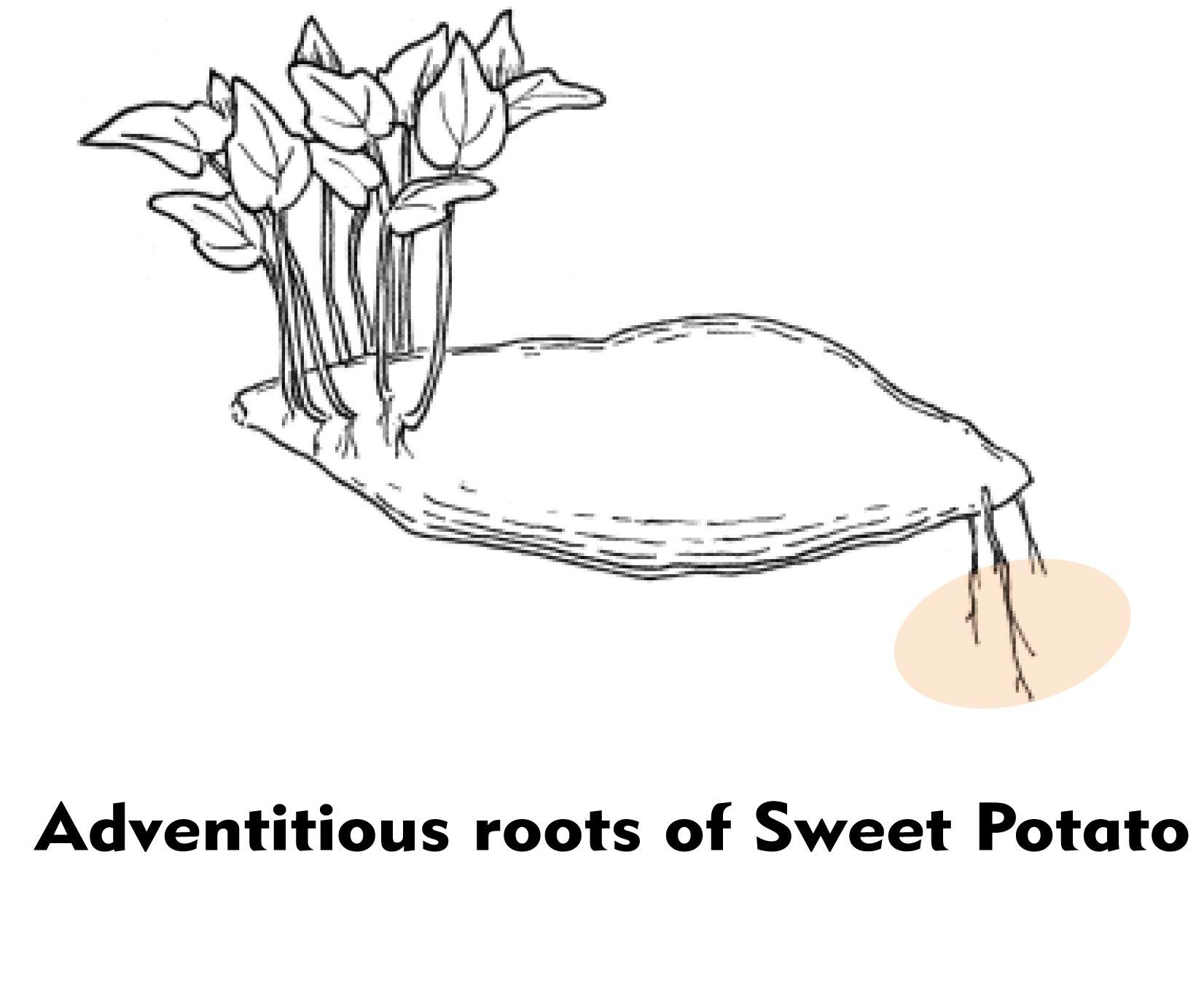
- Sweet potatoes (Ipomea batatas) have adventitious roots that are modified for storage. These roots are swollen and store carbohydrates and nutrients required by the plant.
- Pistia plants, known as water cabbages, are aquatic plants that float on water. They have lateral branches known as offsets, with short internodes, with each node bearing a rosette of leaves and a tuft of roots.
- Eichhornia is also an example of aquatic plants containing offsets. However, it does not have adventitious roots.
- Carrot or Daucus carota is an example of a root vegetable, and it has an edible taproot. Taproots are different from adventitious roots, as they arise from the radicle of the embryo. Turnip is also an example of a taproot.
- Mint plants have stolons or runners, which are a form of stems that grow on the soil surface or just below it, and they form adventitious roots at the nodes. Jasmine plants also have runners for propagation.
- Chrysanthemums also have adventitious roots that are swollen but they do not have offsets.
So, the correct answer is ‘Sweet potato and Pistia’.
Note:
- An important difference between taproot and the adventitious root is that tap roots always grow underground while adventitious roots grow above as well as underground.
- Adventitious roots are useful for nutrient storage, propagation, etc.
Complete answer:
The roots are modified and have a lateral branch consisting of short internodes and each node bears a rosette of leaves and a tuft of roots that are found in the aquatic plants like Pistia and Eichhornia.
- Sweet potatoes (Ipomea batatas) have adventitious roots that are modified for storage. These roots are swollen and store carbohydrates and nutrients required by the plant.
- Pistia plants, known as water cabbages, are aquatic plants that float on water. They have lateral branches known as offsets, with short internodes, with each node bearing a rosette of leaves and a tuft of roots.
- Eichhornia is also an example of aquatic plants containing offsets. However, it does not have adventitious roots.
- Carrot or Daucus carota is an example of a root vegetable, and it has an edible taproot. Taproots are different from adventitious roots, as they arise from the radicle of the embryo. Turnip is also an example of a taproot.
- Mint plants have stolons or runners, which are a form of stems that grow on the soil surface or just below it, and they form adventitious roots at the nodes. Jasmine plants also have runners for propagation.
- Chrysanthemums also have adventitious roots that are swollen but they do not have offsets.
So, the correct answer is ‘Sweet potato and Pistia’.
Note:
- An important difference between taproot and the adventitious root is that tap roots always grow underground while adventitious roots grow above as well as underground.
- Adventitious roots are useful for nutrient storage, propagation, etc.
Recently Updated Pages
Master Class 11 English: Engaging Questions & Answers for Success

Master Class 11 Social Science: Engaging Questions & Answers for Success
Master Class 11 Maths: Engaging Questions & Answers for Success
Master Class 11 Biology: Engaging Questions & Answers for Success
Master Class 11 Physics: Engaging Questions & Answers for Success
Master Class 11 Chemistry: Engaging Questions & Answers for Success
Trending doubts
One Metric ton is equal to kg A 10000 B 1000 C 100 class 11 physics CBSE
Difference Between Prokaryotic Cells and Eukaryotic Cells
Find the value of the expression given below sin 30circ class 11 maths CBSE
Difference between physical and chemical change class 11 chemistry CBSE
Two of the body parts which do not appear in MRI are class 11 biology CBSE
Draw a diagram of a plant cell and label at least eight class 11 biology CBSE