




In mitotic cell division
a. Amount of DNA in the daughter cells will be equal to the parent cell
b. Size will be half of the parent cell
c. DNA will be double of the parent cell
d. Both A and C
Answer
 Verified
586.5k+ views
Hint: Mitosis is a cell cycle, where there is the replication of the chromosomes happened and they divided and separate to form the two nuclei, and genetically identified cells are formed, and daughter cells always have a diploid number of chromosomes.
Complete answer:
Mitosis mainly consists of 4 stages
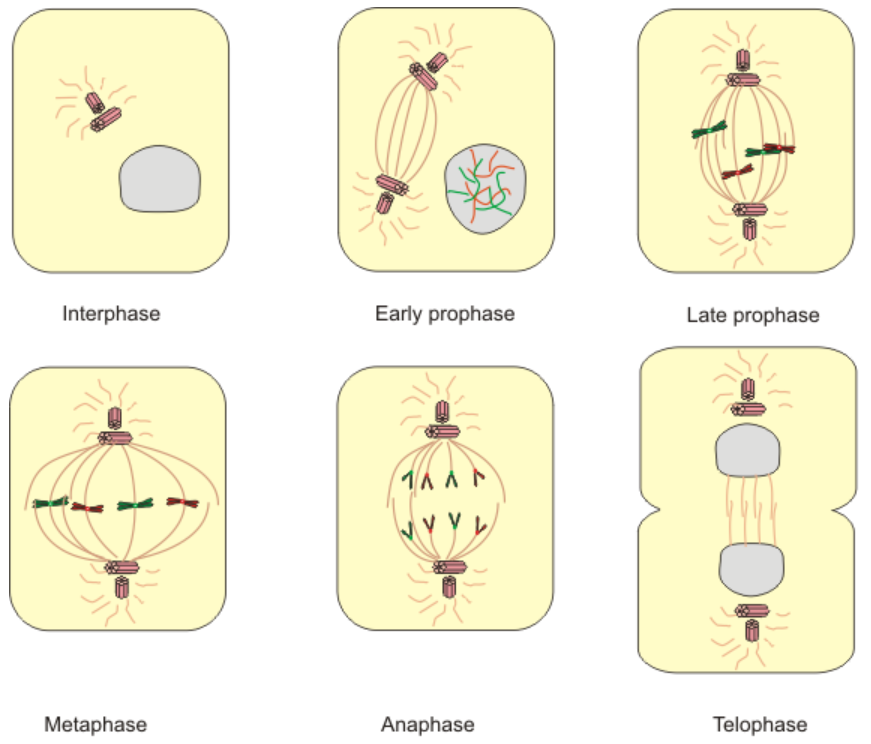
> Prophase: In this phase all the chromatin material undergoes condensation and mitotic spindles begin to appear.
- Centrioles move to the opposite poles and the nuclear membrane starts to break down.
> Metaphase: In prometaphase, microtubules have been located and attached to the kinetochores and the centrioles begin pulling the chromosome towards the opposite end of the cells.
In this phase, chromosomes align along the metaphase line or equatorial plate.
> Anaphase: During this phase, the cohesins that attach to the sister chromatids begin to cleave.
During this phase, the polar microtubules are pushed against each other so that the cell elongates and during the late anaphase chromosomes reach the overall condensation to help the chromosomal segregation and nucleus formation.
> Telophase: It is the reversal of prophase and prometaphase events
At telophase, the polar microtubules continue to lengthen and elongate the cell even more.
The nuclear membrane begins to form with the help of membrane vesicles and the nucleolus begins to reappear and chromosomes separated and the nuclear membrane starts enclosing the chromosomes. Each nucleus has daughter chromosomes that are identical to the mother and the mitosis ends.
Hence, the correct answer is option (A).
Note: After the completion of the mitosis, another process called cytokinesis begins takes place, it is not a phase of mitosis, where it is a separate process that includes in the cell division, division of the nucleus takes place in mitosis, and here division of cytoplasm takes place.
Complete answer:
Mitosis mainly consists of 4 stages
> Prophase: In this phase all the chromatin material undergoes condensation and mitotic spindles begin to appear.
- Centrioles move to the opposite poles and the nuclear membrane starts to break down.
> Metaphase: In prometaphase, microtubules have been located and attached to the kinetochores and the centrioles begin pulling the chromosome towards the opposite end of the cells.
In this phase, chromosomes align along the metaphase line or equatorial plate.
> Anaphase: During this phase, the cohesins that attach to the sister chromatids begin to cleave.
During this phase, the polar microtubules are pushed against each other so that the cell elongates and during the late anaphase chromosomes reach the overall condensation to help the chromosomal segregation and nucleus formation.
> Telophase: It is the reversal of prophase and prometaphase events
At telophase, the polar microtubules continue to lengthen and elongate the cell even more.
The nuclear membrane begins to form with the help of membrane vesicles and the nucleolus begins to reappear and chromosomes separated and the nuclear membrane starts enclosing the chromosomes. Each nucleus has daughter chromosomes that are identical to the mother and the mitosis ends.
Hence, the correct answer is option (A).
Note: After the completion of the mitosis, another process called cytokinesis begins takes place, it is not a phase of mitosis, where it is a separate process that includes in the cell division, division of the nucleus takes place in mitosis, and here division of cytoplasm takes place.
Recently Updated Pages
Master Class 11 Computer Science: Engaging Questions & Answers for Success

Master Class 11 Business Studies: Engaging Questions & Answers for Success
Master Class 11 Economics: Engaging Questions & Answers for Success
Master Class 11 English: Engaging Questions & Answers for Success
Master Class 11 Maths: Engaging Questions & Answers for Success
Master Class 11 Biology: Engaging Questions & Answers for Success
Trending doubts
There are 720 permutations of the digits 1 2 3 4 5 class 11 maths CBSE
Discuss the various forms of bacteria class 11 biology CBSE
Explain zero factorial class 11 maths CBSE
What organs are located on the left side of your body class 11 biology CBSE
Draw a diagram of nephron and explain its structur class 11 biology CBSE
How do I convert ms to kmh Give an example class 11 physics CBSE