




In man, ribs are attached to ___
A. Clavicle
B. Ileum
C. Sternum
D. Scapula
Answer
 Verified
479.1k+ views
Hint: The rib cage is a hard and cartilaginous design that encompasses the thoracic cavity and supports the shoulder support to shape the center part. Ribs are made up of bones which form the rib cage, it is part of the axial skeleton. The rib cage provides safety to internal organs. The ribs are arranged into true ribs, false ribs and floating ribs.
Complete answer:
• The human rib cage comprises 24 ribs in 12 sets. The skeletal arrangement of humans comprises a system of bones and barely any ligaments. The skeletal system comprises 206 bones and a couple of ligaments. They are grouped into axial and appendicular skeletons.
• The skull, vertebrae, sternum, and ribs comprise the axial skeleton. Bones of appendages alongside their supports comprise the appendicular skeleton.
• Each rib is a slim and flattened bone associated dorsally to the vertebral column and ventrally to the sternum. It has two surfaces on its dorsal end and is consequently called bicephalic.
• Initially, seven sets of ribs are called true ribs. Dorsally they are joined to thoracic vertebrae and ventrally associated with the sternum with the assistance of the hyaline ligament.
• The eighth, ninth, and tenth sets of ribs don't attach straightforwardly with the sternum; however, along with the seventh rib they join together with the help of hyaline ligament. These are called false ribs.
• The last two sets of ribs are not attached ventrally to anything and are hence called floating ribs.
• Thoracic vertebrae, ribs, and sternum together form a structure called the rib cage. The space between the ribs is known as intercostal spaces; they contain intercostal muscles and neurovascular packs containing nerves and vessels.
• At the front of the body, the greater part of the ribs are joined by the costal ligament to the sternum, which is shown in the below image.
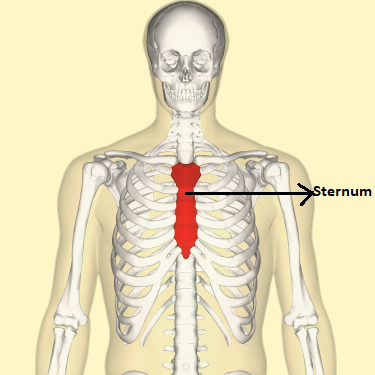
Therefore, option (C) is correct.
Note:
Rib cage plays an important role in respiration along with intercostal muscles and diaphragm. It also protects the heart, lungs, and stomach. Each rib comprises a head, neck, and shaft. The rib cage of human males has a larger capacity as compared to females, that is the reason males can inhale and exhale more air as compared to their female counterparts.
Complete answer:
• The human rib cage comprises 24 ribs in 12 sets. The skeletal arrangement of humans comprises a system of bones and barely any ligaments. The skeletal system comprises 206 bones and a couple of ligaments. They are grouped into axial and appendicular skeletons.
• The skull, vertebrae, sternum, and ribs comprise the axial skeleton. Bones of appendages alongside their supports comprise the appendicular skeleton.
• Each rib is a slim and flattened bone associated dorsally to the vertebral column and ventrally to the sternum. It has two surfaces on its dorsal end and is consequently called bicephalic.
• Initially, seven sets of ribs are called true ribs. Dorsally they are joined to thoracic vertebrae and ventrally associated with the sternum with the assistance of the hyaline ligament.
• The eighth, ninth, and tenth sets of ribs don't attach straightforwardly with the sternum; however, along with the seventh rib they join together with the help of hyaline ligament. These are called false ribs.
• The last two sets of ribs are not attached ventrally to anything and are hence called floating ribs.
• Thoracic vertebrae, ribs, and sternum together form a structure called the rib cage. The space between the ribs is known as intercostal spaces; they contain intercostal muscles and neurovascular packs containing nerves and vessels.
• At the front of the body, the greater part of the ribs are joined by the costal ligament to the sternum, which is shown in the below image.
Therefore, option (C) is correct.
Note:
Rib cage plays an important role in respiration along with intercostal muscles and diaphragm. It also protects the heart, lungs, and stomach. Each rib comprises a head, neck, and shaft. The rib cage of human males has a larger capacity as compared to females, that is the reason males can inhale and exhale more air as compared to their female counterparts.
Recently Updated Pages
Master Class 11 Computer Science: Engaging Questions & Answers for Success

Master Class 11 Business Studies: Engaging Questions & Answers for Success
Master Class 11 Economics: Engaging Questions & Answers for Success
Master Class 11 English: Engaging Questions & Answers for Success
Master Class 11 Maths: Engaging Questions & Answers for Success
Master Class 11 Biology: Engaging Questions & Answers for Success
Trending doubts
One Metric ton is equal to kg A 10000 B 1000 C 100 class 11 physics CBSE
There are 720 permutations of the digits 1 2 3 4 5 class 11 maths CBSE
Discuss the various forms of bacteria class 11 biology CBSE
Draw a diagram of a plant cell and label at least eight class 11 biology CBSE
State the laws of reflection of light
Explain zero factorial class 11 maths CBSE