




In L-C-R series circuit, power factor at resonance is:
A. less than one
B. greater than one
C. unity
D. cannot predict
Answer
 Verified
647.4k+ views
Hint: Power factor is the cosine of the angle between net voltage and the current. At resonance, the magnitudes of ${{V}_{L}}$ and ${{V}_{c}}$ are equal. Since they are in opposite directions, their resultant will be zero. Hence the net voltage vector will be equal to ${{V}_{R}}$. And the angle between ${{V}_{R}}$ and i is zero.
Complete step by step answer:
In an AC circuit, the voltage (potential difference) across the components in the circuit and the current flowing in the circuit are treated as vectors. The phase difference between the current and the voltage across the respective component is the angle between the current vector and the voltage vector of the component.
Since the voltage across the resistance and the current are always in phase, the vectors of voltage of resistance (${{V}_{R}}$) and current (i) are parallel.
There is a phase difference of $+\dfrac{\pi }{2}$ between the inductor voltage and the current. That is the inductor voltage leads the current by a phase of $\dfrac{\pi }{2}$.
Therefore, the vector of inductor voltage (${{V}_{L}}$) is at an angle of $+\dfrac{\pi }{2}$ from the current vector.
There is a phase difference of $-\dfrac{\pi }{2}$ between the capacitor voltage and the current. That is the capacitor voltage lags behind the current by a phase of $\dfrac{\pi }{2}$.
Therefore, the vector of capacitor voltage (${{V}_{c}}$) is at an angle of $-\dfrac{\pi }{2}$ from the current vector.
The entire can be summarised with the help of the diagram given below.
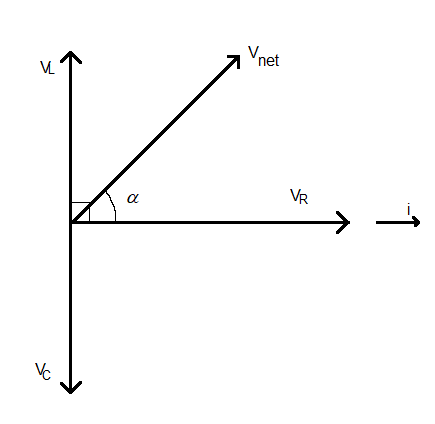
Power factor is equal to $\cos \alpha $. From the diagram we get that
At resonance, the magnitudes of ${{V}_{L}}$ and ${{V}_{c}}$ are equal. Since they are in opposite directions, their resultant will be zero. Hence the net voltage vector will be equal to ${{V}_{R}}$. And the angle between ${{V}_{R}}$ and i is zero.
Hence, $\alpha =0$, which means that $\cos \alpha =\cos 0=1$ .
Therefore, the value of the power factor for the L-C-R series circuit at resonance is equal to one or unity.
Hence, the correct option is C.
Note: Power factor is defined as the ratio of the power consumed by the circuit (resistance) to the power supplied to by the source of the circuit. In other words, is the ratio of the power of heat generated to the power supplied.
Since at resonance the net voltage is only due to the resistance of the circuit, all the power will be consumed by the resistance. Hence, all the energy will be converted into heat and the value of power factor will be maximum.
Therefore, the value of the power factor is one.
Complete step by step answer:
In an AC circuit, the voltage (potential difference) across the components in the circuit and the current flowing in the circuit are treated as vectors. The phase difference between the current and the voltage across the respective component is the angle between the current vector and the voltage vector of the component.
Since the voltage across the resistance and the current are always in phase, the vectors of voltage of resistance (${{V}_{R}}$) and current (i) are parallel.
There is a phase difference of $+\dfrac{\pi }{2}$ between the inductor voltage and the current. That is the inductor voltage leads the current by a phase of $\dfrac{\pi }{2}$.
Therefore, the vector of inductor voltage (${{V}_{L}}$) is at an angle of $+\dfrac{\pi }{2}$ from the current vector.
There is a phase difference of $-\dfrac{\pi }{2}$ between the capacitor voltage and the current. That is the capacitor voltage lags behind the current by a phase of $\dfrac{\pi }{2}$.
Therefore, the vector of capacitor voltage (${{V}_{c}}$) is at an angle of $-\dfrac{\pi }{2}$ from the current vector.
The entire can be summarised with the help of the diagram given below.
Power factor is equal to $\cos \alpha $. From the diagram we get that
At resonance, the magnitudes of ${{V}_{L}}$ and ${{V}_{c}}$ are equal. Since they are in opposite directions, their resultant will be zero. Hence the net voltage vector will be equal to ${{V}_{R}}$. And the angle between ${{V}_{R}}$ and i is zero.
Hence, $\alpha =0$, which means that $\cos \alpha =\cos 0=1$ .
Therefore, the value of the power factor for the L-C-R series circuit at resonance is equal to one or unity.
Hence, the correct option is C.
Note: Power factor is defined as the ratio of the power consumed by the circuit (resistance) to the power supplied to by the source of the circuit. In other words, is the ratio of the power of heat generated to the power supplied.
Since at resonance the net voltage is only due to the resistance of the circuit, all the power will be consumed by the resistance. Hence, all the energy will be converted into heat and the value of power factor will be maximum.
Therefore, the value of the power factor is one.
Recently Updated Pages
Basicity of sulphurous acid and sulphuric acid are

Master Class 12 Economics: Engaging Questions & Answers for Success
Master Class 12 Biology: Engaging Questions & Answers for Success
Master Class 11 English: Engaging Questions & Answers for Success
Master Class 11 Physics: Engaging Questions & Answers for Success
Master Class 11 Computer Science: Engaging Questions & Answers for Success
Trending doubts
Draw a labelled sketch of the human eye class 12 physics CBSE
The chemical formula of tear gas is A CO Cl 2 B C 10 class 12 chemistry CBSE
Draw ray diagrams each showing i myopic eye and ii class 12 physics CBSE
Which are the Top 10 Largest Countries of the World?
Differentiate between homogeneous and heterogeneous class 12 chemistry CBSE
Which is the correct genotypic ratio of mendel dihybrid class 12 biology CBSE