




In insects, Malpighian tubules drain materials directly from the
(a) Gut
(b) Haemocoel
(C) Spider
(d) Jellyfish
Answer
 Verified
558k+ views
Hint: Insects possess an open circulatory system that is devoid of any localized fine structures like blood vessels for the transportation of blood. Malpighian tubules are excretory organs of insects that drain materials directly from the structure which is their main body cavity.
Complete answer:
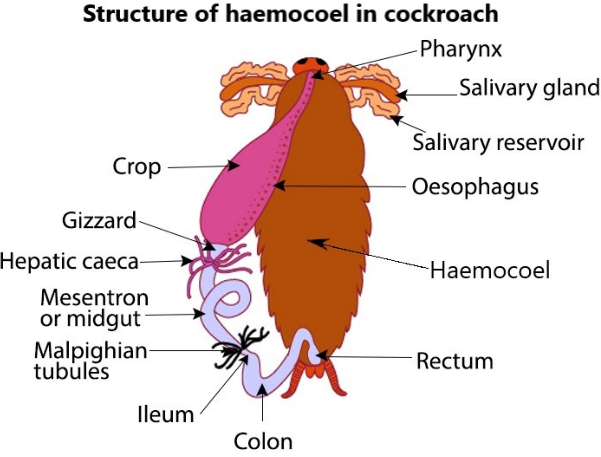
In insects, the malpighian tubules are used to drain materials directly from the haemocoel. Malpighian tubules are slender tube-like structures that perform the functions of removing metabolic nitrogenous wastes from the body. They originate at the junction of the midgut and hindgut. As in insects, there is an open circulatory system i.e the blood does not circulate within blood vessels but is released directly into the spaces or hemocoel which is the main body cavity in insects. No capillaries are present to transport blood or any fluid collected from tissues to the heart. Malpighian tubules branch into thin filamentous tubes to increase the surface area for the absorption of wastes from the blood-filled hemocoel.
Additional Information:
-The blood-filled spaces in arthropods are of three types– dorsal or pericardial sinus, middle or perivisceral sinus, and ventral or perineural sinus. The dorsal sinus encloses the heart, the middle sinus encloses digestive, respiratory, excretory, and reproductive systems, ventral sinus encloses the sterna and nerve cord.
-Hemocoel is filled by hemolymph whose function is comparable to our blood. Just like blood fulfills the nutrients and oxygen requirements of all the cells in our body, hemolymph does the same.
-The only difference is that hemolymph uses copper as the binding agent of oxygen rather than iron in the blood.
So, the correct answer is ‘Haemocoel.’
Note:
-Hemocoel is also found in Mollusca. In mollusks e.g Pila, the blood does not circulate within blood vessels but is collected from the gills and pumped through the heart. It is then released directly into spaces (the hemocoel). No capillaries are present to transport blood or any fluid collected from tissues to the heart.
-Blood is colorless in arthropods and bluish in mollusks due to a respiratory pigment ‘ hemocyanin’.
Complete answer:
In insects, the malpighian tubules are used to drain materials directly from the haemocoel. Malpighian tubules are slender tube-like structures that perform the functions of removing metabolic nitrogenous wastes from the body. They originate at the junction of the midgut and hindgut. As in insects, there is an open circulatory system i.e the blood does not circulate within blood vessels but is released directly into the spaces or hemocoel which is the main body cavity in insects. No capillaries are present to transport blood or any fluid collected from tissues to the heart. Malpighian tubules branch into thin filamentous tubes to increase the surface area for the absorption of wastes from the blood-filled hemocoel.
Additional Information:
-The blood-filled spaces in arthropods are of three types– dorsal or pericardial sinus, middle or perivisceral sinus, and ventral or perineural sinus. The dorsal sinus encloses the heart, the middle sinus encloses digestive, respiratory, excretory, and reproductive systems, ventral sinus encloses the sterna and nerve cord.
-Hemocoel is filled by hemolymph whose function is comparable to our blood. Just like blood fulfills the nutrients and oxygen requirements of all the cells in our body, hemolymph does the same.
-The only difference is that hemolymph uses copper as the binding agent of oxygen rather than iron in the blood.
So, the correct answer is ‘Haemocoel.’
Note:
-Hemocoel is also found in Mollusca. In mollusks e.g Pila, the blood does not circulate within blood vessels but is collected from the gills and pumped through the heart. It is then released directly into spaces (the hemocoel). No capillaries are present to transport blood or any fluid collected from tissues to the heart.
-Blood is colorless in arthropods and bluish in mollusks due to a respiratory pigment ‘ hemocyanin’.
Recently Updated Pages
Master Class 11 Social Science: Engaging Questions & Answers for Success

Master Class 11 English: Engaging Questions & Answers for Success
Master Class 11 Maths: Engaging Questions & Answers for Success
Master Class 11 Chemistry: Engaging Questions & Answers for Success
Master Class 11 Biology: Engaging Questions & Answers for Success
Master Class 11 Physics: Engaging Questions & Answers for Success
Trending doubts
One Metric ton is equal to kg A 10000 B 1000 C 100 class 11 physics CBSE
Difference Between Prokaryotic Cells and Eukaryotic Cells
How many of the following diseases can be studied with class 11 biology CBSE
Draw a diagram of a plant cell and label at least eight class 11 biology CBSE
Two of the body parts which do not appear in MRI are class 11 biology CBSE
Which gas is abundant in air class 11 chemistry CBSE