




In huygens’ eyepiece,
A. The cross wires are outside eyepiece
B. Condition for achromatism is satisfied
C. condition for minimum spherical aberration is not satisfied
D. the image formed by the objective is a virtual image
Answer
 Verified
660k+ views
Hint: Huygens’s eyepiece is a special two lens arrangement that is capable of avoiding chromatic and spherical aberrations. Here the lens on which cross wires are usually made is shifted a bit towards the objective.
Complete step by step answer:
Using a single eye lens in telescopes and microscopes has disadvantages. A lens does not focus all the rays at a single point. Due to the difference in refractive index for different wavelengths of light, the rays get split acid passed through a lens. Also the rays that hit the centre of the lens converge at a different point than the race that hit the outer ends this difference in focal points is called Spherical aberration. Huygens’s eyepiece is a special arrangement of lenses that avoid these issues.
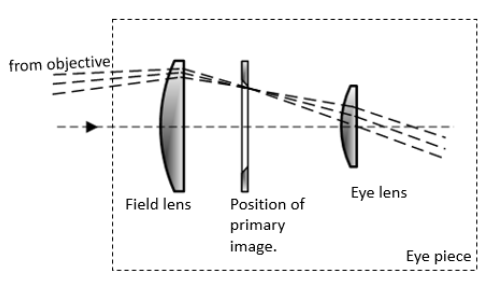
It consists of two plano-convex lenses separated by a small distance. Huygens found that keeping the lenses apart helps in avoiding chromatic aberration.
Also, the special arrangement of lenses at appropriate distances can avoid spherical aberration to the maximum. That means they have minimum spherical aberration.
In microscopes and telescopes, the light is first focused by the objective at a point to form a primary image. A field lens is placed at this point and cross-wires are made on that lens so that when the image is focused, the cross wires would also be under focus. But in the case of Huygens’s eyepiece, the field lens is not at the point of primary image but closer to the objective. So if we make cross-wires on this lens, the cross wires would be blurry and out of focus when we view the image. So cross wires are not present in Huygens’s eyepiece.
The objective of a microscope/telescope is a different lens. It always forms a real image of the object no matter which eyepiece we use. So the objective always forms a real image.
Going through the options, we see that option B is correct.
Note: There are many eyepieces that use two lenses and cross wires are made on the field lens So that they focus along with the image. But this arrangement has the issue that dusts and scratches that are present on the field lens would also appear in the image. In Huygens’s eyepiece, this does not happen.
Complete step by step answer:
Using a single eye lens in telescopes and microscopes has disadvantages. A lens does not focus all the rays at a single point. Due to the difference in refractive index for different wavelengths of light, the rays get split acid passed through a lens. Also the rays that hit the centre of the lens converge at a different point than the race that hit the outer ends this difference in focal points is called Spherical aberration. Huygens’s eyepiece is a special arrangement of lenses that avoid these issues.
It consists of two plano-convex lenses separated by a small distance. Huygens found that keeping the lenses apart helps in avoiding chromatic aberration.
Also, the special arrangement of lenses at appropriate distances can avoid spherical aberration to the maximum. That means they have minimum spherical aberration.
In microscopes and telescopes, the light is first focused by the objective at a point to form a primary image. A field lens is placed at this point and cross-wires are made on that lens so that when the image is focused, the cross wires would also be under focus. But in the case of Huygens’s eyepiece, the field lens is not at the point of primary image but closer to the objective. So if we make cross-wires on this lens, the cross wires would be blurry and out of focus when we view the image. So cross wires are not present in Huygens’s eyepiece.
The objective of a microscope/telescope is a different lens. It always forms a real image of the object no matter which eyepiece we use. So the objective always forms a real image.
Going through the options, we see that option B is correct.
Note: There are many eyepieces that use two lenses and cross wires are made on the field lens So that they focus along with the image. But this arrangement has the issue that dusts and scratches that are present on the field lens would also appear in the image. In Huygens’s eyepiece, this does not happen.
Recently Updated Pages
Master Class 12 Economics: Engaging Questions & Answers for Success

Master Class 12 Social Science: Engaging Questions & Answers for Success
Master Class 12 English: Engaging Questions & Answers for Success
Master Class 12 Maths: Engaging Questions & Answers for Success
Master Class 12 Physics: Engaging Questions & Answers for Success
Master Class 12 Biology: Engaging Questions & Answers for Success
Trending doubts
Draw a labelled sketch of the human eye class 12 physics CBSE
Which are the Top 10 Largest Countries of the World?
Draw ray diagrams each showing i myopic eye and ii class 12 physics CBSE
Which is the correct genotypic ratio of mendel dihybrid class 12 biology CBSE
Differentiate between homogeneous and heterogeneous class 12 chemistry CBSE
Which animal never drinks water in its entire life class 12 biology CBSE