




In gravity free space iron man of mass ‘\[{\text{M}}\]’ standing at the height ‘\[h\]’ above the floor throws a precious stone of mass ‘\[m\]’ straight down with speed \[u\]. When stone reaches the floor, what is the distance of iron man above the floor?
a. $\left( 1 \right){\text{ }}h\left( {1 + \dfrac{m}{M}} \right)$
b. $\left( 2 \right){\text{ }}h\left( {1 - \dfrac{m}{M}} \right)$
c. $\left( 3 \right){\text{ }}h\left( {\dfrac{m}{M}} \right)$
d. $\left( 4 \right){\text{ }}h$
Answer
 Verified
568.8k+ views
Hint: According to the law of conservation of momentum, in an isolated system, the vector sum of linear momentum of all the bodies of the system is conserved and is not affected due to their mutual action or reaction. An isolated system means a system with no external force acting on it.
Complete step by step answer:
In the gravity-free space, there are no particles present in that system. Thus, there is no force acting on the iron man. For a system, the center of mass remains the same if there are no external forces on the system, that is, internal forces cannot change the center of mass of the system.
So we have to say that the net change in the center of \[{\text{mass}}\; = 0\].
It is stated in a question, in a gravity-free space, a man of mass \[{\text{M}}\] standing at a height \[v\] from the ground and releasing a stone of mass m downwards with velocity \[u\], after the release a man is moving little upward with velocity \[{\text{V}}\], because of gravity-free space.
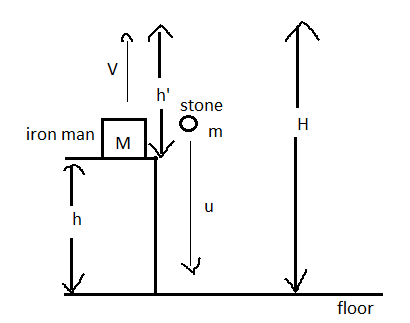
From the law of conservation of momentum,
$MV - mu = 0$
We have to equate the terms we get,
$MV = mu$
Take \[V\]as in RHS and remaining terms are in the LHS, we get
\[V = \dfrac{{mu}}{M}.....\left( 1 \right)\]
Here, \[{\text{M}}\] is the mass of the iron man
\[m\] is the mass of the stone.
\[u\] is the velocity of stone
\[{\text{V}}\] is the velocity of man.
Now, time taken by the stone to reach floor is given by, ${t_{{\text{stone}}}} = \dfrac{d}{v} = \dfrac{h}{u}.....\left( 2 \right)$
In that time, the height reached by the iron man of mass m is given by, $t_{\text{man}} = \dfrac{h^{'}}{V}....\left( 3 \right)$
From the equation \[\left( 2 \right)\] and\[\left( 3 \right)\], the time taken in both cases is the same during the upward and downward motion.
So we can write it as equate form, we get
$\therefore {t_{{\text{stone}}}} = {t_{{\text{man}}}}$
$\dfrac{h}{u} = \dfrac{h^{'}}{V}$
Let us take a cross-multiplication we get,
\[{h^{'}}u = hV\]
Take \[{h^{'}}\] as in RHS and \[u\] in the LHS as divided form we get,
The height reached by the man after releasing the stone from height is given by, ${h^{'}} = \dfrac{h}{u}V....\left( 4 \right)$
Substitute equation \[\left( 1 \right)\]in \[\left( 4 \right)\] we get,
$ \Rightarrow {h^{'}} = \dfrac{h}{u}\left( {\dfrac{{mu}}{M}} \right)$
Cancel the same terms we get,
$ \Rightarrow {h^{'}} = \dfrac{{mh}}{M}....\left( 5 \right)$
Now we have to find out the total height,
The total height from the floor is given by, $H = h + {h^{'}}$
Substitute equation \[\left( 5 \right)\]in the formula for total height we get,
$H = h + \dfrac{{mh}}{M}$
Taking \[h\]as common we can write it as,
$ \Rightarrow H = h\left( {1 + \dfrac{m}{M}} \right)$
Hence, the correct answer is option (A).
Note: Momentum is a property of a moving body, which is a product of mass and velocity. The law of conservation of linear momentum is universal that as it applies to both, microscopic as well as macroscopic systems.
Complete step by step answer:
In the gravity-free space, there are no particles present in that system. Thus, there is no force acting on the iron man. For a system, the center of mass remains the same if there are no external forces on the system, that is, internal forces cannot change the center of mass of the system.
So we have to say that the net change in the center of \[{\text{mass}}\; = 0\].
It is stated in a question, in a gravity-free space, a man of mass \[{\text{M}}\] standing at a height \[v\] from the ground and releasing a stone of mass m downwards with velocity \[u\], after the release a man is moving little upward with velocity \[{\text{V}}\], because of gravity-free space.
From the law of conservation of momentum,
$MV - mu = 0$
We have to equate the terms we get,
$MV = mu$
Take \[V\]as in RHS and remaining terms are in the LHS, we get
\[V = \dfrac{{mu}}{M}.....\left( 1 \right)\]
Here, \[{\text{M}}\] is the mass of the iron man
\[m\] is the mass of the stone.
\[u\] is the velocity of stone
\[{\text{V}}\] is the velocity of man.
Now, time taken by the stone to reach floor is given by, ${t_{{\text{stone}}}} = \dfrac{d}{v} = \dfrac{h}{u}.....\left( 2 \right)$
In that time, the height reached by the iron man of mass m is given by, $t_{\text{man}} = \dfrac{h^{'}}{V}....\left( 3 \right)$
From the equation \[\left( 2 \right)\] and\[\left( 3 \right)\], the time taken in both cases is the same during the upward and downward motion.
So we can write it as equate form, we get
$\therefore {t_{{\text{stone}}}} = {t_{{\text{man}}}}$
$\dfrac{h}{u} = \dfrac{h^{'}}{V}$
Let us take a cross-multiplication we get,
\[{h^{'}}u = hV\]
Take \[{h^{'}}\] as in RHS and \[u\] in the LHS as divided form we get,
The height reached by the man after releasing the stone from height is given by, ${h^{'}} = \dfrac{h}{u}V....\left( 4 \right)$
Substitute equation \[\left( 1 \right)\]in \[\left( 4 \right)\] we get,
$ \Rightarrow {h^{'}} = \dfrac{h}{u}\left( {\dfrac{{mu}}{M}} \right)$
Cancel the same terms we get,
$ \Rightarrow {h^{'}} = \dfrac{{mh}}{M}....\left( 5 \right)$
Now we have to find out the total height,
The total height from the floor is given by, $H = h + {h^{'}}$
Substitute equation \[\left( 5 \right)\]in the formula for total height we get,
$H = h + \dfrac{{mh}}{M}$
Taking \[h\]as common we can write it as,
$ \Rightarrow H = h\left( {1 + \dfrac{m}{M}} \right)$
Hence, the correct answer is option (A).
Note: Momentum is a property of a moving body, which is a product of mass and velocity. The law of conservation of linear momentum is universal that as it applies to both, microscopic as well as macroscopic systems.
Recently Updated Pages
Master Class 11 Computer Science: Engaging Questions & Answers for Success

Master Class 11 Business Studies: Engaging Questions & Answers for Success
Master Class 11 Economics: Engaging Questions & Answers for Success
Master Class 11 English: Engaging Questions & Answers for Success
Master Class 11 Maths: Engaging Questions & Answers for Success
Master Class 11 Biology: Engaging Questions & Answers for Success
Trending doubts
One Metric ton is equal to kg A 10000 B 1000 C 100 class 11 physics CBSE
There are 720 permutations of the digits 1 2 3 4 5 class 11 maths CBSE
Discuss the various forms of bacteria class 11 biology CBSE
Draw a diagram of a plant cell and label at least eight class 11 biology CBSE
State the laws of reflection of light
Explain zero factorial class 11 maths CBSE