




In glycolysis, during oxidation, electrons are removed by -
(a)ATP
(b)Glyceraldehyde-3-Phosphate
(c)${ NAD }^{ + }$
(d)Molecular oxygen
Answer
 Verified
628.5k+ views
Hint: The process of glycolysis occurs in every living cell of the body. It occurs in ten enzyme-catalyzed reactions. During oxidizing reaction, an oxidizing agent accepts electrons and reduces itself in the step catalyzed by glyceraldehyde-3-phosphate dehydrogenase.
Complete answer:
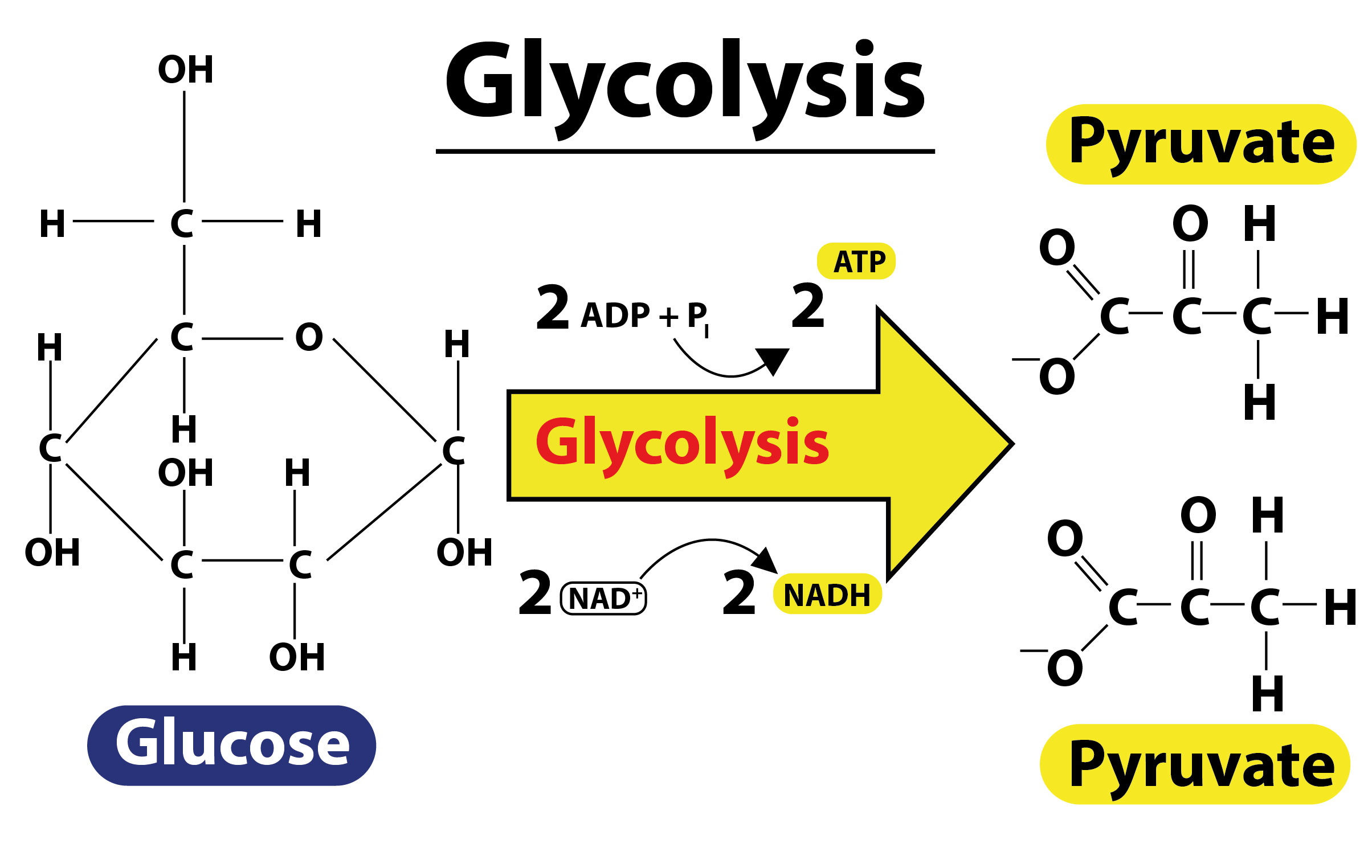
- Glycolysis is the first step in respiration of living cells. It is the metabolic pathway that converts glucose to pyruvate through ten enzyme-catalyzed reactions.
- In the oxidation reaction, glyceraldehyde-3-phosphate is oxidized, resulting in the removal of a pair of electrons by ${ NAD }^{ + }$ and the addition of a phosphate group to form 1,3-diphosphoglyceric acid.
- ${ NAD }^{ + }$ is thus an oxidizing agent which reduces itself by accepting electrons and forming NADH.
- The reaction is given as ${ NAD }^{ + }\quad +\quad { P }_{ i }\quad \overset { Glyceraldehyde\quad 3-phosphate\quad dehydrogenase }{ \longrightarrow } \quad NADH\quad +\quad { H }^{ + }$. As denoted, the reaction is catalyzed by glyceraldehyde 3-phosphate dehydrogenase.
Additional Information:
- In glycolysis, one molecule of glucose produces four ATP, two NADH, and two pyruvate molecules.
- Although four ATP molecules are formed, two molecules of ATP are already used in the first half of glycolysis, thus the net gain is two ATP molecules.
- The two pyruvate molecules formed are further used in starting the Krebs/Citric acid cycle.
So, the correct answer is ‘${ NAD }^{ + }$’.
Note: - Red blood cells, or erythrocytes, are solely reliant on glycolysis as a source of energy because they do not have mitochondria.
- The enzymes involved in glycolysis are rate limiting steps and are needed in sufficient quantities for the reactions to continue.
Complete answer:
- Glycolysis is the first step in respiration of living cells. It is the metabolic pathway that converts glucose to pyruvate through ten enzyme-catalyzed reactions.
- In the oxidation reaction, glyceraldehyde-3-phosphate is oxidized, resulting in the removal of a pair of electrons by ${ NAD }^{ + }$ and the addition of a phosphate group to form 1,3-diphosphoglyceric acid.
- ${ NAD }^{ + }$ is thus an oxidizing agent which reduces itself by accepting electrons and forming NADH.
- The reaction is given as ${ NAD }^{ + }\quad +\quad { P }_{ i }\quad \overset { Glyceraldehyde\quad 3-phosphate\quad dehydrogenase }{ \longrightarrow } \quad NADH\quad +\quad { H }^{ + }$. As denoted, the reaction is catalyzed by glyceraldehyde 3-phosphate dehydrogenase.
Additional Information:
- In glycolysis, one molecule of glucose produces four ATP, two NADH, and two pyruvate molecules.
- Although four ATP molecules are formed, two molecules of ATP are already used in the first half of glycolysis, thus the net gain is two ATP molecules.
- The two pyruvate molecules formed are further used in starting the Krebs/Citric acid cycle.
So, the correct answer is ‘${ NAD }^{ + }$’.
Note: - Red blood cells, or erythrocytes, are solely reliant on glycolysis as a source of energy because they do not have mitochondria.
- The enzymes involved in glycolysis are rate limiting steps and are needed in sufficient quantities for the reactions to continue.
Recently Updated Pages
If x a + bt + ct2 where x is in meters and t is in class 11 physics CBSE

A car covers the first half distance between two places class 11 physics CBSE
The resultant of two vectors overrightarrow P and overrightarrow class 11 physics CBSE
Find the value of cos 135 class 11 maths CBSE
A mass M is held in place by an applied force F and class 11 physics CBSE
A solution of glucose in water is labelled as 10 dfracwv class 11 chemistry CBSE
Trending doubts
One Metric ton is equal to kg A 10000 B 1000 C 100 class 11 physics CBSE
Find the value of the expression given below sin 30circ class 11 maths CBSE
What do you mean by retardation What is its SI uni class 11 physics CBSE
Draw a diagram of nephron and explain its structur class 11 biology CBSE
10 examples of friction in our daily life
Difference between physical and chemical change class 11 chemistry CBSE