




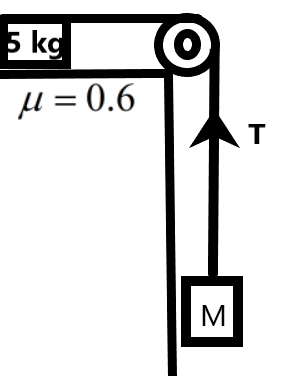
In given figure, the minimum value of ‘M’ such that 5 kg will move is –
A) 1 kg
B) 2 kg
C) 3 kg
D) 4 kg
Answer
 Verified
637.2k+ views
Hint: We need to understand the relation between the vertical force due to the gravitational force on the mass with the horizontal force due to the frictional force acting on the mass on the table. We can solve this by finding the proper relation between them.
Complete answer:
We know that a mass which is hung from a height has a force acting on it in the vertically downward direction due to the force of gravity. This force forms a tension on the string on which the mass is hung.
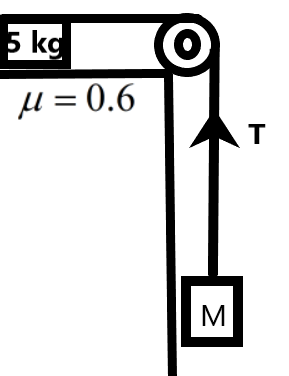
When another mass is attached to this string at the other end, then the tension will be felt by this mass. So, the tension on the string and the frictional force on the block on the table should be balanced for the masses to be at equilibrium. When the tension overcomes the frictional force then the masses start moving.
We can find the tension on the string from the given information as –
\[T=Mg\]
The frictional force acting on the mass of 5 kg placed on a table with coefficient of friction \[\mu \] is given as –
\[\begin{align}
& F=\mu mg \\
& \Rightarrow F=(0.6)(5)g \\
& \therefore F=3gN \\
\end{align}\]
Now, we can equate the tension and the frictional force in the system to get minimum mass required to trigger motion in the system as –
\[\begin{align}
& T={{F}_{f}} \\
& \Rightarrow Mg=3g \\
& \therefore M=3kg \\
\end{align}\]
This is the required mass.
The correct answer is option C.
Note:
We have found the minimum mass which can cause motion in the system. This is also the maximum mass which can keep the block on the horizontal table to be at rest or it balances the frictional force acting on the mass on the table from slipping.
Complete answer:
We know that a mass which is hung from a height has a force acting on it in the vertically downward direction due to the force of gravity. This force forms a tension on the string on which the mass is hung.
When another mass is attached to this string at the other end, then the tension will be felt by this mass. So, the tension on the string and the frictional force on the block on the table should be balanced for the masses to be at equilibrium. When the tension overcomes the frictional force then the masses start moving.
We can find the tension on the string from the given information as –
\[T=Mg\]
The frictional force acting on the mass of 5 kg placed on a table with coefficient of friction \[\mu \] is given as –
\[\begin{align}
& F=\mu mg \\
& \Rightarrow F=(0.6)(5)g \\
& \therefore F=3gN \\
\end{align}\]
Now, we can equate the tension and the frictional force in the system to get minimum mass required to trigger motion in the system as –
\[\begin{align}
& T={{F}_{f}} \\
& \Rightarrow Mg=3g \\
& \therefore M=3kg \\
\end{align}\]
This is the required mass.
The correct answer is option C.
Note:
We have found the minimum mass which can cause motion in the system. This is also the maximum mass which can keep the block on the horizontal table to be at rest or it balances the frictional force acting on the mass on the table from slipping.
Recently Updated Pages
If x a + bt + ct2 where x is in meters and t is in class 11 physics CBSE

A car covers the first half distance between two places class 11 physics CBSE
The resultant of two vectors overrightarrow P and overrightarrow class 11 physics CBSE
Find the value of cos 135 class 11 maths CBSE
A mass M is held in place by an applied force F and class 11 physics CBSE
A solution of glucose in water is labelled as 10 dfracwv class 11 chemistry CBSE
Trending doubts
One Metric ton is equal to kg A 10000 B 1000 C 100 class 11 physics CBSE
Find the value of the expression given below sin 30circ class 11 maths CBSE
What do you mean by retardation What is its SI uni class 11 physics CBSE
Draw a diagram of nephron and explain its structur class 11 biology CBSE
10 examples of friction in our daily life
Difference between physical and chemical change class 11 chemistry CBSE