




In ______ flowers, the margin of the thalamus grows upward enclosing the ovary completely and getting fused with it
(a) Hypogynous
(b) Perigynous
(c) Epigynous
(d) Both (b) and (c)
Answer
 Verified
621k+ views
Hint: In the classification of flowers, the position of the ovary is used with regard to other floral organs. The flower in which the ovary is inferior to other floral organs is an example of the sunflower, apple, etc.
Complete step by step answer:
In epigynous flowers, in the shape of a flask, the thalamus is hollowed out, but its inner wall is fused with the ovary wall. From the upper side, only the style and stigma of the pistil are observed. The top of the ovary carries other floral organs. While other floral organs are superior, the ovary or gynoecium is said to be inferior, e.g: apple, sunflower, cucumber, etc.
Epigynous flower: Epi - above, gynous - gynoecium is placed below the other three whorls, that is, gynoecium, or the other whorls occur above or superior to the ovary. Therefore, the ovary is known as the inferior ovary of this type of flower.
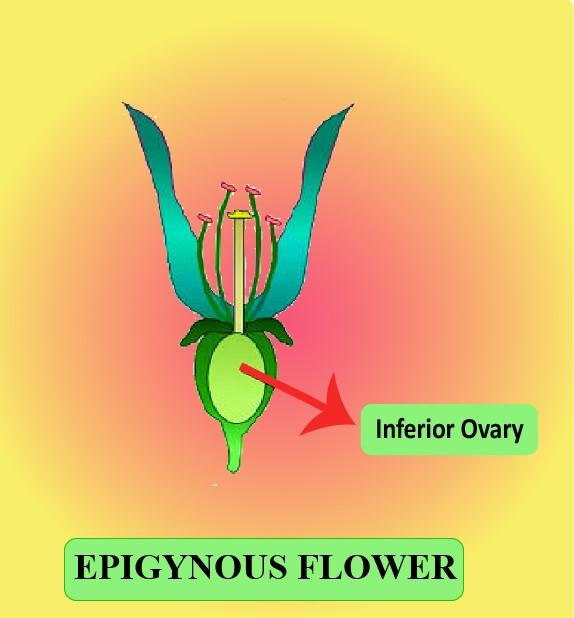
So, the correct answer is, ‘Epigynous’.
Additional information:
- Hypogynous flower: hypo - below, gynous - gynoecium. They have the stamens and other floral sections found below the carpels (or gynoecium). Therefore, the flower's ovary is often referred to as the superior ovary. Examples: Anacardiaceae family members, Malvaceae, etc.
- Perigynous flowers are those in which the gynoecium remains in the middle and other portions of the flower are found almost at the same level on the rim of the thalamus. It is said that the ovary is half inferior. Example: Rose.
Note: There are four whorls in a typical flower, namely calyx, corolla, androecium, and gynoecium, where the outermost whorl is calyx, while the innermost whorl is gynoecium. Examples of epigynous flowers belong to the Cucurbitaceae, Liliaceae, Asteraceae, etc. family members.
Complete step by step answer:
In epigynous flowers, in the shape of a flask, the thalamus is hollowed out, but its inner wall is fused with the ovary wall. From the upper side, only the style and stigma of the pistil are observed. The top of the ovary carries other floral organs. While other floral organs are superior, the ovary or gynoecium is said to be inferior, e.g: apple, sunflower, cucumber, etc.
Epigynous flower: Epi - above, gynous - gynoecium is placed below the other three whorls, that is, gynoecium, or the other whorls occur above or superior to the ovary. Therefore, the ovary is known as the inferior ovary of this type of flower.
So, the correct answer is, ‘Epigynous’.
Additional information:
- Hypogynous flower: hypo - below, gynous - gynoecium. They have the stamens and other floral sections found below the carpels (or gynoecium). Therefore, the flower's ovary is often referred to as the superior ovary. Examples: Anacardiaceae family members, Malvaceae, etc.
- Perigynous flowers are those in which the gynoecium remains in the middle and other portions of the flower are found almost at the same level on the rim of the thalamus. It is said that the ovary is half inferior. Example: Rose.
Note: There are four whorls in a typical flower, namely calyx, corolla, androecium, and gynoecium, where the outermost whorl is calyx, while the innermost whorl is gynoecium. Examples of epigynous flowers belong to the Cucurbitaceae, Liliaceae, Asteraceae, etc. family members.
Recently Updated Pages
Master Class 11 English: Engaging Questions & Answers for Success

Master Class 11 Social Science: Engaging Questions & Answers for Success
Master Class 11 Maths: Engaging Questions & Answers for Success
Master Class 11 Biology: Engaging Questions & Answers for Success
Master Class 11 Physics: Engaging Questions & Answers for Success
Master Class 11 Chemistry: Engaging Questions & Answers for Success
Trending doubts
One Metric ton is equal to kg A 10000 B 1000 C 100 class 11 physics CBSE
Difference Between Prokaryotic Cells and Eukaryotic Cells
Two of the body parts which do not appear in MRI are class 11 biology CBSE
Find the value of the expression given below sin 30circ class 11 maths CBSE
Draw a diagram of a plant cell and label at least eight class 11 biology CBSE
10 examples of friction in our daily life