



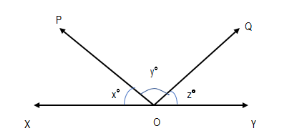
In figure, x:y:z=5:4:6. If XOY is a straight line, then the values of x, y and z are:
(a). $x=60{}^\circ $
(b). $y=48{}^\circ $
(c). $z=72{}^\circ $
(d). $z=80{}^\circ $
Answer
 Verified
612k+ views
Hint: Think of the basic definition of ratio and use the fractional form of a ratio. Also, use the property that the angle on one side of a straight line is a straight angle, i.e., equal to $180{}^\circ $ .
Complete step-by-step answer:
Let us first know what a ratio is.
A ratio in basic words is a quantity used to define a comparison between two quantities. A bit toward the advanced side, it is the quantity that defines how many times of one quantity is that of others.
At our level, apart from the definition, we will treat it as a simple fraction that defines a relation between two given quantities.
Now, starting with the solution to the above question. First, we will convert the ratio given in the question to the fractional form. On doing so, we get
x:y:z=5:4:6
$\dfrac{x}{y}=\dfrac{5}{4}..........(i)$
$\dfrac{z}{y}=\dfrac{6}{4}............(ii)$
Now we know that the angle on one side of a straight line is a straight angle, i.e., equal to $180{}^\circ $ .
$\therefore x+y+z=180$
If we take y common from the left-hand side of the equation, we get
$y\left( \dfrac{x}{y}+1+\dfrac{z}{y} \right)=180$
Now we will substitute the value $\dfrac{x}{y}$ and $\dfrac{z}{y}$ from equations (i) and (ii), respectively. On doing so, we get
$y\left( \dfrac{5}{4}+1+\dfrac{6}{4} \right)=180$
$\Rightarrow y=\dfrac{180\times 4}{15}=48{}^\circ $
Now we will put the value of y in equation (i). On doing so, we get
$\dfrac{x}{48{}^\circ }=\dfrac{5}{4}$
$\Rightarrow x=60{}^\circ $
Again, if we substitute y in equation (ii), we get
$\dfrac{z}{48}=\dfrac{6}{4}$
$\Rightarrow z=72{}^\circ $
Therefore, the values of x, y and z are $60{}^\circ ,\text{ 48}{}^\circ \text{ and 72}{}^\circ $ , respectively. Hence, options (a), (b) and (c) are correct.
Note: Read the question carefully as in the question, including ratio, there is always a chance that the question might have a twist hidden in the words of the question. Also, while solving a fraction for finding the ratio, be sure that you convert it to the simplest form, i.e., the numerator and the denominator must not have any common factors.
Complete step-by-step answer:
Let us first know what a ratio is.
A ratio in basic words is a quantity used to define a comparison between two quantities. A bit toward the advanced side, it is the quantity that defines how many times of one quantity is that of others.
At our level, apart from the definition, we will treat it as a simple fraction that defines a relation between two given quantities.
Now, starting with the solution to the above question. First, we will convert the ratio given in the question to the fractional form. On doing so, we get
x:y:z=5:4:6
$\dfrac{x}{y}=\dfrac{5}{4}..........(i)$
$\dfrac{z}{y}=\dfrac{6}{4}............(ii)$
Now we know that the angle on one side of a straight line is a straight angle, i.e., equal to $180{}^\circ $ .
$\therefore x+y+z=180$
If we take y common from the left-hand side of the equation, we get
$y\left( \dfrac{x}{y}+1+\dfrac{z}{y} \right)=180$
Now we will substitute the value $\dfrac{x}{y}$ and $\dfrac{z}{y}$ from equations (i) and (ii), respectively. On doing so, we get
$y\left( \dfrac{5}{4}+1+\dfrac{6}{4} \right)=180$
$\Rightarrow y=\dfrac{180\times 4}{15}=48{}^\circ $
Now we will put the value of y in equation (i). On doing so, we get
$\dfrac{x}{48{}^\circ }=\dfrac{5}{4}$
$\Rightarrow x=60{}^\circ $
Again, if we substitute y in equation (ii), we get
$\dfrac{z}{48}=\dfrac{6}{4}$
$\Rightarrow z=72{}^\circ $
Therefore, the values of x, y and z are $60{}^\circ ,\text{ 48}{}^\circ \text{ and 72}{}^\circ $ , respectively. Hence, options (a), (b) and (c) are correct.
Note: Read the question carefully as in the question, including ratio, there is always a chance that the question might have a twist hidden in the words of the question. Also, while solving a fraction for finding the ratio, be sure that you convert it to the simplest form, i.e., the numerator and the denominator must not have any common factors.
Recently Updated Pages
Master Class 8 Social Science: Engaging Questions & Answers for Success

Master Class 8 English: Engaging Questions & Answers for Success
Class 8 Question and Answer - Your Ultimate Solutions Guide
Master Class 8 Maths: Engaging Questions & Answers for Success
Master Class 8 Science: Engaging Questions & Answers for Success
Master Class 7 English: Engaging Questions & Answers for Success
Trending doubts
Difference Between Plant Cell and Animal Cell
Fill the blanks with the suitable prepositions 1 The class 9 english CBSE
Who is eligible for RTE class 9 social science CBSE
Which places in India experience sunrise first and class 9 social science CBSE
What is pollution? How many types of pollution? Define it
Name 10 Living and Non living things class 9 biology CBSE