




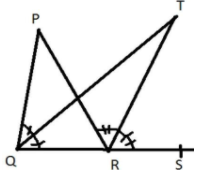
In Figure, the side QR of $\vartriangle PQR$ is produced to a point S. If the bisectors of $\angle PQR$ and $\angle PRS$ meet at point T, then prove that \[\angle {\mathbf{QTR}} = \dfrac{1}{2}\angle {\mathbf{QPR}}.\]
Answer
 Verified
617.7k+ views
Hint: First we need to apply the relationship of exterior angle with the interior angles in the triangle TQR. Then apply the same relationship in triangle PQR. Use both equations with some transformations to get the result.
Complete step-by-step answer:
Line QR is extended till point S. It is given that bisectors of $\angle PQR$ and $\angle PRS$ meet at point T. Then two triangles will be $\vartriangle PQR$ and $\vartriangle TQR$.
Since the exterior angle of the triangle is equal to the sum of two opposite interior angles.
So, we will have first in $\vartriangle TQR$, having exterior angle TRS:
$\angle TRS = \angle TQR + \angle QTR$
Applying the transformation in above equation we get,
$\angle QTR = \angle TRS - \angle TQR$…(1)
Similarly in $\vartriangle PQR$, having exterior angle PRS:
$\angle PRS = \angle PQR + \angle QPR$….(2)
Since line TR is the bisector of $\angle PRS$. It means $\angle PRS = 2 \times \angle TRS$.
And line TQ is the bisector of $\angle PQR$. It means $\angle PQR = 2 \times \angle TQR$
So, in equation (2) by substituting above valueS , we get
$2\angle TRS = 2\angle TQR + \angle QPR$
$\angle QPR = 2\angle TRS - 2\angle TQR$….(3)
Dividing above equation by 2 on both sides in equation (3) , we get
$\dfrac{1}{2}\angle QPR = \angle TRS - \angle TQR$…(4)
Now by comparing equations (1) and (4), where both RHS are same, we get the equation as,
\[\angle {\mathbf{QTR}} = \dfrac{1}{2}\angle {\mathbf{QPR}}.\]
Hence we have proved the result.
Note: Geometry has many shapes which are having many theorems. These theorems are relating the sides and angles of those shapes. Many interesting results can be obtained from the given shape by using relevant theorems. Many real life problems are being solved with the help of geometrical theorems. In the above question two important theorems for triangles are used. Similarly for other problems we may apply many theorems. A careful visualization of the shape is very important for getting the correct result.
Complete step-by-step answer:
Line QR is extended till point S. It is given that bisectors of $\angle PQR$ and $\angle PRS$ meet at point T. Then two triangles will be $\vartriangle PQR$ and $\vartriangle TQR$.
Since the exterior angle of the triangle is equal to the sum of two opposite interior angles.
So, we will have first in $\vartriangle TQR$, having exterior angle TRS:
$\angle TRS = \angle TQR + \angle QTR$
Applying the transformation in above equation we get,
$\angle QTR = \angle TRS - \angle TQR$…(1)
Similarly in $\vartriangle PQR$, having exterior angle PRS:
$\angle PRS = \angle PQR + \angle QPR$….(2)
Since line TR is the bisector of $\angle PRS$. It means $\angle PRS = 2 \times \angle TRS$.
And line TQ is the bisector of $\angle PQR$. It means $\angle PQR = 2 \times \angle TQR$
So, in equation (2) by substituting above valueS , we get
$2\angle TRS = 2\angle TQR + \angle QPR$
$\angle QPR = 2\angle TRS - 2\angle TQR$….(3)
Dividing above equation by 2 on both sides in equation (3) , we get
$\dfrac{1}{2}\angle QPR = \angle TRS - \angle TQR$…(4)
Now by comparing equations (1) and (4), where both RHS are same, we get the equation as,
\[\angle {\mathbf{QTR}} = \dfrac{1}{2}\angle {\mathbf{QPR}}.\]
Hence we have proved the result.
Note: Geometry has many shapes which are having many theorems. These theorems are relating the sides and angles of those shapes. Many interesting results can be obtained from the given shape by using relevant theorems. Many real life problems are being solved with the help of geometrical theorems. In the above question two important theorems for triangles are used. Similarly for other problems we may apply many theorems. A careful visualization of the shape is very important for getting the correct result.

Recently Updated Pages
Master Class 12 Business Studies: Engaging Questions & Answers for Success

Master Class 12 Biology: Engaging Questions & Answers for Success
Master Class 12 Chemistry: Engaging Questions & Answers for Success
Class 12 Question and Answer - Your Ultimate Solutions Guide
Master Class 11 Social Science: Engaging Questions & Answers for Success
Master Class 11 English: Engaging Questions & Answers for Success
Trending doubts
10 slogans on organ donation class 8 english CBSE
Name the states through which the Tropic of Cancer class 8 social science CBSE
Full form of STD, ISD and PCO
What is roughage Give two examples class 8 biology CBSE
Describe the elements of Belgian model for accommodating class 8 social science CBSE
What is the difference between rai and mustard see class 8 biology CBSE