



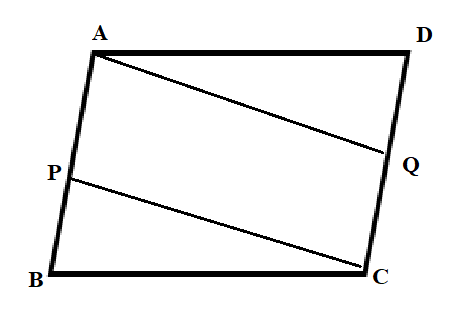
In figure, $\square ABCD$ is a parallelogram, $P$ and $Q$ are mid-points of side $AB$ and $DC$ respectively, then prove $\square APCQ$ is a parallelogram.
Answer
 Verified
584.1k+ views
Hint: Since, $P$ and $Q$ are mid-points of side $AB$ and $DC$ respectively, this implies $AP = \dfrac{1}{2}AB$ and $CQ = \dfrac{1}{2}CD$. We will use the given condition, to find the relation between opposite sides of $\square APCQ$. If opposite sides are equal and parallel, then the quadrilateral is a parallelogram.
Complete step-by-step answer:
Here, we are given that $\square ABCD$ is a parallelogram.
In a parallelogram, opposite sides are parallel and equal.
Therefore, we can say $AB\parallel CD$ and $AB = CD$
As $P$ and $Q$ are mid-points of side $AB$ and $DC$ respectively.
$AP = \dfrac{1}{2}AB$ and $CQ = \dfrac{1}{2}CD$
Therefore, $CQ = \dfrac{1}{2}AB$
Hence, $AP = CQ$
Also, $AP$ is a part of $AB$ and $CQ$ is a part of $CD$.
Then, we can say $AP\parallel CQ$
Therefore, if opposite sides are equal and parallel, then the quadrilateral $\square APCQ$ is a parallelogram.
Note: A quadrilateral is a polygon with four sides. A parallelogram is a quadrilateral, where opposite sides are equal and parallel. In a parallelogram opposite angles are equal. When the perpendicular distance between two lines is the same at the corresponding points, then the lines are parallel.
Complete step-by-step answer:
Here, we are given that $\square ABCD$ is a parallelogram.
In a parallelogram, opposite sides are parallel and equal.
Therefore, we can say $AB\parallel CD$ and $AB = CD$
As $P$ and $Q$ are mid-points of side $AB$ and $DC$ respectively.
$AP = \dfrac{1}{2}AB$ and $CQ = \dfrac{1}{2}CD$
Therefore, $CQ = \dfrac{1}{2}AB$
Hence, $AP = CQ$
Also, $AP$ is a part of $AB$ and $CQ$ is a part of $CD$.
Then, we can say $AP\parallel CQ$
Therefore, if opposite sides are equal and parallel, then the quadrilateral $\square APCQ$ is a parallelogram.
Note: A quadrilateral is a polygon with four sides. A parallelogram is a quadrilateral, where opposite sides are equal and parallel. In a parallelogram opposite angles are equal. When the perpendicular distance between two lines is the same at the corresponding points, then the lines are parallel.
Recently Updated Pages
Master Class 11 English: Engaging Questions & Answers for Success

Master Class 11 Maths: Engaging Questions & Answers for Success
Master Class 11 Biology: Engaging Questions & Answers for Success
Master Class 11 Social Science: Engaging Questions & Answers for Success
Master Class 11 Physics: Engaging Questions & Answers for Success
Master Class 11 Accountancy: Engaging Questions & Answers for Success
Trending doubts
Difference Between Plant Cell and Animal Cell
Fill the blanks with the suitable prepositions 1 The class 9 english CBSE
Which places in India experience sunrise first and class 9 social science CBSE
Who is eligible for RTE class 9 social science CBSE
What is pollution? How many types of pollution? Define it
Name 10 Living and Non living things class 9 biology CBSE