




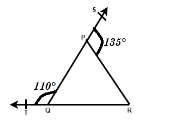
In figure, sides QP and QR of \[\Delta PQR\] are produced to points T and S respectively. If \[\angle TQP = 110^\circ \] and \[\angle SPR = 135^\circ \], then find the value of \[\angle PRQ\].
Answer
 Verified
558.3k+ views
Hint:One sufficient information for solving this question is that the sum of all angles of a triangle is \[180^\circ \]. So, by using this concept we can solve for the value of \[\angle PRQ\]. We are going to apply the concept of linear pair (when a line intersects another line at an angle, the two angles formed make a linear pair, and the sum of the two angles of a linear pair is \[180^\circ \]).
So, first we are going to apply the concept of linear pair to the angle \[\angle SPR\] and then to the angle \[\angle TQP\] and find their corresponding linear pair and then use the angle sum property of triangle to solve for the value of \[\angle PRQ\].
Formula Used:
We are going to use the concept of angle sum property of a triangle – the sum of all angles of a triangle is \[180^\circ \], which hence, is:
\[\angle PQR + \angle QPR + \angle PRQ = 180^\circ \]
Complete step by step solution:
In this question, we need to solve for the value of \[\angle PRQ\] which is in the \[\Delta PQR\].
First, we calculate the other angles of the triangle. We have been given the value of \[\angle SPR\] and \[\angle TQP\] and we need to calculate the angles adjacent to them.
And we can easily do that by applying the concept of linear pair.
\[\angle SPR = 135^\circ \] and \[\angle TQP = 110^\circ \]
So, first we solve for \[\angle QPR\]:
\[\angle SPR + \angle QPR = 180^\circ \]
Hence, \[\angle QPR = 180^\circ - 135^\circ = 45^\circ \]
Now, we solve for \[\angle PQR\]
\[\angle TQP + \angle PQR = 180^\circ \]
Hence, \[\angle PQR = 180^\circ - 110^\circ = 70^\circ \]
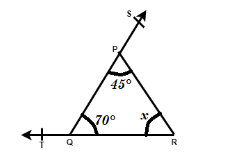
So, now we have two out of three angles of a triangle and we need to solve for the third unknown angle. And we can easily do that by applying the concept of the angle sum property, so we have:
\[\angle PQR + \angle QPR + \angle PRQ = 180^\circ \]
\[70^\circ + 45^\circ + x = 180^\circ \]
\[115^\circ + x = 180^\circ \]
\[x = 180 - 115 = 65^\circ \]
Hence, \[\angle PRQ = 65^\circ \]
Note: So, we saw that in solving questions like these, we need to see what information we have got with us. Like here, we used the concept of angle sum property of triangle, because the figure clearly gave a triangle. Then we applied the concept of linear pair, because the angles in the triangle which we needed to find for calculating the \[\angle PRQ\] and the angles whose measure is given lie on a straight line, hence forming a linear pair. The biggest giveaway is always what shape the figure is; we figure that out, we know in which direction we need to go.
So, first we are going to apply the concept of linear pair to the angle \[\angle SPR\] and then to the angle \[\angle TQP\] and find their corresponding linear pair and then use the angle sum property of triangle to solve for the value of \[\angle PRQ\].
Formula Used:
We are going to use the concept of angle sum property of a triangle – the sum of all angles of a triangle is \[180^\circ \], which hence, is:
\[\angle PQR + \angle QPR + \angle PRQ = 180^\circ \]
Complete step by step solution:
In this question, we need to solve for the value of \[\angle PRQ\] which is in the \[\Delta PQR\].
First, we calculate the other angles of the triangle. We have been given the value of \[\angle SPR\] and \[\angle TQP\] and we need to calculate the angles adjacent to them.
And we can easily do that by applying the concept of linear pair.
\[\angle SPR = 135^\circ \] and \[\angle TQP = 110^\circ \]
So, first we solve for \[\angle QPR\]:
\[\angle SPR + \angle QPR = 180^\circ \]
Hence, \[\angle QPR = 180^\circ - 135^\circ = 45^\circ \]
Now, we solve for \[\angle PQR\]
\[\angle TQP + \angle PQR = 180^\circ \]
Hence, \[\angle PQR = 180^\circ - 110^\circ = 70^\circ \]
So, now we have two out of three angles of a triangle and we need to solve for the third unknown angle. And we can easily do that by applying the concept of the angle sum property, so we have:
\[\angle PQR + \angle QPR + \angle PRQ = 180^\circ \]
\[70^\circ + 45^\circ + x = 180^\circ \]
\[115^\circ + x = 180^\circ \]
\[x = 180 - 115 = 65^\circ \]
Hence, \[\angle PRQ = 65^\circ \]
Note: So, we saw that in solving questions like these, we need to see what information we have got with us. Like here, we used the concept of angle sum property of triangle, because the figure clearly gave a triangle. Then we applied the concept of linear pair, because the angles in the triangle which we needed to find for calculating the \[\angle PRQ\] and the angles whose measure is given lie on a straight line, hence forming a linear pair. The biggest giveaway is always what shape the figure is; we figure that out, we know in which direction we need to go.
Recently Updated Pages
Master Class 11 Computer Science: Engaging Questions & Answers for Success

Master Class 11 Business Studies: Engaging Questions & Answers for Success
Master Class 11 Economics: Engaging Questions & Answers for Success
Master Class 11 English: Engaging Questions & Answers for Success
Master Class 11 Maths: Engaging Questions & Answers for Success
Master Class 11 Biology: Engaging Questions & Answers for Success
Trending doubts
One Metric ton is equal to kg A 10000 B 1000 C 100 class 11 physics CBSE
There are 720 permutations of the digits 1 2 3 4 5 class 11 maths CBSE
Discuss the various forms of bacteria class 11 biology CBSE
Draw a diagram of a plant cell and label at least eight class 11 biology CBSE
State the laws of reflection of light
Explain zero factorial class 11 maths CBSE