




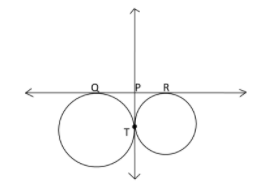
In figure, QR is a common tangent to the given circles, touching externally at the point T. The tangent at T meets QR at P. If $PT = 3.8cm$, then find the length of QR.
Answer
 Verified
646.2k+ views
Hint: Observe the tangents drawn to both the circles. Use the theorem, the lengths of tangents drawn from an external point to a circle are equal. You will obtain $QR = 2PT$.
Complete step-by-step answer:
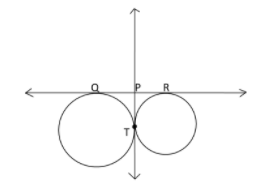
Two circles can be seen in the figure. For better understanding, lets name the bigger circle ${C_1}$and the smaller circle ${C_2}$.
We can see that tangents PQ and PT are drawn from an external point P to the circle ${C_1}$.
So,
$PQ = PT$ ---(1)
{Lengths of tangents drawn from an external point to a circle are equal.}
Similarly,
Tangents PR and PT are drawn to the circle ${C_2}$from an external point P;
Again using the same theorem,
$PR = PT$ ----(2)
QR can be written as
$QR = QP + PR$ ---(3)
Substituting the values of PQ and PR from equations (1) and (2) respectively, in equation (3),
We obtain,
$
QR = PT + PT \\
QR = 2PT \\
$
Given that $PT = 3.8cm$
So,
$
QR = 2 \times 3.8 \\
QR = 7.6cm \\
$
Note: It should be noted that in such type of questions, one must not confuse tangent and secant; a tangent to a circle is a straight line in the plane of circle, which touches the circle at only one point whereas secant to a circle intersects it at two distinct point. The theorems of tangent to a circle should not be applied on a secant as the results will be wrong.
Complete step-by-step answer:
Two circles can be seen in the figure. For better understanding, lets name the bigger circle ${C_1}$and the smaller circle ${C_2}$.
We can see that tangents PQ and PT are drawn from an external point P to the circle ${C_1}$.
So,
$PQ = PT$ ---(1)
{Lengths of tangents drawn from an external point to a circle are equal.}
Similarly,
Tangents PR and PT are drawn to the circle ${C_2}$from an external point P;
Again using the same theorem,
$PR = PT$ ----(2)
QR can be written as
$QR = QP + PR$ ---(3)
Substituting the values of PQ and PR from equations (1) and (2) respectively, in equation (3),
We obtain,
$
QR = PT + PT \\
QR = 2PT \\
$
Given that $PT = 3.8cm$
So,
$
QR = 2 \times 3.8 \\
QR = 7.6cm \\
$
Note: It should be noted that in such type of questions, one must not confuse tangent and secant; a tangent to a circle is a straight line in the plane of circle, which touches the circle at only one point whereas secant to a circle intersects it at two distinct point. The theorems of tangent to a circle should not be applied on a secant as the results will be wrong.
Recently Updated Pages
Basicity of sulphurous acid and sulphuric acid are

Master Class 10 Computer Science: Engaging Questions & Answers for Success
Master Class 10 Social Science: Engaging Questions & Answers for Success
Master Class 10 Science: Engaging Questions & Answers for Success
Class 10 Question and Answer - Your Ultimate Solutions Guide
Master Class 10 Maths: Engaging Questions & Answers for Success
Trending doubts
What is the Total Duration of Football Match?
Explain the Treaty of Vienna of 1815 class 10 social science CBSE
In football, which nation is called "La Roja"?
Why is there a time difference of about 5 hours between class 10 social science CBSE
10 examples of evaporation in daily life with explanations
What is the full form of POSCO class 10 social science CBSE