




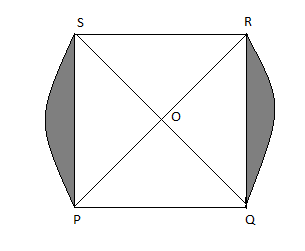
In figure, PQRS is a square lawn with side PQ = 42 metres. Two circular flowerbeds are there on the sides PS and QR with centre at O, the intersection of its diagonals. Find the total area of the two flower beds (shaded parts).
Answer
 Verified
598.8k+ views
Hint: The area between the sector of circle and the triangle is equal to the area of flower bed.
The area of the flowerbed can be determined by subtracting the area of the triangle from the area of the sector of the circle.
Complete step by step solution:
In the figure, the circular flowerbeds are drawn on the sides of the circle.
The side of square PQ is equal to $42$ m and as each side of square is equal to each other, it means that PQ = QR = $42$ m.
The sector of the circle has centre O. This means that the radius ($r$) of the sector is equal to the length of side OP.
Length of side OP can be determined by determining the diagonal of square as OP is equal to half of the diagonal of square, PR. OP is half of diagonal of square because diagonals of square bisect each other because of which OP = OR and thereby OP is half of PR.
Diagonal of square, PR = $\sqrt{2}$ × side of square = $42\sqrt{2}$ m
This indicates OP = r = $\dfrac{1}{2}\times 42\sqrt{2}\text{ m}=21\sqrt{2}\text{ m}$
$\begin{align}
& \text{Area of sector of circle =}\dfrac{\theta }{360{}^\circ }\pi {{r}^{2}} \\
& =\dfrac{90{}^\circ }{360{}^\circ }\times \dfrac{22}{7}\times \left( 21\sqrt{2} \right)\text{ }{{\text{m}}^{2}} \\
& =693\text{ }{{\text{m}}^{\text{2}}}
\end{align}$
$\begin{align}
& \text{Area of triangle =}\dfrac{1}{4}\times \text{Area of square} \\
& =\dfrac{1}{4}\times {{\left( side \right)}^{2}}\text{ }{{\text{m}}^{2}} \\
& =\dfrac{42\times 42}{4}\text{ }{{\text{m}}^{\text{2}}} \\
& =441\text{ }{{\text{m}}^{\text{2}}}
\end{align}$
$\begin{align}
& \text{Area of one circular flower bed = 693 }-\text{ 441 }{{\text{m}}^{2}} \\
& \text{= 252 }{{\text{m}}^{2}}
\end{align}$
By multiplying the area of one flower bed by two, the area of two flower beds can be calculated.
$\begin{align}
& \text{Area of two circular flower beds = 2 }\times \text{ 252 }{{\text{m}}^{2}} \\
& \text{= 504 }{{\text{m}}^{2}}
\end{align}$
Note:
The circular flower beds in the given figure cannot be called semi-circles as they were not drawn on the radius of the circle but flower beds were drawn on the segment of circle.
The area of the flowerbed can be determined by subtracting the area of the triangle from the area of the sector of the circle.
Complete step by step solution:
In the figure, the circular flowerbeds are drawn on the sides of the circle.
The side of square PQ is equal to $42$ m and as each side of square is equal to each other, it means that PQ = QR = $42$ m.
The sector of the circle has centre O. This means that the radius ($r$) of the sector is equal to the length of side OP.
Length of side OP can be determined by determining the diagonal of square as OP is equal to half of the diagonal of square, PR. OP is half of diagonal of square because diagonals of square bisect each other because of which OP = OR and thereby OP is half of PR.
Diagonal of square, PR = $\sqrt{2}$ × side of square = $42\sqrt{2}$ m
This indicates OP = r = $\dfrac{1}{2}\times 42\sqrt{2}\text{ m}=21\sqrt{2}\text{ m}$
$\begin{align}
& \text{Area of sector of circle =}\dfrac{\theta }{360{}^\circ }\pi {{r}^{2}} \\
& =\dfrac{90{}^\circ }{360{}^\circ }\times \dfrac{22}{7}\times \left( 21\sqrt{2} \right)\text{ }{{\text{m}}^{2}} \\
& =693\text{ }{{\text{m}}^{\text{2}}}
\end{align}$
$\begin{align}
& \text{Area of triangle =}\dfrac{1}{4}\times \text{Area of square} \\
& =\dfrac{1}{4}\times {{\left( side \right)}^{2}}\text{ }{{\text{m}}^{2}} \\
& =\dfrac{42\times 42}{4}\text{ }{{\text{m}}^{\text{2}}} \\
& =441\text{ }{{\text{m}}^{\text{2}}}
\end{align}$
$\begin{align}
& \text{Area of one circular flower bed = 693 }-\text{ 441 }{{\text{m}}^{2}} \\
& \text{= 252 }{{\text{m}}^{2}}
\end{align}$
By multiplying the area of one flower bed by two, the area of two flower beds can be calculated.
$\begin{align}
& \text{Area of two circular flower beds = 2 }\times \text{ 252 }{{\text{m}}^{2}} \\
& \text{= 504 }{{\text{m}}^{2}}
\end{align}$
Note:
The circular flower beds in the given figure cannot be called semi-circles as they were not drawn on the radius of the circle but flower beds were drawn on the segment of circle.
Recently Updated Pages
Master Class 10 Computer Science: Engaging Questions & Answers for Success

Differentiate between voluntary action and reflex class 10 biology CBSE
The uses of bleaching powder are A It is used bleaching class 10 chemistry CBSE
Fill in the blanks with abstract nouns of the words class 10 english CBSE
How many threedigit numbers are there class 10 maths CBSE
What is a reflex arc class 10 biology CBSE
Trending doubts
Explain the Treaty of Vienna of 1815 class 10 social science CBSE
In basketball, how many quarters are played in an NBA game?
10 examples of evaporation in daily life with explanations
Which country is known as "The land of Fire and Ice"?
What is the full form of POSCO class 10 social science CBSE
In which year voting age was reduced from 21 to 18?