




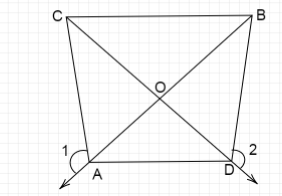
In figure, \[OA = OD\] and \[\angle 1 = \angle 2\]. Prove that \[\vartriangle OCB\] is an isosceles triangle.
Answer
 Verified
595.8k+ views
Hint: Here we use the property of supplementary angles to find angles on a straight line along with \[\angle 1,\angle 2\]. And using the given sides equal we prove two triangles \[\vartriangle AOC,\vartriangle DOB\] as congruent triangles which will give us their sides equal which are also sides of triangle\[\vartriangle OCB\].
* An isosceles triangle has two sides equal to each other and angles opposite to opposite sides are also equal.
* Vertically opposite angles are the angles which lie on the exact opposite side of the intersection of two lines.
* Two triangles are said to be congruent if they are associative in any of the forms stated
SSS- Side, side, side
SAS- Side, angle, side
ASA- Angle, side, angle
Complete step-by-step answer:
In this figure we have \[\angle 1 = \angle 2\]
Take straight line \[AB\] , then sum of angles on straight line is equal to \[{180^ \circ }\]
\[
\angle 1 + \angle OAC = {180^ \circ } \\
\angle OAC = {180^ \circ } - \angle 1 \\
\] \[...(i)\]
Similarly, Take straight line \[CD\] , then sum of angles on straight line is equal to \[{180^ \circ }\]
\[
\angle 2 + \angle ODB = {180^ \circ } \\
\angle ODB = {180^ \circ } - \angle 2 \\
\] \[...(ii)\]
Since \[\angle 1 = \angle 2\]
Therefore if we subtract same angle from \[{180^ \circ }\], both angles obtained will be equal
\[
{180^ \circ } - \angle 1 = {180^ \circ } - \angle 2 \\
\angle OAC = \angle ODB \\
\]
Also when two lines intersect then vertically opposite angles are equal.
So, we get \[\angle AOC = \angle DOB\]
Since two sets of angles of two triangles are equal therefore the third angle of triangles will also be equal. So, \[\angle ACO = \angle DBO\]
Now we prove triangles congruent.
Taking two triangles, \[\vartriangle CAO,\vartriangle BDO\]
We have \[\angle OAC = \angle ODB\] , \[\angle AOC = \angle DOB\], \[\angle ACO = \angle DBO\] and sides \[AO = OD\]
Therefore, we can say triangles are congruent i.e. \[\vartriangle CAO \cong \vartriangle BDO\]
Which means the sides of triangles are equal, which gives us \[OC = OB\]
In \[\vartriangle OCB\] two sides are equal to each other, so \[\vartriangle OCB\] is an isosceles triangle.
Note:Students many times make the mistake of taking alternate interior angles equal here but we are not given the set of lines \[AD,BC\] parallel so we don’t use that approach. In these types of questions, always prove congruency using the help of vertically opposite angles, alternate angles (if lines are parallel).
* An isosceles triangle has two sides equal to each other and angles opposite to opposite sides are also equal.
* Vertically opposite angles are the angles which lie on the exact opposite side of the intersection of two lines.
* Two triangles are said to be congruent if they are associative in any of the forms stated
SSS- Side, side, side
SAS- Side, angle, side
ASA- Angle, side, angle
Complete step-by-step answer:
In this figure we have \[\angle 1 = \angle 2\]
Take straight line \[AB\] , then sum of angles on straight line is equal to \[{180^ \circ }\]
\[
\angle 1 + \angle OAC = {180^ \circ } \\
\angle OAC = {180^ \circ } - \angle 1 \\
\] \[...(i)\]
Similarly, Take straight line \[CD\] , then sum of angles on straight line is equal to \[{180^ \circ }\]
\[
\angle 2 + \angle ODB = {180^ \circ } \\
\angle ODB = {180^ \circ } - \angle 2 \\
\] \[...(ii)\]
Since \[\angle 1 = \angle 2\]
Therefore if we subtract same angle from \[{180^ \circ }\], both angles obtained will be equal
\[
{180^ \circ } - \angle 1 = {180^ \circ } - \angle 2 \\
\angle OAC = \angle ODB \\
\]
Also when two lines intersect then vertically opposite angles are equal.
So, we get \[\angle AOC = \angle DOB\]
Since two sets of angles of two triangles are equal therefore the third angle of triangles will also be equal. So, \[\angle ACO = \angle DBO\]
Now we prove triangles congruent.
Taking two triangles, \[\vartriangle CAO,\vartriangle BDO\]
We have \[\angle OAC = \angle ODB\] , \[\angle AOC = \angle DOB\], \[\angle ACO = \angle DBO\] and sides \[AO = OD\]
Therefore, we can say triangles are congruent i.e. \[\vartriangle CAO \cong \vartriangle BDO\]
Which means the sides of triangles are equal, which gives us \[OC = OB\]
In \[\vartriangle OCB\] two sides are equal to each other, so \[\vartriangle OCB\] is an isosceles triangle.
Note:Students many times make the mistake of taking alternate interior angles equal here but we are not given the set of lines \[AD,BC\] parallel so we don’t use that approach. In these types of questions, always prove congruency using the help of vertically opposite angles, alternate angles (if lines are parallel).
Recently Updated Pages
Master Class 9 General Knowledge: Engaging Questions & Answers for Success

Master Class 9 Social Science: Engaging Questions & Answers for Success
Master Class 9 English: Engaging Questions & Answers for Success
Master Class 9 Maths: Engaging Questions & Answers for Success
Master Class 9 Science: Engaging Questions & Answers for Success
Class 9 Question and Answer - Your Ultimate Solutions Guide
Trending doubts
Find the mode and median of the data 13 16 12 14 1-class-9-maths-CBSE
What were the main changes brought about by the Bolsheviks class 9 social science CBSE
What is the theme or message of the poem The road not class 9 english CBSE
What are the major achievements of the UNO class 9 social science CBSE
Explain the importance of pH in everyday life class 9 chemistry CBSE
Differentiate between parenchyma collenchyma and sclerenchyma class 9 biology CBSE