




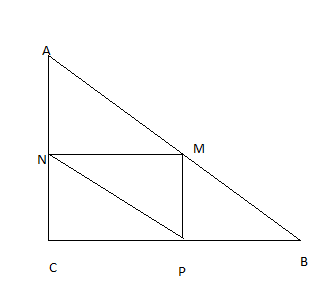
In figure, $M,N$ and $P$ are the midpoints of $AB$,$AC$ and $BC$ respectively. If $MN = 3cm$ ,$NP = 3.5cm$ and $MP = 2.5cm$, calculate the length of $BC,AB$ and $AC$.
Answer
 Verified
609.9k+ views
Hint: In order to solve this question we have to apply the concept of mid-point theorem.
According to the mid-point theorem, the straight line joining the mid-points of two sides of a triangle is parallel to the third side and it is also half of the length of that side.
On further simplification we get the required answer.
Complete step-by-step solution:
It is given in the question that $M,N$ and $P$ are the mid-points of $AB$,$AC$ and $BC$ respectively.
We have to find the length of $BC,AB$ and $AC$.
Therefore by applying the concept of mid-point theorem we can write-
$MN\parallel BC$ and $MN = \dfrac{1}{2}BC$
It is given that the data $MN = 3cm$,$NP = 3.5cm$ and $MP = 2.5cm$,
So, we can write that-
$BC = 2MN$
$BC = 2MN = 2 \times 3 = 6cm$
Since the length of $MN = 3cm$
$\therefore $The length of $BC = 6cm$
Again from the diagram, since $M$ and $P$ are the mid-points of $AB$ and $BC$,
So we can write that-
$MP\parallel AC$ and $MP = \dfrac{1}{2}AC$
Hence we can write that-
$AC = 2MP$$ = 2 \times 2.5 = 5cm$
$\therefore $ The length of $AC = 5cm$
Also from the diagram, $N$ and $P$ are the mid-points of $AC$ and $BC$ respectively.
So we can write $NP\parallel AB$ and $NP = \dfrac{1}{2}AB$
Hence we can write that-
$2NP = AB$
So, $AB = 2NP = 2 \times 3.5 = 7cm$ since the length of $NP = 3.5cm$
$\therefore $ The length of $AB = 7cm$
Thus the length of $BC = 6cm$
Length of $AB = 7cm$
And length of $AC = 5cm$
Thus, the correct option is $A$.
Note: Mid-point means the middle point on any straight line which is equidistant from both the sides of the straight line.
According to the converse of the mid-point theorem, when a line is drawn through the midpoint of one side of a triangle then it is parallel to the third side and it bisects the third side.
Many of us get confused while applying the concept of mid-point theorem with the converse mid-point theorem. So keep in mind the statement of both the theorems to have a clear idea on each theorem and you can apply it whenever required.
According to the mid-point theorem, the straight line joining the mid-points of two sides of a triangle is parallel to the third side and it is also half of the length of that side.
On further simplification we get the required answer.
Complete step-by-step solution:
It is given in the question that $M,N$ and $P$ are the mid-points of $AB$,$AC$ and $BC$ respectively.
We have to find the length of $BC,AB$ and $AC$.
Therefore by applying the concept of mid-point theorem we can write-
$MN\parallel BC$ and $MN = \dfrac{1}{2}BC$
It is given that the data $MN = 3cm$,$NP = 3.5cm$ and $MP = 2.5cm$,
So, we can write that-
$BC = 2MN$
$BC = 2MN = 2 \times 3 = 6cm$
Since the length of $MN = 3cm$
$\therefore $The length of $BC = 6cm$
Again from the diagram, since $M$ and $P$ are the mid-points of $AB$ and $BC$,
So we can write that-
$MP\parallel AC$ and $MP = \dfrac{1}{2}AC$
Hence we can write that-
$AC = 2MP$$ = 2 \times 2.5 = 5cm$
$\therefore $ The length of $AC = 5cm$
Also from the diagram, $N$ and $P$ are the mid-points of $AC$ and $BC$ respectively.
So we can write $NP\parallel AB$ and $NP = \dfrac{1}{2}AB$
Hence we can write that-
$2NP = AB$
So, $AB = 2NP = 2 \times 3.5 = 7cm$ since the length of $NP = 3.5cm$
$\therefore $ The length of $AB = 7cm$
Thus the length of $BC = 6cm$
Length of $AB = 7cm$
And length of $AC = 5cm$
Thus, the correct option is $A$.
Note: Mid-point means the middle point on any straight line which is equidistant from both the sides of the straight line.
According to the converse of the mid-point theorem, when a line is drawn through the midpoint of one side of a triangle then it is parallel to the third side and it bisects the third side.
Many of us get confused while applying the concept of mid-point theorem with the converse mid-point theorem. So keep in mind the statement of both the theorems to have a clear idea on each theorem and you can apply it whenever required.
Recently Updated Pages
Class 10 Question and Answer - Your Ultimate Solutions Guide

Master Class 10 Computer Science: Engaging Questions & Answers for Success
Master Class 10 General Knowledge: Engaging Questions & Answers for Success
Master Class 12 Economics: Engaging Questions & Answers for Success
Master Class 12 Social Science: Engaging Questions & Answers for Success
Master Class 12 English: Engaging Questions & Answers for Success
Trending doubts
Explain the Treaty of Vienna of 1815 class 10 social science CBSE
The slogan Jai Hind was given by A Lal Bahadur Shastri class 10 social science CBSE
10 examples of evaporation in daily life with explanations
What is the full form of POSCO class 10 social science CBSE
Five things I will do to build a great India class 10 english CBSE
Identify the feminine form of noun nephew a shenephew class 10 english CBSE