




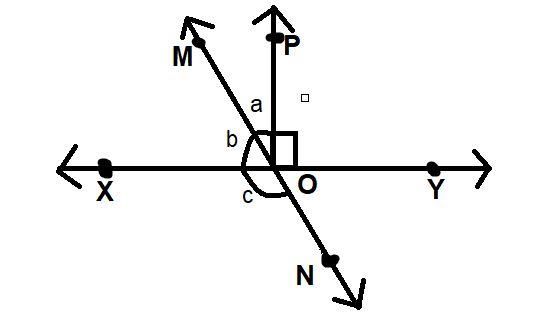
In figure, lines XY and MN intersect at O. If $\angle POY = {90^0}$ and a: b=2:3, find c.
Answer
 Verified
627.6k+ views
Hint: Here we go through by applying the properties of supplementary angle, complementary angles and then assume the given ratio with some variable as we let a=2x and b=3x. then apply the condition of angle to find the unknown angle.
Complete step-by-step answer:
Here in the given question the ratio of angle a: b is given as 2:3. So we have to let the $\angle POM = a = 2x$ and $\angle MOX = b = 3x$.
Given $\angle POY = {90^0}$ ,
So,$\angle POX$ will be ${180^0}$-$\angle POY = {90^0}$ (Because $XOY$ is straight line)
Then $\angle POX$=$\angle POM$+$\angle MOX$=${90^0}$
And as we know that $\angle POM$ and $\angle MOX$ are complementary because the sum of these two angles is ${90^0}$. I.e. $\angle POM + \angle MOX = {90^0}$ after putting the values of these angle we get,
$
\Rightarrow 2x + 3x = {90^0} \\
\Rightarrow 5x = {90^0} \\
\therefore x = {18^0} \\
$
By putting the values of we get,
$\angle POM = a = 2 \times {18^0} = {36^0}$ And $\angle MOX = b = 3 \times {18^0} = {54^0}$
And we also know that $\angle MOX$ and $\angle XON$ are supplementary angles because the sum of these two angles is ${180^0}$. i.e. $\angle MOX + \angle XON = {180^0}$
$
\Rightarrow {54^0} + \angle XON = {180^0} \\
\Rightarrow \angle XON = {180^0} - {54^0} = {126^0} \\
$
Hence the value of $\angle XON = c = {126^0}$.
Note: Whenever we face such a type of question the key concept for solving the question is to first determine which two angles are complementary and which two are supplementary and by putting the values of the angle in that values we will easily get the answer.
Complete step-by-step answer:
Here in the given question the ratio of angle a: b is given as 2:3. So we have to let the $\angle POM = a = 2x$ and $\angle MOX = b = 3x$.
Given $\angle POY = {90^0}$ ,
So,$\angle POX$ will be ${180^0}$-$\angle POY = {90^0}$ (Because $XOY$ is straight line)
Then $\angle POX$=$\angle POM$+$\angle MOX$=${90^0}$
And as we know that $\angle POM$ and $\angle MOX$ are complementary because the sum of these two angles is ${90^0}$. I.e. $\angle POM + \angle MOX = {90^0}$ after putting the values of these angle we get,
$
\Rightarrow 2x + 3x = {90^0} \\
\Rightarrow 5x = {90^0} \\
\therefore x = {18^0} \\
$
By putting the values of we get,
$\angle POM = a = 2 \times {18^0} = {36^0}$ And $\angle MOX = b = 3 \times {18^0} = {54^0}$
And we also know that $\angle MOX$ and $\angle XON$ are supplementary angles because the sum of these two angles is ${180^0}$. i.e. $\angle MOX + \angle XON = {180^0}$
$
\Rightarrow {54^0} + \angle XON = {180^0} \\
\Rightarrow \angle XON = {180^0} - {54^0} = {126^0} \\
$
Hence the value of $\angle XON = c = {126^0}$.
Note: Whenever we face such a type of question the key concept for solving the question is to first determine which two angles are complementary and which two are supplementary and by putting the values of the angle in that values we will easily get the answer.

Recently Updated Pages
Basicity of sulphurous acid and sulphuric acid are

Master Class 11 Business Studies: Engaging Questions & Answers for Success
Master Class 11 Computer Science: Engaging Questions & Answers for Success
Master Class 11 Economics: Engaging Questions & Answers for Success
Master Class 12 English: Engaging Questions & Answers for Success
Master Class 12 Social Science: Engaging Questions & Answers for Success
Trending doubts
Give 10 examples for herbs , shrubs , climbers , creepers
What is the shape of Earth A Circle B Square C Sphere class 6 social science CBSE
What is the chemical symbol for gold?
The planet nearest to earth is A Mercury B Venus C class 6 social science CBSE
Which country first gave women the right to vote?
Write a formal letter on this topic Write a formal class 6 english CBSE