




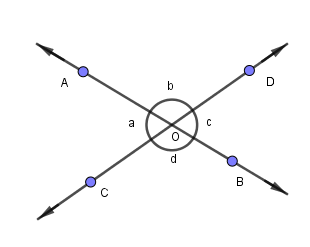
In figure, lines AB and CD intersect each other at point O. If $a:b = 4:5$, find a, b, c, and d.
Answer
 Verified
644.7k+ views
Hint: In this question we will keep in mind that a straight line forms an angle of ${180^ \circ }$. According to the given figure,$\angle AOC + \angle AOD = {180^ \circ}$.$\angle AOC = {80^ \circ }$$\angle AOC$ denotes $a$, $\angle AOD$ denotes $b$, $\angle BOD$ denotes $c$ and $\angle BOC$ denotes $d$.
Complete step by step solution:
Given,
$a:b = 4:5$
$\dfrac{a}{b} = \dfrac{4}{5}$
$ \Rightarrow 5a = 4b$
$ \Rightarrow a = \dfrac{{4b}}{5}$
Now, we know that $\angle AOC$ is $a$ and $\angle AOD$ is $b$.
$\angle AOC + \angle AOD = {180^ \circ }$
$ \Rightarrow a + b = {180^ \circ }$
Putting the value of $a$ in the above equation, we get
$ \Rightarrow \dfrac{{4b}}{5} + b = {180^ \circ }$
$ \Rightarrow \dfrac{{9b}}{5} = {180^ \circ }$
$ \Rightarrow b = {180^ \circ } \times \dfrac{5}{9}$
$\therefore b = {100^ \circ }$ Or $\angle AOD$$ = {100^ \circ }$
Now we will find the value of $a$ by putting the value of $b$ in equation $a = \dfrac{{4b}}{5}$
$a = \dfrac{{4b}}{5}$
$ \Rightarrow a = \dfrac{{4 \times {{100}^ \circ }}}{5}$
$\Rightarrow a = {80^ \circ }$Or $\angle AOC = {80^ \circ }$
We have already found the value of ‘a’ and ‘b’. Now, we will find the value of $c$ and $d$.
From the above figure we know that;
$\angle AOC + \angle COB = {180^ \circ }$ …. [Linear pair]
$ \Rightarrow {80^ \circ } + \angle COB = {180^ \circ }$
$\therefore \angle COB = {100^ \circ }$ Or d $ = {100^ \circ }$
Again, from the given figure we know that;
\[\angle COB + \angle DOB = {180^ \circ }\] [Linear pair]
\[ \Rightarrow {100^ \circ } + \angle DOB = {180^ \circ }\]
\[\Rightarrow \angle DOB = {80^ \circ }\]Or $c = {80^ \circ }$
$\therefore$ The required angles are: $a={80^\circ}$, ${b=100^\circ}$, $c={80^\circ}$ and $d={80^\circ}$.
Note:
In these types of questions we should apply a rule of straight line that a straight line always forms an angle of ${180^ \circ }$. If we add two angles that are $a$ and $b$ then it will be equal to ${180^ \circ }$. We can see this from the given figure that AB and CD are two straight lines intersecting each other at O. $\angle AOC + \angle AOD = {180^ \circ }$, \[\angle COB + \angle DOB = {180^ \circ }\], $\angle AOC + \angle COB = {180^ \circ }$ and $\angle AOD + \angle BOD = {180^ \circ }$. Ratios of two angles were also given in the question that is a : b is 4 : 5 through which we can find the angles at which line AB and CD intersect each other. So by applying these given information we can find the value of $\angle AOD$, $\angle AOC$, $\angle COB$ and \[\angle DOB\].
Alternatively, you can use the concept of transversal lines: When two lines intersect each other, opposite angles are equal.
Complete step by step solution:
Given,
$a:b = 4:5$
$\dfrac{a}{b} = \dfrac{4}{5}$
$ \Rightarrow 5a = 4b$
$ \Rightarrow a = \dfrac{{4b}}{5}$
Now, we know that $\angle AOC$ is $a$ and $\angle AOD$ is $b$.
$\angle AOC + \angle AOD = {180^ \circ }$
$ \Rightarrow a + b = {180^ \circ }$
Putting the value of $a$ in the above equation, we get
$ \Rightarrow \dfrac{{4b}}{5} + b = {180^ \circ }$
$ \Rightarrow \dfrac{{9b}}{5} = {180^ \circ }$
$ \Rightarrow b = {180^ \circ } \times \dfrac{5}{9}$
$\therefore b = {100^ \circ }$ Or $\angle AOD$$ = {100^ \circ }$
Now we will find the value of $a$ by putting the value of $b$ in equation $a = \dfrac{{4b}}{5}$
$a = \dfrac{{4b}}{5}$
$ \Rightarrow a = \dfrac{{4 \times {{100}^ \circ }}}{5}$
$\Rightarrow a = {80^ \circ }$Or $\angle AOC = {80^ \circ }$
We have already found the value of ‘a’ and ‘b’. Now, we will find the value of $c$ and $d$.
From the above figure we know that;
$\angle AOC + \angle COB = {180^ \circ }$ …. [Linear pair]
$ \Rightarrow {80^ \circ } + \angle COB = {180^ \circ }$
$\therefore \angle COB = {100^ \circ }$ Or d $ = {100^ \circ }$
Again, from the given figure we know that;
\[\angle COB + \angle DOB = {180^ \circ }\] [Linear pair]
\[ \Rightarrow {100^ \circ } + \angle DOB = {180^ \circ }\]
\[\Rightarrow \angle DOB = {80^ \circ }\]Or $c = {80^ \circ }$
$\therefore$ The required angles are: $a={80^\circ}$, ${b=100^\circ}$, $c={80^\circ}$ and $d={80^\circ}$.
Note:
In these types of questions we should apply a rule of straight line that a straight line always forms an angle of ${180^ \circ }$. If we add two angles that are $a$ and $b$ then it will be equal to ${180^ \circ }$. We can see this from the given figure that AB and CD are two straight lines intersecting each other at O. $\angle AOC + \angle AOD = {180^ \circ }$, \[\angle COB + \angle DOB = {180^ \circ }\], $\angle AOC + \angle COB = {180^ \circ }$ and $\angle AOD + \angle BOD = {180^ \circ }$. Ratios of two angles were also given in the question that is a : b is 4 : 5 through which we can find the angles at which line AB and CD intersect each other. So by applying these given information we can find the value of $\angle AOD$, $\angle AOC$, $\angle COB$ and \[\angle DOB\].
Alternatively, you can use the concept of transversal lines: When two lines intersect each other, opposite angles are equal.
Recently Updated Pages
Basicity of sulphurous acid and sulphuric acid are

Master Class 12 Economics: Engaging Questions & Answers for Success
Master Class 12 Biology: Engaging Questions & Answers for Success
Master Class 11 English: Engaging Questions & Answers for Success
Master Class 11 Physics: Engaging Questions & Answers for Success
Master Class 11 Computer Science: Engaging Questions & Answers for Success
Trending doubts
Difference Between Plant Cell and Animal Cell
Fill the blanks with the suitable prepositions 1 The class 9 english CBSE
What is pollution? How many types of pollution? Define it
What is the full form of pH?
What is the Full Form of ICSE, CBSE and SSC
Name 10 Living and Non living things class 9 biology CBSE