




In figure, \[AD{\text{ }} = {\text{ }}DB{\text{ }} = {\text{ }}DE\].$\angle EAC = \angle FAC$ and $\angle F = 90^\circ $. Such that $\Delta CEG$ is isosceles.
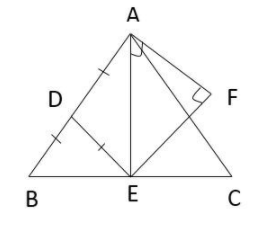
(A) True
(B) False
Answer
 Verified
595.2k+ views
Hint:We know that for a triangle to be isosceles, it should have two sides of equal length and the corresponding angles to be congruent i.e. angles must be equal to each other. The sum of all the angles of a triangle is $180^\circ $. In question as we can see it is given that all the angles are acute and one angle is $90^\circ $, if it is isosceles right angle and other angles are acute.
Complete step-by-step answer:
We are given that
$
AB = DB = DE \\
\angle EAC = \angle FAC \\
\angle F = 90^\circ \\
$
Now as we can see that, in$\vartriangle DBE$,
$DE = DB$
As $DE = AD$, therefore it is an isosceles triangle so it’s corresponding angles should be equal.
So, $\therefore \angle DBE = \angle DEB = m$ -- 1
In, $\vartriangle DAE$
Given, $AD = ED$
It is also an isosceles triangle
$\therefore \angle DEA = \angle DAE = n$ -- 2
Now, take $\vartriangle ABE$
As in a triangle sum of all angles is ${180^ \circ }$
$\therefore ABE + AEB + BAE = {180^ \circ }$
Here, $\angle AEB$ can be written as
$\angle AED + \angle DEB$ -- 3
From equation 1 and 2
$\angle ABE + \angle AED + \angle DEB + \angle BAE = {180^ \circ }$
$ \Rightarrow m + n + m + n = {180^ \circ }$
$2m + 2n = {180^ \circ }$
$\therefore $ $m + n = {90^ \circ }$
I.e. $\angle DEB + \angle DEA = {90^ \circ }$ $\left( {\because \angle DEB = m,\angle DEA = n} \right)$
From equation 3,$\angle AEB = {90^ \circ }$
As $\angle AEB$ and $\angle AEC$ is on line BC so,
$
\angle AEB + \angle AEC = {180^ \circ } \\
{90^ \circ } + \angle AEC = {180^ \circ } \\
\angle AEC = {180^ \circ } - {90^ \circ } \\
\angle AEC = {90^ \circ } \\
$
Now in $\vartriangle AEF$
Sum of all the angles of triangle is ${180^ \circ }$
Therefore,
$
\angle EAF + \angle AEF + \angle EFA = {180^ \circ } \\
\angle EAF + \angle AEF + {90^ \circ } = {180^ \circ } \\
\angle EAF + \angle AEF = {90^ \circ } \\
\angle AEF = {90^ \circ } - \angle EAF \\
$
As, $\angle AEC = {90^ \circ }$
So, $
\angle AEC = \angle AEF + \angle FEC \\
{90^ \circ } = \angle AEF + \angle FEC \\
\angle AEF = {90^ \circ } - \angle FEC \\
$ $\left( {\angle AEF = {{90}^ \circ } - \angle EAF} \right)$
$
\Rightarrow {90^ \circ } - \angle EAF = {90^ \circ } - \angle FEC \\
\angle EAF = \angle FEC \\
$
In $\vartriangle AEC$
We know that sum of angles of triangle is ${180^ \circ }$
Therefore,
$
\angle ACE + \angle EAC + \angle AEC = {180^ \circ } \\
\angle ACE + \angle EAC + {90^ \circ } = {180^ \circ } \\
\angle ACE = {180^ \circ } - {90^ \circ } - \angle EAC \\
\angle ACE = {90^ \circ } - \angle EAC \\
$
Now taking $\vartriangle GCE$
Sum of all the angles of triangle is ${180^ \circ }$
$\angle GCE + \angle GEC + \angle CGE = {180^ \circ }$
Here, $\angle GCE = \angle ACE$,
$
\therefore {90^ \circ } - \angle EAC + \angle 2EAC + \angle CGE = {180^ \circ } \\
\angle EAC + \angle CGE = {90^ \circ } \\
\\
$
So, $\angle GCE = {90^ \circ } - \angle EAC$ -- 5
From equation 4 and 5
$\angle GEC = \angle GCE$
$ \Rightarrow \vartriangle CEG$ or $\vartriangle GEC$is isosceles.
So the correct option is true.
Note:Any triangle is to be considered isosceles triangle if it has two equal sides and two equal angles. One should can make mistake while assigning names to the angels and then putting value of these angles
Complete step-by-step answer:
We are given that
$
AB = DB = DE \\
\angle EAC = \angle FAC \\
\angle F = 90^\circ \\
$
Now as we can see that, in$\vartriangle DBE$,
$DE = DB$
As $DE = AD$, therefore it is an isosceles triangle so it’s corresponding angles should be equal.
So, $\therefore \angle DBE = \angle DEB = m$ -- 1
In, $\vartriangle DAE$
Given, $AD = ED$
It is also an isosceles triangle
$\therefore \angle DEA = \angle DAE = n$ -- 2
Now, take $\vartriangle ABE$
As in a triangle sum of all angles is ${180^ \circ }$
$\therefore ABE + AEB + BAE = {180^ \circ }$
Here, $\angle AEB$ can be written as
$\angle AED + \angle DEB$ -- 3
From equation 1 and 2
$\angle ABE + \angle AED + \angle DEB + \angle BAE = {180^ \circ }$
$ \Rightarrow m + n + m + n = {180^ \circ }$
$2m + 2n = {180^ \circ }$
$\therefore $ $m + n = {90^ \circ }$
I.e. $\angle DEB + \angle DEA = {90^ \circ }$ $\left( {\because \angle DEB = m,\angle DEA = n} \right)$
From equation 3,$\angle AEB = {90^ \circ }$
As $\angle AEB$ and $\angle AEC$ is on line BC so,
$
\angle AEB + \angle AEC = {180^ \circ } \\
{90^ \circ } + \angle AEC = {180^ \circ } \\
\angle AEC = {180^ \circ } - {90^ \circ } \\
\angle AEC = {90^ \circ } \\
$
Now in $\vartriangle AEF$
Sum of all the angles of triangle is ${180^ \circ }$
Therefore,
$
\angle EAF + \angle AEF + \angle EFA = {180^ \circ } \\
\angle EAF + \angle AEF + {90^ \circ } = {180^ \circ } \\
\angle EAF + \angle AEF = {90^ \circ } \\
\angle AEF = {90^ \circ } - \angle EAF \\
$
As, $\angle AEC = {90^ \circ }$
So, $
\angle AEC = \angle AEF + \angle FEC \\
{90^ \circ } = \angle AEF + \angle FEC \\
\angle AEF = {90^ \circ } - \angle FEC \\
$ $\left( {\angle AEF = {{90}^ \circ } - \angle EAF} \right)$
$
\Rightarrow {90^ \circ } - \angle EAF = {90^ \circ } - \angle FEC \\
\angle EAF = \angle FEC \\
$
In $\vartriangle AEC$
We know that sum of angles of triangle is ${180^ \circ }$
Therefore,
$
\angle ACE + \angle EAC + \angle AEC = {180^ \circ } \\
\angle ACE + \angle EAC + {90^ \circ } = {180^ \circ } \\
\angle ACE = {180^ \circ } - {90^ \circ } - \angle EAC \\
\angle ACE = {90^ \circ } - \angle EAC \\
$
Now taking $\vartriangle GCE$
Sum of all the angles of triangle is ${180^ \circ }$
$\angle GCE + \angle GEC + \angle CGE = {180^ \circ }$
Here, $\angle GCE = \angle ACE$,
$
\therefore {90^ \circ } - \angle EAC + \angle 2EAC + \angle CGE = {180^ \circ } \\
\angle EAC + \angle CGE = {90^ \circ } \\
\\
$
So, $\angle GCE = {90^ \circ } - \angle EAC$ -- 5
From equation 4 and 5
$\angle GEC = \angle GCE$
$ \Rightarrow \vartriangle CEG$ or $\vartriangle GEC$is isosceles.
So the correct option is true.
Note:Any triangle is to be considered isosceles triangle if it has two equal sides and two equal angles. One should can make mistake while assigning names to the angels and then putting value of these angles
Recently Updated Pages
Master Class 10 Computer Science: Engaging Questions & Answers for Success

Master Class 10 General Knowledge: Engaging Questions & Answers for Success
Master Class 10 English: Engaging Questions & Answers for Success
Master Class 10 Social Science: Engaging Questions & Answers for Success
Master Class 10 Maths: Engaging Questions & Answers for Success
Master Class 10 Science: Engaging Questions & Answers for Success
Trending doubts
What is the median of the first 10 natural numbers class 10 maths CBSE
Which women's tennis player has 24 Grand Slam singles titles?
Who is the Brand Ambassador of Incredible India?
Why is there a time difference of about 5 hours between class 10 social science CBSE
Write a letter to the principal requesting him to grant class 10 english CBSE
A moving boat is observed from the top of a 150 m high class 10 maths CBSE