




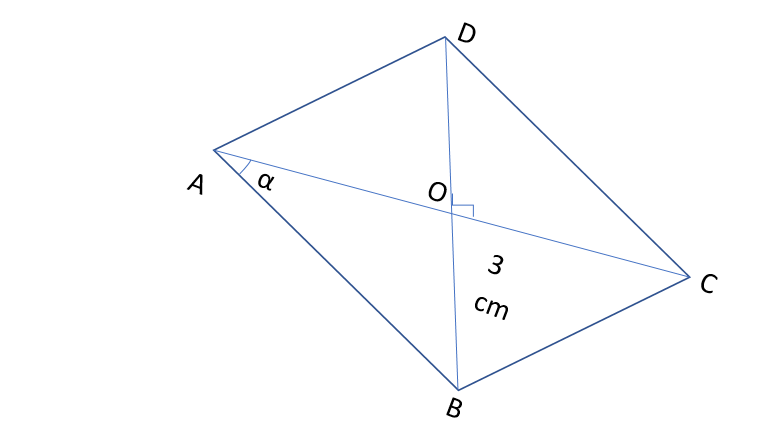
In figure ABCD is a rhombus whose diagonals AC makes an angle alpha with AB. If \[\cos \alpha = \dfrac{2}{3}\] and OB = 3 cm, Find the lengths of diagonals AC and BD.
Answer
 Verified
615.6k+ views
Hint: In a right triangle, the square of the hypotenuse is equal to the sum of the squares of the other two sides.
\[{a^2} = {b^2} + {c^2}\]
Use Pythagorean Theorem to solve the problem.
Complete step by step solution:
In figure ABCD is a rhombus \[\cos \alpha = \dfrac{2}{3}\] and OB = 3 cm
\[\vartriangle AOB,\;\vartriangle BOC,\;\vartriangle COD\;and\;\vartriangle AOD\]are right triangles
In \[\vartriangle AOB\], \[\cos \alpha = \dfrac{2}{3} = \dfrac{{AO}}{{AB}}\]
As per the above equation and taking x as a variable in the above equation, we can say
\[OA = 2x\] and \[AB = 3x\]
In \[\vartriangle AOB\]which is a right angles triangle by applying Pythagoras theorem:-
\[ \Rightarrow A{B^2} = A{O^2} + B{O^2}\]
\[ \Rightarrow {\left( {3x} \right)^2} = {\left( {2x} \right)^2} + {3^2}\]
We will first try to convert the above equation into standard form of a quadratic equation
\[ \Rightarrow 9{x^2} = 4{x^2} + 9\]
Now we will try to isolate the x terms in the equation.
\[ \Rightarrow 9{x^2} - 4{x^2} = 9\]
\[ \Rightarrow 5{x^2} = 9\]
\[ \Rightarrow {x^2} = \dfrac{9}{5}\]
When I'm solving an equation, I know that I can do whatever I like to that equation as long as I do the exact same thing to both sides of that equation. On the left-hand side of this particular equation, I have an x2, and I want a plain old x. To turn the x2 into an x, I can take the square root of each side of the equation, like this:
\[ \Rightarrow x = \sqrt {\dfrac{9}{5}} \]
\[ \Rightarrow x = \dfrac{3}{{\sqrt 5 }}\]
\[
Hence,\;OA\; = 2x = 2{\times}\dfrac{3}{{\sqrt 5 }} = \dfrac{6}{{\sqrt 5 }}cm \\
and\;AB = 3x = 3{\times}\dfrac{3}{{\sqrt 5 }} = \dfrac{9}{{\sqrt 5 }}cm \\
\]
\[
Hence\;diagonal \\
BD = 2{\times}OB = 2{\times}3 = 6\;cm \\
AC = 2{\times }OA = 2{\times}\dfrac{6}{{\sqrt 5 }} = \dfrac{{12}}{{\sqrt 5 }}cm \\
\]
The length of diagonals AC=$\dfrac{{12}}{{\sqrt 5 }}cm$ and BD=$6$cm .
Note:
The general approach is to collect all ${x^2}$ terms on one side of the equation while keeping the constants to the opposite side. After doing so, the next obvious step is to take the square roots of both sides to solve for the value of x. Always attach the symbol $ \pm $ when you get the square root of the constant.
\[{a^2} = {b^2} + {c^2}\]
Use Pythagorean Theorem to solve the problem.
Complete step by step solution:
In figure ABCD is a rhombus \[\cos \alpha = \dfrac{2}{3}\] and OB = 3 cm
\[\vartriangle AOB,\;\vartriangle BOC,\;\vartriangle COD\;and\;\vartriangle AOD\]are right triangles
In \[\vartriangle AOB\], \[\cos \alpha = \dfrac{2}{3} = \dfrac{{AO}}{{AB}}\]
As per the above equation and taking x as a variable in the above equation, we can say
\[OA = 2x\] and \[AB = 3x\]
In \[\vartriangle AOB\]which is a right angles triangle by applying Pythagoras theorem:-
\[ \Rightarrow A{B^2} = A{O^2} + B{O^2}\]
\[ \Rightarrow {\left( {3x} \right)^2} = {\left( {2x} \right)^2} + {3^2}\]
We will first try to convert the above equation into standard form of a quadratic equation
\[ \Rightarrow 9{x^2} = 4{x^2} + 9\]
Now we will try to isolate the x terms in the equation.
\[ \Rightarrow 9{x^2} - 4{x^2} = 9\]
\[ \Rightarrow 5{x^2} = 9\]
\[ \Rightarrow {x^2} = \dfrac{9}{5}\]
When I'm solving an equation, I know that I can do whatever I like to that equation as long as I do the exact same thing to both sides of that equation. On the left-hand side of this particular equation, I have an x2, and I want a plain old x. To turn the x2 into an x, I can take the square root of each side of the equation, like this:
\[ \Rightarrow x = \sqrt {\dfrac{9}{5}} \]
\[ \Rightarrow x = \dfrac{3}{{\sqrt 5 }}\]
\[
Hence,\;OA\; = 2x = 2{\times}\dfrac{3}{{\sqrt 5 }} = \dfrac{6}{{\sqrt 5 }}cm \\
and\;AB = 3x = 3{\times}\dfrac{3}{{\sqrt 5 }} = \dfrac{9}{{\sqrt 5 }}cm \\
\]
\[
Hence\;diagonal \\
BD = 2{\times}OB = 2{\times}3 = 6\;cm \\
AC = 2{\times }OA = 2{\times}\dfrac{6}{{\sqrt 5 }} = \dfrac{{12}}{{\sqrt 5 }}cm \\
\]
The length of diagonals AC=$\dfrac{{12}}{{\sqrt 5 }}cm$ and BD=$6$cm .
Note:
The general approach is to collect all ${x^2}$ terms on one side of the equation while keeping the constants to the opposite side. After doing so, the next obvious step is to take the square roots of both sides to solve for the value of x. Always attach the symbol $ \pm $ when you get the square root of the constant.
Recently Updated Pages
Master Class 12 Business Studies: Engaging Questions & Answers for Success

Master Class 12 Biology: Engaging Questions & Answers for Success
Master Class 12 Chemistry: Engaging Questions & Answers for Success
Class 12 Question and Answer - Your Ultimate Solutions Guide
Master Class 11 Social Science: Engaging Questions & Answers for Success
Master Class 11 English: Engaging Questions & Answers for Success
Trending doubts
What is the Full Form of ICSE / ISC ?
Fill the blanks with the suitable prepositions 1 The class 9 english CBSE
Difference Between Plant Cell and Animal Cell
How many hours before the closure of election must class 9 social science CBSE
What is pollution? How many types of pollution? Define it
Name 10 Living and Non living things class 9 biology CBSE