




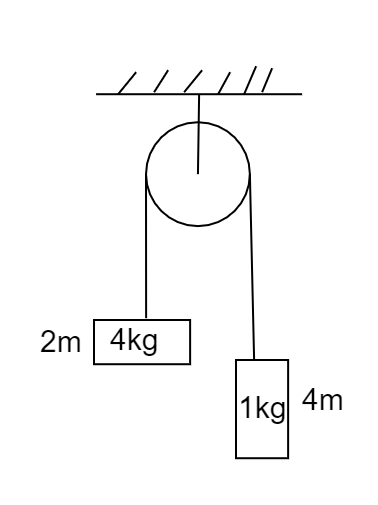
In Fig. shown, both blocks are released from rest. Length of $ 4\;kg $ the block is $ 2\;m $ and of $ 1\;kg $ is $ 4\;m $ . Find the time they took to cross each other? Assume pulley to be light and string to be light and inelastic.
Answer
 Verified
599.7k+ views
Hint: Here to find the time required by both blocks to cross each other, we will first evaluate the acceleration of the combined system. After that, we will use the equation of motions which relates the distance, time, and acceleration and by substitution, we will find the time required.
Formula used
Equation of motion
$ S = ut + \dfrac{1}{2}a{t^2} $
where $ s $ is the distance, $ u $ is initial velocity, $ a $ is acceleration, and $ t $ is time.
Complete Step-by-step solution
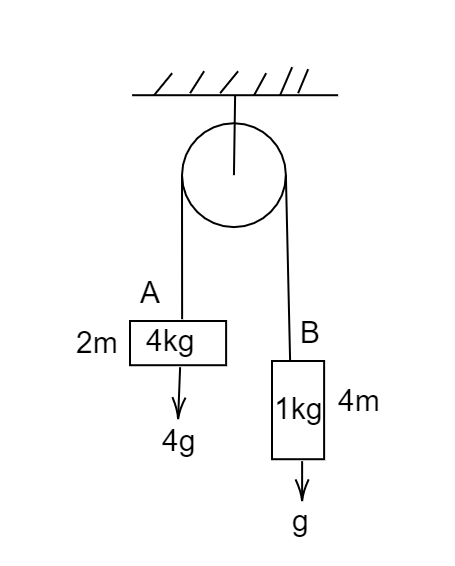
We will first try to understand the system consist of a pulley and two blocks that are released from rest, as we can see from the figure that the block $ A $ is being heavier than the block $ B $ , hence the gravitational acceleration $ g $ on the block $ A $ would be $ 4\;g $ and on the block, $ B $ it would only $ g $ .
Now for both blocks, the friction between the blocks can be given as
For block $ A $
$ \Rightarrow 4g - T = 4a $ ………. $ (1) $
For block $ B $
$ \Rightarrow T - g = a $ ………. $ (2) $
Solving the equation $ (1) $ and $ (2) $ we the acceleration is given as
$ \Rightarrow a = \dfrac{{4g - 1g}}{{4 + 1}} $
$ \Rightarrow a = \dfrac{{3g}}{5} $
Substituting the value of $ g = 10m/{s^2} $ , hence it results in
$ \Rightarrow a = \dfrac{{3 \times 10m/{s^2}}}{5} $
$ \therefore a = 6m/{s^2} $
Now the relative acceleration of block $ A $ with respect to block $ B $ can be evaluated as
$ \Rightarrow a = 2 \times 6m/{s^2} $
$ \Rightarrow a = 12m/{s^2} $
Now we will use the equation of motion which relates the distance, time, and acceleration given as
$ \Rightarrow S = ut + \dfrac{1}{2}a{t^2} $
where $ s $ is the distance, $ u $ is initial velocity, $ a $ is acceleration, and $ t $ is time.
Now from the figure, it can be seen that the total distance covered by the blocks to cross each other is given as $ S = 2m + 4m = 6\;m $ , and both blocks are released from rest hence the initial velocity can be given as $ u = 0\;m/s $ .
Therefore substituting the values in the equation of motion results in
$ \Rightarrow 6m = \dfrac{1}{2} \times \left( {12m/{s^2}} \right) \times {t^2} $
$ \Rightarrow t = \sqrt {\dfrac{{2 \times 6m}}{{12m/{s^2}}}} $
$ \therefore t = 1\;sec $
Hence the time taken by both the blocks to cross each other when they are released from rest is $ t = 1\;sec $ .
Note
Here in this question we have used the method of friction between the blocks method to find the acceleration. We have used gravitational acceleration which is $ g = 9.8m/{s^2} $ but we have used $ g = 10m/{s^2} $ it for our convenience as it is not provided in the question.
Formula used
Equation of motion
$ S = ut + \dfrac{1}{2}a{t^2} $
where $ s $ is the distance, $ u $ is initial velocity, $ a $ is acceleration, and $ t $ is time.
Complete Step-by-step solution
We will first try to understand the system consist of a pulley and two blocks that are released from rest, as we can see from the figure that the block $ A $ is being heavier than the block $ B $ , hence the gravitational acceleration $ g $ on the block $ A $ would be $ 4\;g $ and on the block, $ B $ it would only $ g $ .
Now for both blocks, the friction between the blocks can be given as
For block $ A $
$ \Rightarrow 4g - T = 4a $ ………. $ (1) $
For block $ B $
$ \Rightarrow T - g = a $ ………. $ (2) $
Solving the equation $ (1) $ and $ (2) $ we the acceleration is given as
$ \Rightarrow a = \dfrac{{4g - 1g}}{{4 + 1}} $
$ \Rightarrow a = \dfrac{{3g}}{5} $
Substituting the value of $ g = 10m/{s^2} $ , hence it results in
$ \Rightarrow a = \dfrac{{3 \times 10m/{s^2}}}{5} $
$ \therefore a = 6m/{s^2} $
Now the relative acceleration of block $ A $ with respect to block $ B $ can be evaluated as
$ \Rightarrow a = 2 \times 6m/{s^2} $
$ \Rightarrow a = 12m/{s^2} $
Now we will use the equation of motion which relates the distance, time, and acceleration given as
$ \Rightarrow S = ut + \dfrac{1}{2}a{t^2} $
where $ s $ is the distance, $ u $ is initial velocity, $ a $ is acceleration, and $ t $ is time.
Now from the figure, it can be seen that the total distance covered by the blocks to cross each other is given as $ S = 2m + 4m = 6\;m $ , and both blocks are released from rest hence the initial velocity can be given as $ u = 0\;m/s $ .
Therefore substituting the values in the equation of motion results in
$ \Rightarrow 6m = \dfrac{1}{2} \times \left( {12m/{s^2}} \right) \times {t^2} $
$ \Rightarrow t = \sqrt {\dfrac{{2 \times 6m}}{{12m/{s^2}}}} $
$ \therefore t = 1\;sec $
Hence the time taken by both the blocks to cross each other when they are released from rest is $ t = 1\;sec $ .
Note
Here in this question we have used the method of friction between the blocks method to find the acceleration. We have used gravitational acceleration which is $ g = 9.8m/{s^2} $ but we have used $ g = 10m/{s^2} $ it for our convenience as it is not provided in the question.
Recently Updated Pages
Master Class 11 English: Engaging Questions & Answers for Success

Master Class 11 Social Science: Engaging Questions & Answers for Success
Master Class 11 Maths: Engaging Questions & Answers for Success
Master Class 11 Biology: Engaging Questions & Answers for Success
Master Class 11 Physics: Engaging Questions & Answers for Success
Master Class 11 Chemistry: Engaging Questions & Answers for Success
Trending doubts
One Metric ton is equal to kg A 10000 B 1000 C 100 class 11 physics CBSE
Difference Between Prokaryotic Cells and Eukaryotic Cells
Find the value of the expression given below sin 30circ class 11 maths CBSE
1 ton equals to A 100 kg B 1000 kg C 10 kg D 10000 class 11 physics CBSE
Two of the body parts which do not appear in MRI are class 11 biology CBSE
What are hard magnetic materials class 11 physics CBSE