




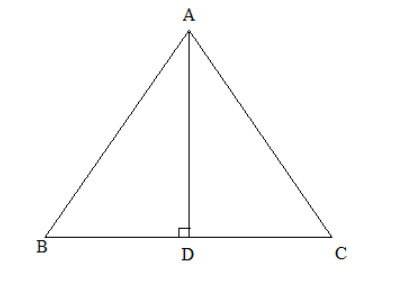
In fig. Given below, AB = BC=CA =2a and segment AD$ \bot $ side BC. Show that
i) AD= $a\sqrt 3 $
ii) area of $\vartriangle ABC = {a^2}\sqrt 3 $
Answer
 Verified
598.2k+ views
Hint- In this question, we know that all sides are equal. So first of all we show that BD = DC =a. After this using the pythagorean theorem, we will find the length of the perpendicular AD. Using the formula for finding the area of the triangle, we will find the area of the given triangle.
Complete step-by-step answer:
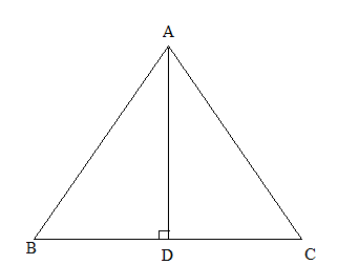
The diagram for the question is given below:
It is given that:
AB = BC = CA =2a and AD$ \bot $ BC.
In $\vartriangle ABD$and $\vartriangle ACD$, we have:
AB = CA
$\angle ADB = \angle ADC = {90^0}$.
AD = AD (common side)
$\therefore $ By using SAS rule of congruence, $\vartriangle ABD \cong \vartriangle ACD$
So, we can say that, BD = CD.
Now, we know that $\vartriangle ABD$is a right triangle and BD = a and AB = 2a.
Therefore, using the pythagorean theorem, we can write:
$A{B^2} = B{D^2} + A{D^2}$
$ \Rightarrow A{D^2} = A{B^2} - B{D^2}$
$ \Rightarrow AD = \sqrt {A{B^2} - B{D^2}} $
Putting the value of AB and Bd in above equation, we get:
$ \Rightarrow AD = \sqrt {{{(2a)}^2} - {a^2}} = \sqrt {3{a^2}} = a\sqrt 3 $.
Therefore, the length of perpendicular AD =$a\sqrt 3 $.
Now, we know that,
Area of a triangle ABC =$\dfrac{1}{2} \times base \times height $
Putting the values of base and height in above equation, we get:
Area of $\vartriangle ABC = \dfrac{1}{2} \times 2a \times a\sqrt 3 = {a^2}\sqrt 3 $.
Therefore, we have proved the statement 1 and 2.
Note- In this type of question where you have to prove some results related to mensuration, you should have pre knowledge of basic theorem like pythagoras theorem and also you should have knowledge about the given shape like in parallelogram opposite sides are equal and parallel. According to the pythagorean theorem, in a right triangle, the sum of squares of two sides is equal to the square of the third largest side.
Complete step-by-step answer:
The diagram for the question is given below:
It is given that:
AB = BC = CA =2a and AD$ \bot $ BC.
In $\vartriangle ABD$and $\vartriangle ACD$, we have:
AB = CA
$\angle ADB = \angle ADC = {90^0}$.
AD = AD (common side)
$\therefore $ By using SAS rule of congruence, $\vartriangle ABD \cong \vartriangle ACD$
So, we can say that, BD = CD.
Now, we know that $\vartriangle ABD$is a right triangle and BD = a and AB = 2a.
Therefore, using the pythagorean theorem, we can write:
$A{B^2} = B{D^2} + A{D^2}$
$ \Rightarrow A{D^2} = A{B^2} - B{D^2}$
$ \Rightarrow AD = \sqrt {A{B^2} - B{D^2}} $
Putting the value of AB and Bd in above equation, we get:
$ \Rightarrow AD = \sqrt {{{(2a)}^2} - {a^2}} = \sqrt {3{a^2}} = a\sqrt 3 $.
Therefore, the length of perpendicular AD =$a\sqrt 3 $.
Now, we know that,
Area of a triangle ABC =$\dfrac{1}{2} \times base \times height $
Putting the values of base and height in above equation, we get:
Area of $\vartriangle ABC = \dfrac{1}{2} \times 2a \times a\sqrt 3 = {a^2}\sqrt 3 $.
Therefore, we have proved the statement 1 and 2.
Note- In this type of question where you have to prove some results related to mensuration, you should have pre knowledge of basic theorem like pythagoras theorem and also you should have knowledge about the given shape like in parallelogram opposite sides are equal and parallel. According to the pythagorean theorem, in a right triangle, the sum of squares of two sides is equal to the square of the third largest side.
Recently Updated Pages
Master Class 10 Computer Science: Engaging Questions & Answers for Success

Master Class 10 General Knowledge: Engaging Questions & Answers for Success
Master Class 10 English: Engaging Questions & Answers for Success
Master Class 10 Social Science: Engaging Questions & Answers for Success
Master Class 10 Maths: Engaging Questions & Answers for Success
Master Class 10 Science: Engaging Questions & Answers for Success
Trending doubts
The draft of the Preamble of the Indian Constitution class 10 social science CBSE
Who gave "Inqilab Zindabad" slogan?
Why is there a time difference of about 5 hours between class 10 social science CBSE
What is the minimum age for fighting the election in class 10 social science CBSE
Write an application to the principal requesting five class 10 english CBSE
My birthday is June 27 a On b Into c Between d In class 10 english CBSE