




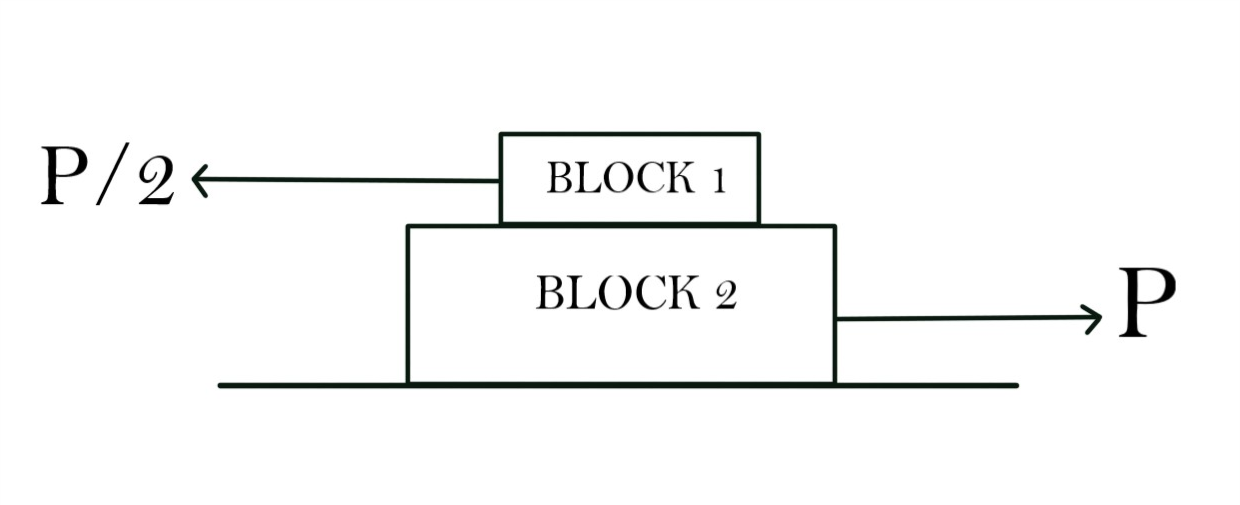
In fig. block 1 is placed on block2. Both of them have mass $1kg$. The coefficients of friction between block 1 and 2 are ${\mu _s} = 0.75$and ${\mu _k} = 0.6$. The table is frictionless. A force $\dfrac{p}{2}$ is applied on block 1 to the left, and force $P$ on block 2 on the right. Find the minimum value of P such that sliding occurs between the two blocks.
Answer
 Verified
596.1k+ views
Hint: Make a free body diagram of both the blocks and balance forces for each of them. They compare both the equations. The friction on each block would be equal and opposite in direction and is equal to the product of coefficient of static friction and mass of block 1.
Complete step-by-step answer:
First, we have to make the free body diagram of both the blocks individually.
Free body diagrams of block 1 and block 2 are given below.
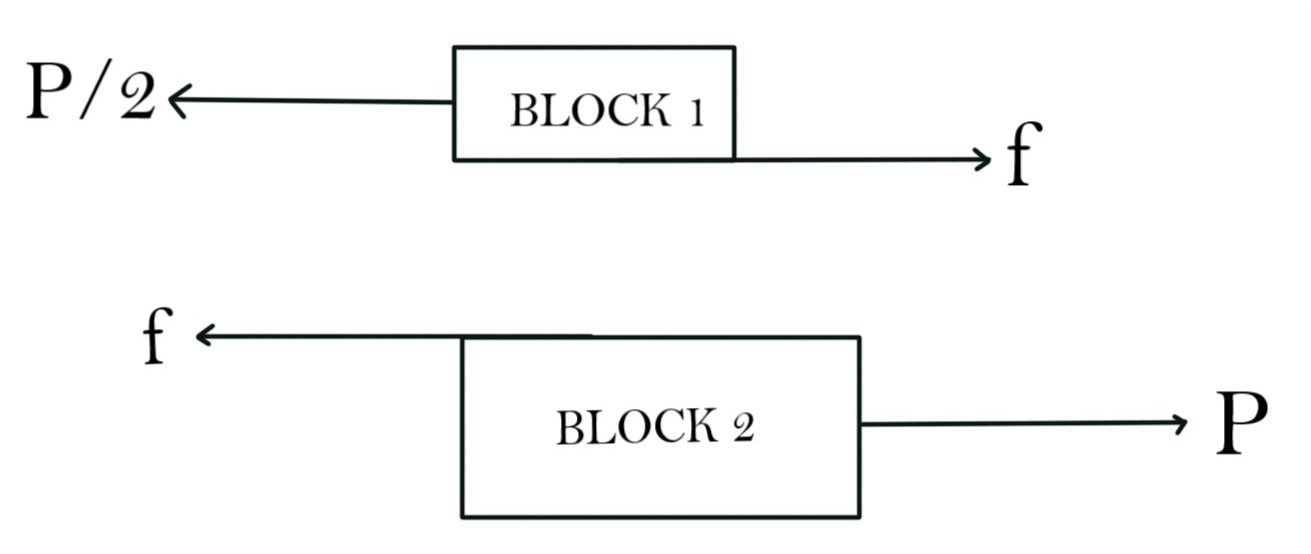
Where f is the force of friction between the two blocks. Here the force of friction on block 1 is to the right because the force of the block is trying to make the block move toward left. Similarly, the force of friction on block 2 is to the left. The force on friction between the two blocks is equal in magnitude because it is an internal force.
We know that,
$f = {\mu _s}mg$
$
f = 0.75 \times 1 \times 10 \\
f = 7.5N \\
$
From the free body diagram of first block, we can conclude:
$
\dfrac{P}{2} \geqslant f \\
\dfrac{P}{2} \geqslant 7.5 \\
P \geqslant 15N \\
$
From the free body diagram of second block, we can conclude:
$P \geqslant 7.5N$
From both the equations, we can conclude that $P$should be greater than $7.5N$ in order to make the blocks slide.
Additional information: Static friction is the frictional force acting between two surfaces which are attempting to move but are not moving. Kinetic friction is the frictional force acting between two surfaces which are in motion against each other. Static friction is always greater than that of kinetic friction.
Note: In this question, we use static friction instead of kinetic friction because static friction is greater than kinetic friction and the force has to overcome static friction in order to make the blocks slide over each other.
Complete step-by-step answer:
First, we have to make the free body diagram of both the blocks individually.
Free body diagrams of block 1 and block 2 are given below.
Where f is the force of friction between the two blocks. Here the force of friction on block 1 is to the right because the force of the block is trying to make the block move toward left. Similarly, the force of friction on block 2 is to the left. The force on friction between the two blocks is equal in magnitude because it is an internal force.
We know that,
$f = {\mu _s}mg$
$
f = 0.75 \times 1 \times 10 \\
f = 7.5N \\
$
From the free body diagram of first block, we can conclude:
$
\dfrac{P}{2} \geqslant f \\
\dfrac{P}{2} \geqslant 7.5 \\
P \geqslant 15N \\
$
From the free body diagram of second block, we can conclude:
$P \geqslant 7.5N$
From both the equations, we can conclude that $P$should be greater than $7.5N$ in order to make the blocks slide.
Additional information: Static friction is the frictional force acting between two surfaces which are attempting to move but are not moving. Kinetic friction is the frictional force acting between two surfaces which are in motion against each other. Static friction is always greater than that of kinetic friction.
Note: In this question, we use static friction instead of kinetic friction because static friction is greater than kinetic friction and the force has to overcome static friction in order to make the blocks slide over each other.
Recently Updated Pages
Master Class 11 Computer Science: Engaging Questions & Answers for Success

Master Class 11 Business Studies: Engaging Questions & Answers for Success
Master Class 11 Economics: Engaging Questions & Answers for Success
Master Class 11 English: Engaging Questions & Answers for Success
Master Class 11 Maths: Engaging Questions & Answers for Success
Master Class 11 Biology: Engaging Questions & Answers for Success
Trending doubts
One Metric ton is equal to kg A 10000 B 1000 C 100 class 11 physics CBSE
There are 720 permutations of the digits 1 2 3 4 5 class 11 maths CBSE
Discuss the various forms of bacteria class 11 biology CBSE
Draw a diagram of a plant cell and label at least eight class 11 biology CBSE
State the laws of reflection of light
Explain zero factorial class 11 maths CBSE