




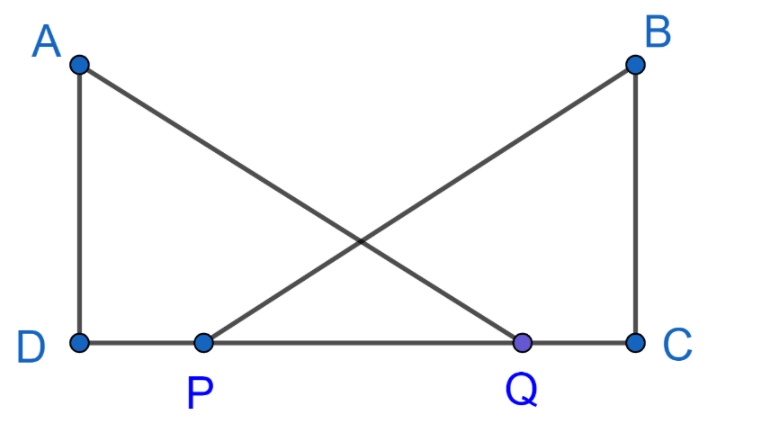
In fig. $AD\bot CD$ and $CB\bot CD$. If $AQ=BP$ and $DP=CQ$, then prove that $\angle DAQ=\angle CBP$.
Answer
 Verified
539.1k+ views
Hint: To solve this question we need to have the knowledge of congruency. In the figure given we will divide the figure into two Triangles in such a manner that it will prove both the triangle congruent as congruent and hence forth with the help of c.p.c.t. we will prove $\angle DAQ=\angle CBP$.
Complete step by step answer:
The question asks us to prove equal angle $\angle DAQ=\angle CBP$ when there are conditions given to us which are $AD\bot CD$ and $CB\bot CD$. The lengths are equal as $AQ=BP$ and $DP=CQ$. To solve this question the first step will be to consider a triangle which contains the angle that we need to prove equal which is $\angle DAQ$ and $\angle CBP$ as per the conditions which are given in the question. We will first find the congruence of the two triangles on rules of congruence which are $\vartriangle ADQ$ and $\vartriangle BCP$ as per all the conditions given to us.
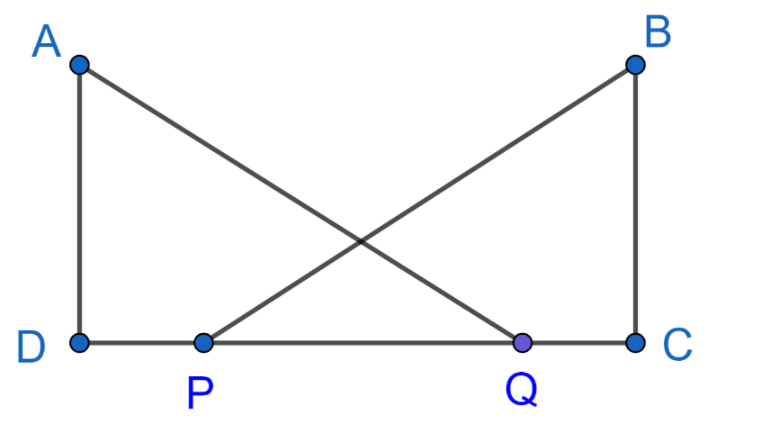
In the triangles $\vartriangle ADQ$ and $\vartriangle BCP$we will apply congruent:
$i)\angle ADC=\angle BCP={{90}^{\circ }}(given)$
$ii)AQ=BP(given)$
$iii)DQ=CP$
But the third condition is not exactly given in the problem. So we will expand to see the actual condition.
$\Rightarrow DP+PQ=CQ+PQ$
On subtracting the both side of the expression with $PQ$ we get:
$\Rightarrow DP+PQ-PQ=CQ+PQ-PQ$
On doing so the result we got is:
$\Rightarrow DP=CQ(given)$
On seeing the conditions collectively we infer that the triangles are proved congruent by $RHS$ (Right Angle, Hypotenuse, Side). So the triangles $\vartriangle ADQ$ and $\vartriangle BCP$ are now congruent.
On applying c.p.c.t(Corresponding parts of congruent triangle) which says that if the triangles are congruent then the sides corresponding to that triangles will be equal.
$\because \vartriangle ADQ\approx \vartriangle BPC$
$\therefore \angle DAQ=\angle CBP\text{(by c}\text{.p}\text{.c}\text{.t)}$
Note: In these types of questions, the figure may be divided into many triangles to prove the congruent. The triangle we need to choose should be such, which will give us the relation between what we are given to prove in the question. Also keep in mind regarding the condition given in the question.
Complete step by step answer:
The question asks us to prove equal angle $\angle DAQ=\angle CBP$ when there are conditions given to us which are $AD\bot CD$ and $CB\bot CD$. The lengths are equal as $AQ=BP$ and $DP=CQ$. To solve this question the first step will be to consider a triangle which contains the angle that we need to prove equal which is $\angle DAQ$ and $\angle CBP$ as per the conditions which are given in the question. We will first find the congruence of the two triangles on rules of congruence which are $\vartriangle ADQ$ and $\vartriangle BCP$ as per all the conditions given to us.
In the triangles $\vartriangle ADQ$ and $\vartriangle BCP$we will apply congruent:
$i)\angle ADC=\angle BCP={{90}^{\circ }}(given)$
$ii)AQ=BP(given)$
$iii)DQ=CP$
But the third condition is not exactly given in the problem. So we will expand to see the actual condition.
$\Rightarrow DP+PQ=CQ+PQ$
On subtracting the both side of the expression with $PQ$ we get:
$\Rightarrow DP+PQ-PQ=CQ+PQ-PQ$
On doing so the result we got is:
$\Rightarrow DP=CQ(given)$
On seeing the conditions collectively we infer that the triangles are proved congruent by $RHS$ (Right Angle, Hypotenuse, Side). So the triangles $\vartriangle ADQ$ and $\vartriangle BCP$ are now congruent.
On applying c.p.c.t(Corresponding parts of congruent triangle) which says that if the triangles are congruent then the sides corresponding to that triangles will be equal.
$\because \vartriangle ADQ\approx \vartriangle BPC$
$\therefore \angle DAQ=\angle CBP\text{(by c}\text{.p}\text{.c}\text{.t)}$
Note: In these types of questions, the figure may be divided into many triangles to prove the congruent. The triangle we need to choose should be such, which will give us the relation between what we are given to prove in the question. Also keep in mind regarding the condition given in the question.
Recently Updated Pages
Master Class 11 English: Engaging Questions & Answers for Success

Master Class 11 Maths: Engaging Questions & Answers for Success
Class 11 Question and Answer - Your Ultimate Solutions Guide
Master Class 11 Biology: Engaging Questions & Answers for Success
Master Class 11 Physics: Engaging Questions & Answers for Success
Master Class 11 Accountancy: Engaging Questions & Answers for Success
Trending doubts
Explain the Treaty of Vienna of 1815 class 10 social science CBSE
Who Won 36 Oscar Awards? Record Holder Revealed
What is the median of the first 10 natural numbers class 10 maths CBSE
Why is it 530 pm in india when it is 1200 afternoon class 10 social science CBSE
Why is there a time difference of about 5 hours between class 10 social science CBSE
What is the full form of POSCO class 10 social science CBSE