




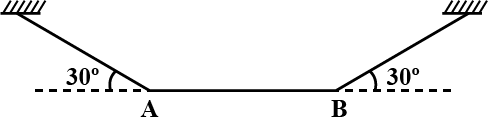
In Fig. a massive rod AB is held in a horizontal position by two massless strings. If the string at B breaks and if the horizontal acceleration of centre of mass, vertical acceleration and angular acceleration of rod about the centre of mass are ${a_x}$, ${a_y}$ and $\alpha $ respectively, then
A) $2\sqrt 3 ay$ =$\sqrt 3 \alpha l$ +2${a_x}$
B) $\sqrt 3 {a_y}$ =$\sqrt 3 \alpha l$ +${a_x}$
C) ${a_y}$=$\sqrt 3 \alpha l$ +${2_\alpha }x$
D) $2{a_y}$ =$\alpha l$ +$2\sqrt 3 {a_x}$
Answer
 Verified
587.4k+ views
Hint: The question is a bit tricky and can easily be solved by making a diagram according to the components of sin and cos. For some help below diagram is provided. The component $T\cos {30^0}$ provides horizontal acceleration $ax$ to rod and the same way the component $T\sin {30^o}$ provides torque too. Then by equating it with angular acceleration with center of mass m we will find our solution.
Step by step solution:
Step 1:
Assuming tension in string A be T and length of rod AB be L, with mass m.
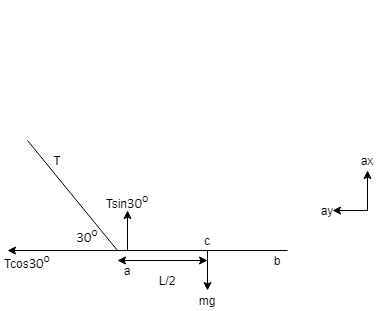
Here c is the center of mass. For more clarity let us consider the diagram below:
Step 2:
The component $T\cos {30^0}$ provides horizontal acceleration $ax$ to rod and $ax$=$\dfrac{{T\cos {{30}^0}}}{M}$
The component $T\sin {30^o}$ provides torque, torque= $T\sin {30^o}$×$\dfrac{L}{2}$
This is equal to $\dfrac{{TL}}{4}$ …. (1)
And in vertical using Newton’s law May= $T\sin {30^o}$−Mg $ \Rightarrow $ ay=$\left( {\dfrac{T}{{2M}} - g} \right)$ ………. (2)
The torque provides necessary angular acceleration, torque=$I\alpha $
Where I about center of mass C is $\dfrac{{M{L^2}}}{{12}}$….. (3)
Equating (1) and (3) together and putting the value of torque $\dfrac{{TL}}{4}$= $\dfrac{{M{L^2}}}{{12}}$
This implies $\dfrac{T}{M}$ =$\dfrac{{\alpha L}}{3}$……. (4)
Hence, from equation (1), (2) and (4) we get $ax$=$\dfrac{{\alpha L\cos {{30}_o}}}{3}$ which is equal to $\dfrac{{\alpha L}}{{2\sqrt 3 }}$
And $ay$=$\dfrac{{\alpha L}}{6} - g$
Thus we get 2ay=2$\sqrt 3 $ax +$\alpha L$
Hence option D is correct.
Note:Point of mistake: The whole solution depends upon the diagram provided in the question and the other one which is made on the basis of the components of the vector. Without this diagram the question is tricky to solve so make it error free. Second thing is the numerical part, assign the equation number before proceeding so as to use and equate where ever necessary.
Step by step solution:
Step 1:
Assuming tension in string A be T and length of rod AB be L, with mass m.
Here c is the center of mass. For more clarity let us consider the diagram below:
Step 2:
The component $T\cos {30^0}$ provides horizontal acceleration $ax$ to rod and $ax$=$\dfrac{{T\cos {{30}^0}}}{M}$
The component $T\sin {30^o}$ provides torque, torque= $T\sin {30^o}$×$\dfrac{L}{2}$
This is equal to $\dfrac{{TL}}{4}$ …. (1)
And in vertical using Newton’s law May= $T\sin {30^o}$−Mg $ \Rightarrow $ ay=$\left( {\dfrac{T}{{2M}} - g} \right)$ ………. (2)
The torque provides necessary angular acceleration, torque=$I\alpha $
Where I about center of mass C is $\dfrac{{M{L^2}}}{{12}}$….. (3)
Equating (1) and (3) together and putting the value of torque $\dfrac{{TL}}{4}$= $\dfrac{{M{L^2}}}{{12}}$
This implies $\dfrac{T}{M}$ =$\dfrac{{\alpha L}}{3}$……. (4)
Hence, from equation (1), (2) and (4) we get $ax$=$\dfrac{{\alpha L\cos {{30}_o}}}{3}$ which is equal to $\dfrac{{\alpha L}}{{2\sqrt 3 }}$
And $ay$=$\dfrac{{\alpha L}}{6} - g$
Thus we get 2ay=2$\sqrt 3 $ax +$\alpha L$
Hence option D is correct.
Note:Point of mistake: The whole solution depends upon the diagram provided in the question and the other one which is made on the basis of the components of the vector. Without this diagram the question is tricky to solve so make it error free. Second thing is the numerical part, assign the equation number before proceeding so as to use and equate where ever necessary.
Recently Updated Pages
Master Class 11 Computer Science: Engaging Questions & Answers for Success

Master Class 11 Business Studies: Engaging Questions & Answers for Success
Master Class 11 Economics: Engaging Questions & Answers for Success
Master Class 11 English: Engaging Questions & Answers for Success
Master Class 11 Maths: Engaging Questions & Answers for Success
Master Class 11 Biology: Engaging Questions & Answers for Success
Trending doubts
There are 720 permutations of the digits 1 2 3 4 5 class 11 maths CBSE
Discuss the various forms of bacteria class 11 biology CBSE
Explain zero factorial class 11 maths CBSE
What organs are located on the left side of your body class 11 biology CBSE
Draw a diagram of nephron and explain its structur class 11 biology CBSE
How do I convert ms to kmh Give an example class 11 physics CBSE