




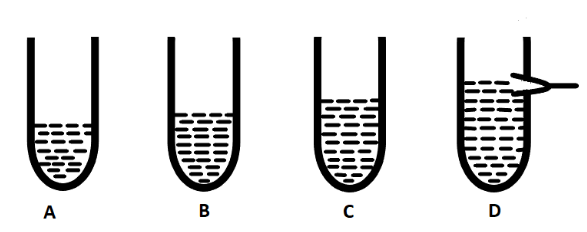
In fig. A, B, C and D represent test tubes each of height $20cm$ which are filled with water up to heights of $12cm$ , $14cm$ , $16cm$ and $18cm$ respectively. If a vibrating tuning fork is placed over the mouth of the tube D, a loud sound is heard. Give the reason for your observation in each case.
Answer
 Verified
585.9k+ views
Hint: Here we will use the concept of resonant frequency. Resonance is defined as the phenomenon in which the amplitude is increased, when the frequency of a force applied periodically will be equal to or close to the natural frequency. When the vibrating tuning fork is brought near to tube B, the adjacent tubes will start vibrating and these vibrations will produce a sound.
Complete answer:
In this case, when the tuning fork is brought near the tube D, the adjacent tubes will start vibrating. With the vibration, a resonance will occur with the air column in tube B whereas the resonance will not occur with the air columns in tube A and C.
Now, the length of the air column in tube B is $20 - 14 = 6cm$ and the length of the air column in tube D is $20 - 18 = 2cm$ . As we can see that the length of the air column in tube B is three times the length of the air column in tube D. therefore, the frequency vibration of the air column in tube B will be equal to the frequency vibration of the sir column in tube D. Also, the frequency of the air column in tube A and C will not be equal to the frequency vibration of the air column in tube D.
Therefore, a loud sound will be produced in tube B and the least sound will be produced in the tubes A and C.
Note:Here, the frequency of air columns in tubes A and C will also not be equal to the frequency of the air column in tube B. Also, the frequency at which the response amplitude will be relatively maximum are known as the system's resonant frequency. At this frequency, large amplitude oscillations will be produced by even small periodic driving forces.
Complete answer:
In this case, when the tuning fork is brought near the tube D, the adjacent tubes will start vibrating. With the vibration, a resonance will occur with the air column in tube B whereas the resonance will not occur with the air columns in tube A and C.
Now, the length of the air column in tube B is $20 - 14 = 6cm$ and the length of the air column in tube D is $20 - 18 = 2cm$ . As we can see that the length of the air column in tube B is three times the length of the air column in tube D. therefore, the frequency vibration of the air column in tube B will be equal to the frequency vibration of the sir column in tube D. Also, the frequency of the air column in tube A and C will not be equal to the frequency vibration of the air column in tube D.
Therefore, a loud sound will be produced in tube B and the least sound will be produced in the tubes A and C.
Note:Here, the frequency of air columns in tubes A and C will also not be equal to the frequency of the air column in tube B. Also, the frequency at which the response amplitude will be relatively maximum are known as the system's resonant frequency. At this frequency, large amplitude oscillations will be produced by even small periodic driving forces.
Recently Updated Pages
Three beakers labelled as A B and C each containing 25 mL of water were taken A small amount of NaOH anhydrous CuSO4 and NaCl were added to the beakers A B and C respectively It was observed that there was an increase in the temperature of the solutions contained in beakers A and B whereas in case of beaker C the temperature of the solution falls Which one of the following statements isarecorrect i In beakers A and B exothermic process has occurred ii In beakers A and B endothermic process has occurred iii In beaker C exothermic process has occurred iv In beaker C endothermic process has occurred

Master Class 11 Social Science: Engaging Questions & Answers for Success
Master Class 11 Physics: Engaging Questions & Answers for Success
Master Class 11 Maths: Engaging Questions & Answers for Success
Master Class 11 Economics: Engaging Questions & Answers for Success
Master Class 11 Computer Science: Engaging Questions & Answers for Success
Three beakers labelled as A B and C each containing 25 mL of water were taken A small amount of NaOH anhydrous CuSO4 and NaCl were added to the beakers A B and C respectively It was observed that there was an increase in the temperature of the solutions contained in beakers A and B whereas in case of beaker C the temperature of the solution falls Which one of the following statements isarecorrect i In beakers A and B exothermic process has occurred ii In beakers A and B endothermic process has occurred iii In beaker C exothermic process has occurred iv In beaker C endothermic process has occurred
Master Class 11 Social Science: Engaging Questions & Answers for Success
Master Class 11 Physics: Engaging Questions & Answers for Success
Trending doubts
One Metric ton is equal to kg A 10000 B 1000 C 100 class 11 physics CBSE
There are 720 permutations of the digits 1 2 3 4 5 class 11 maths CBSE
State and prove Bernoullis theorem class 11 physics CBSE
Draw a diagram of a plant cell and label at least eight class 11 biology CBSE
Difference Between Prokaryotic Cells and Eukaryotic Cells
Discuss the various forms of bacteria class 11 biology CBSE