




In family Caesalpiniaceae, odd sepal is
(a) Anterior
(b) Posterior
(c) Anterior-posterior
(d) None of the above
Answer
 Verified
574.5k+ views
Hint: Caesalpiniaceae family is known also as the peacock flower subfamily. Their calyx consists of 5 green sepals, united or free. There is one modified petal which is smaller than the other 4 petals, flowers borne in terminal clusters.
Complete answer:
In Caesalpiniaceae, the odd sepal is in anterior condition, but in Solanaceae the odd sepal is posterior, which lies near the mother axis. They are mostly shrubs or trees. Leaves are large, pinnately, or pinnately compounds and stipulate. Stipules are either small or articulate. Flowers are big and showy forming clusters, they are bisexual, perigynous, and pentamerous.
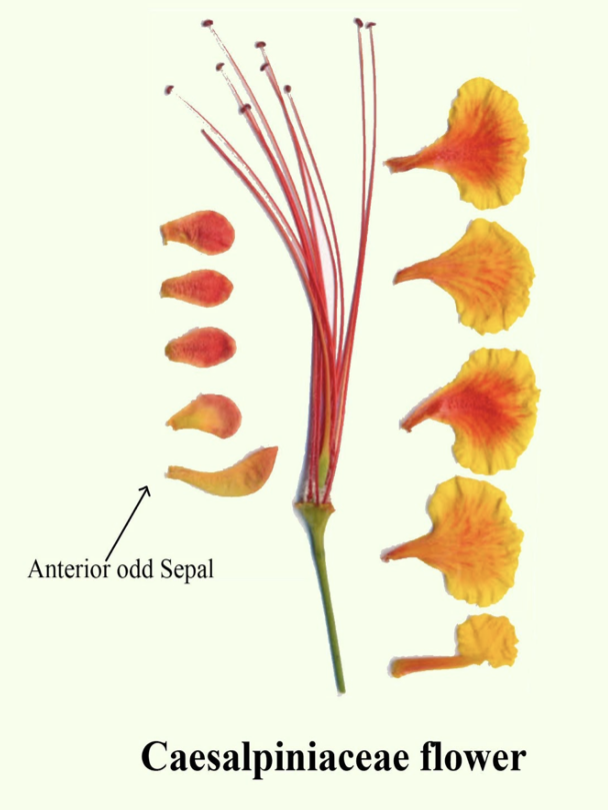
Sepals 5, free, or connate, odd sepal anterior, imbricate aestivation. In Tamarindus the two posterior sepals are united. Petals 5, in Tamarindus there are only three posterior petals; in Copaifera saraca the petals are totally reduced; free, ascending imbricate aestivation, the posterior petal is innermost. Inflorescence mostly racemose or panicle. Fruit is long, legume; seed in some cases is endospermous.
Additional Information:
- Androecium consists of 10 stamens. Anthers are dithecous, basifixed or versatile, Dehiscing by longitudinal slits. Stamens are usually free, rarely connate, but sometimes reduced to staminodes or altogether abortive. In Cassia 3 to 5 stamens, reduced to staminodes, in Tamarindus sp. 3 stamens are well developed, while rest are reduced into staminodes.
- Gynoecium is monocarpellary, ovary is cylindrical with terminal style and a capitate stigma. ovary superior, unilocular; marginal placentation; style long; stigma simple.
- Ovary is unilocular with numerous ovules. Entomophilous pollination is usually seen.
So, the correct answer is '(a) Anterior'.
Note:
- The members of caesalpiniaceae are economically important. Flowers are used as an excellent uterine tonic.
- Fruits of some members are edible. Stem of some of them yields a fibre suitable for making paper, ropes etc.
- Twigs of some of them are used as fodder. Some of them are used in curing skin-diseases such as ringworm etc. Certain plants are grown as ornamental plants.
Complete answer:
In Caesalpiniaceae, the odd sepal is in anterior condition, but in Solanaceae the odd sepal is posterior, which lies near the mother axis. They are mostly shrubs or trees. Leaves are large, pinnately, or pinnately compounds and stipulate. Stipules are either small or articulate. Flowers are big and showy forming clusters, they are bisexual, perigynous, and pentamerous.
Sepals 5, free, or connate, odd sepal anterior, imbricate aestivation. In Tamarindus the two posterior sepals are united. Petals 5, in Tamarindus there are only three posterior petals; in Copaifera saraca the petals are totally reduced; free, ascending imbricate aestivation, the posterior petal is innermost. Inflorescence mostly racemose or panicle. Fruit is long, legume; seed in some cases is endospermous.
Additional Information:
- Androecium consists of 10 stamens. Anthers are dithecous, basifixed or versatile, Dehiscing by longitudinal slits. Stamens are usually free, rarely connate, but sometimes reduced to staminodes or altogether abortive. In Cassia 3 to 5 stamens, reduced to staminodes, in Tamarindus sp. 3 stamens are well developed, while rest are reduced into staminodes.
- Gynoecium is monocarpellary, ovary is cylindrical with terminal style and a capitate stigma. ovary superior, unilocular; marginal placentation; style long; stigma simple.
- Ovary is unilocular with numerous ovules. Entomophilous pollination is usually seen.
So, the correct answer is '(a) Anterior'.
Note:
- The members of caesalpiniaceae are economically important. Flowers are used as an excellent uterine tonic.
- Fruits of some members are edible. Stem of some of them yields a fibre suitable for making paper, ropes etc.
- Twigs of some of them are used as fodder. Some of them are used in curing skin-diseases such as ringworm etc. Certain plants are grown as ornamental plants.
Recently Updated Pages
Master Class 11 Computer Science: Engaging Questions & Answers for Success

Master Class 11 Business Studies: Engaging Questions & Answers for Success
Master Class 11 Economics: Engaging Questions & Answers for Success
Master Class 11 English: Engaging Questions & Answers for Success
Master Class 11 Maths: Engaging Questions & Answers for Success
Master Class 11 Biology: Engaging Questions & Answers for Success
Trending doubts
One Metric ton is equal to kg A 10000 B 1000 C 100 class 11 physics CBSE
There are 720 permutations of the digits 1 2 3 4 5 class 11 maths CBSE
Discuss the various forms of bacteria class 11 biology CBSE
Draw a diagram of a plant cell and label at least eight class 11 biology CBSE
State the laws of reflection of light
Explain zero factorial class 11 maths CBSE