




In earthworms setae are present in all segments except
A. First and the last segment
B. First and the clitellum
C. First segment
D. Clitellum and last segment
E. First, clitellum and last segment
Answer
 Verified
609.9k+ views
Hint: We have to remember that an earthworm is an invertebrate of the earth which belongs to the order Opisthopora. They exhibit a body plan of tube-within-a-tube, are segmented externally with sufficient internal segmentation, and typically have setae on all segments. As we know that the soil, water, and temperature allow, they occur worldwide.
Complete answer:
We have to remember that the segmentation can help move the earthworm. There are muscles and bristles called setae in each segment or part. The clitellum has a thickened glandular and which is present in the non-sectioned part of the body wall close to the head of earthworms and leeches that emits a viscid case in which eggs are stored. It is situated between the fourteenth and seventeenth segments near the anterior side of the body.
A clitellum, which is a modification of a portion of the body wall consisting of a glandular, saddle-like thickening near the gonopores, has sexually mature oligochaetes. With the exception of the first, last and clitular segments, Setae are the 'S' shaped stiff bristles present on the complete earthworm body. These seats serve a significant role in locomotion.
So, the correct answer is “Option E”.
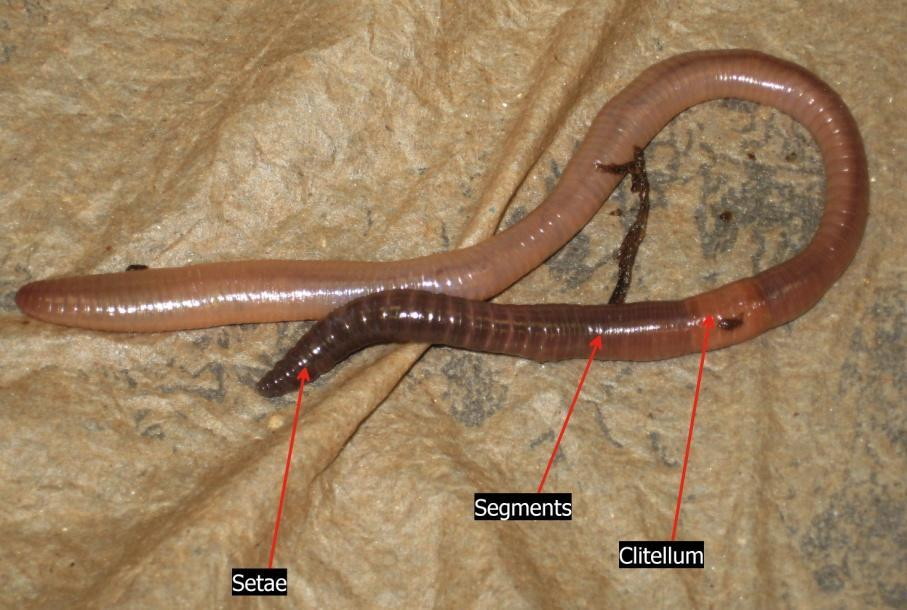
Note: We have to know that the bristles or setae, when moving via the dirt, help anchor and control the worm. The bristles keep tightly into the ground a segment of the worm, while the other area of the body protrudes forward. To allow the body to elongate in one area or contract in other areas, the earthworm utilizes segments to either contract or relax independently. In its movement, segmentation allows the worm to be versatile and solid. If, without being separate, each segment shifted together the earthworm would be stationary.
Complete answer:
We have to remember that the segmentation can help move the earthworm. There are muscles and bristles called setae in each segment or part. The clitellum has a thickened glandular and which is present in the non-sectioned part of the body wall close to the head of earthworms and leeches that emits a viscid case in which eggs are stored. It is situated between the fourteenth and seventeenth segments near the anterior side of the body.
A clitellum, which is a modification of a portion of the body wall consisting of a glandular, saddle-like thickening near the gonopores, has sexually mature oligochaetes. With the exception of the first, last and clitular segments, Setae are the 'S' shaped stiff bristles present on the complete earthworm body. These seats serve a significant role in locomotion.
So, the correct answer is “Option E”.
Note: We have to know that the bristles or setae, when moving via the dirt, help anchor and control the worm. The bristles keep tightly into the ground a segment of the worm, while the other area of the body protrudes forward. To allow the body to elongate in one area or contract in other areas, the earthworm utilizes segments to either contract or relax independently. In its movement, segmentation allows the worm to be versatile and solid. If, without being separate, each segment shifted together the earthworm would be stationary.
Recently Updated Pages
Master Class 11 English: Engaging Questions & Answers for Success

Master Class 11 Social Science: Engaging Questions & Answers for Success
Master Class 11 Maths: Engaging Questions & Answers for Success
Master Class 11 Biology: Engaging Questions & Answers for Success
Master Class 11 Physics: Engaging Questions & Answers for Success
Master Class 11 Chemistry: Engaging Questions & Answers for Success
Trending doubts
One Metric ton is equal to kg A 10000 B 1000 C 100 class 11 physics CBSE
Difference Between Prokaryotic Cells and Eukaryotic Cells
Two of the body parts which do not appear in MRI are class 11 biology CBSE
Find the value of the expression given below sin 30circ class 11 maths CBSE
Draw a diagram of a plant cell and label at least eight class 11 biology CBSE
10 examples of friction in our daily life