




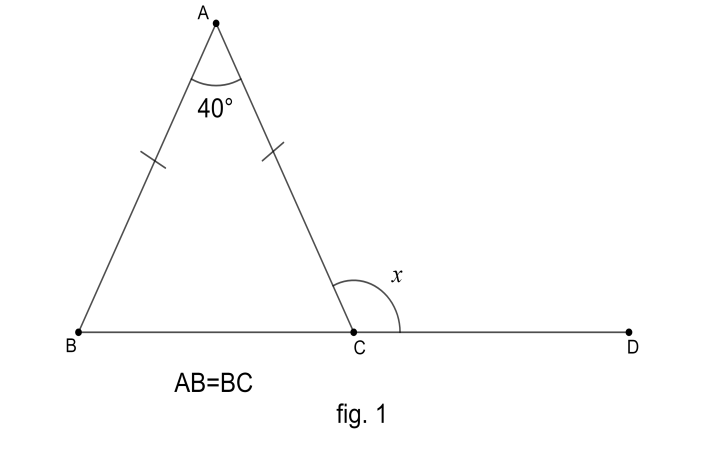
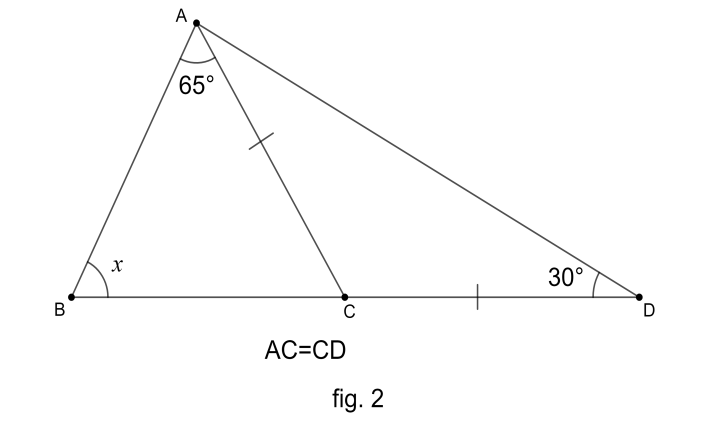
In each of the following figure, find the value of $ x $ .
Answer
 Verified
591.9k+ views
Hint: We have isosceles triangles in both figures. So, we will use the properties of the isosceles triangle. We will use the fact that the sum of all angles of a triangle is $ 180{}^\circ $. We know that the sum of the interior angles is equal to the exterior angle. We will use these relations to find the missing angles. This will help us calculate the value of $ x $ in each figure.
Complete step by step answer:
Let us look at figure 1. We are given that $ \angle \text{BAC}=40{}^\circ $ and $ \text{AB}=\text{AC} $ . Therefore, $ \Delta \text{ABC} $ is an isosceles triangle. In an isosceles triangle, the angles opposite to the equal sides are equal. Hence, $ \angle \text{ABC}=\angle \text{ACB} $ . Now, we know that the sum of all angles of a triangle is $ 180{}^\circ $ . So, in $ \Delta \text{ABC} $ , we have the following,
$ \angle \text{ABC}+\angle \text{ACB }+\angle \text{BAC}=180{}^\circ $
Substituting the value of the known angle and using the relation $ \angle \text{ABC}=\angle \text{ACB} $ , we get
$ 2\angle \text{ABC}+40{}^\circ =180{}^\circ $
Solving the above equation, we get the following,
$ \begin{align}
& 2\angle \text{ABC}=140{}^\circ \\
& \therefore \angle \text{ABC}=70{}^\circ \\
\end{align} $
We have to find the value of $ \angle \text{ACD} $ . This angle is an exterior angle. Therefore, its value is equal to the sum of interior angles. So, we have
$ \angle \text{ACD}=\angle \text{BAC}+\angle \text{ABC} $
Substituting the values, we get
$ \begin{align}
& x=40{}^\circ +70{}^\circ \\
& \therefore x=110{}^\circ \\
\end{align} $
Next, we will look at figure 2. We are given that $ \angle \text{ADC}=30{}^\circ $ and $ \text{AC}=\text{CD} $ . Therefore, $ \Delta \text{ACD} $ is an isosceles triangle. In an isosceles triangle, the angles opposite to the equal sides are equal. Hence, $ \angle \text{ACD}=\angle \text{CAD}=30{}^\circ $ .
Now, from the figure, we can see that $ \angle \text{BAD}=\angle \text{BAC}+\angle \text{CAD} $ . We have $ \angle \text{BAC}=65{}^\circ $ and $ \angle \text{CAD}=30{}^\circ $ . Therefore, we get the following,
$ \begin{align}
& \angle \text{BAD}=65{}^\circ +30{}^\circ \\
& \therefore \angle \text{BAD}=95{}^\circ \\
\end{align} $
We will consider $ \Delta \text{ABD} $ . We know that the sum of all angles of a triangle is $ 180{}^\circ $ . So, we have
$ \angle \text{ABD}+\angle \text{BDA }+\angle \text{BAD}=180{}^\circ $
Substituting the values, we get
$ \begin{align}
& x+30{}^\circ +95{}^\circ =180{}^\circ \\
& \Rightarrow x=180{}^\circ -125{}^\circ \\
& \therefore x=55{}^\circ \\
\end{align} $
Note:
It is essential that we are familiar with the properties of different triangles. We should also understand the relations between the angles in a given geometric figure. Labeling a figure is very important in order to avoid confusion, especially for the names of angles. In figure 1, we can also use the concept of supplementary angles to find the value of $ x $.
Complete step by step answer:
Let us look at figure 1. We are given that $ \angle \text{BAC}=40{}^\circ $ and $ \text{AB}=\text{AC} $ . Therefore, $ \Delta \text{ABC} $ is an isosceles triangle. In an isosceles triangle, the angles opposite to the equal sides are equal. Hence, $ \angle \text{ABC}=\angle \text{ACB} $ . Now, we know that the sum of all angles of a triangle is $ 180{}^\circ $ . So, in $ \Delta \text{ABC} $ , we have the following,
$ \angle \text{ABC}+\angle \text{ACB }+\angle \text{BAC}=180{}^\circ $
Substituting the value of the known angle and using the relation $ \angle \text{ABC}=\angle \text{ACB} $ , we get
$ 2\angle \text{ABC}+40{}^\circ =180{}^\circ $
Solving the above equation, we get the following,
$ \begin{align}
& 2\angle \text{ABC}=140{}^\circ \\
& \therefore \angle \text{ABC}=70{}^\circ \\
\end{align} $
We have to find the value of $ \angle \text{ACD} $ . This angle is an exterior angle. Therefore, its value is equal to the sum of interior angles. So, we have
$ \angle \text{ACD}=\angle \text{BAC}+\angle \text{ABC} $
Substituting the values, we get
$ \begin{align}
& x=40{}^\circ +70{}^\circ \\
& \therefore x=110{}^\circ \\
\end{align} $
Next, we will look at figure 2. We are given that $ \angle \text{ADC}=30{}^\circ $ and $ \text{AC}=\text{CD} $ . Therefore, $ \Delta \text{ACD} $ is an isosceles triangle. In an isosceles triangle, the angles opposite to the equal sides are equal. Hence, $ \angle \text{ACD}=\angle \text{CAD}=30{}^\circ $ .
Now, from the figure, we can see that $ \angle \text{BAD}=\angle \text{BAC}+\angle \text{CAD} $ . We have $ \angle \text{BAC}=65{}^\circ $ and $ \angle \text{CAD}=30{}^\circ $ . Therefore, we get the following,
$ \begin{align}
& \angle \text{BAD}=65{}^\circ +30{}^\circ \\
& \therefore \angle \text{BAD}=95{}^\circ \\
\end{align} $
We will consider $ \Delta \text{ABD} $ . We know that the sum of all angles of a triangle is $ 180{}^\circ $ . So, we have
$ \angle \text{ABD}+\angle \text{BDA }+\angle \text{BAD}=180{}^\circ $
Substituting the values, we get
$ \begin{align}
& x+30{}^\circ +95{}^\circ =180{}^\circ \\
& \Rightarrow x=180{}^\circ -125{}^\circ \\
& \therefore x=55{}^\circ \\
\end{align} $
Note:
It is essential that we are familiar with the properties of different triangles. We should also understand the relations between the angles in a given geometric figure. Labeling a figure is very important in order to avoid confusion, especially for the names of angles. In figure 1, we can also use the concept of supplementary angles to find the value of $ x $.
Recently Updated Pages
Master Class 12 Business Studies: Engaging Questions & Answers for Success

Master Class 12 Biology: Engaging Questions & Answers for Success
Master Class 12 Chemistry: Engaging Questions & Answers for Success
Class 12 Question and Answer - Your Ultimate Solutions Guide
Master Class 11 Social Science: Engaging Questions & Answers for Success
Master Class 11 English: Engaging Questions & Answers for Success
Trending doubts
Explain the Treaty of Vienna of 1815 class 10 social science CBSE
Who Won 36 Oscar Awards? Record Holder Revealed
What is the median of the first 10 natural numbers class 10 maths CBSE
Why is it 530 pm in india when it is 1200 afternoon class 10 social science CBSE
Why is there a time difference of about 5 hours between class 10 social science CBSE
What is the full form of POSCO class 10 social science CBSE